Fr. Kenneth Baker, SJ, editor-emeritus of Homiletic and Pastoral Review has recently translated and made available an outstanding, and prescient, article from then-Father Joseph Ratzinger (now Pope-Emeritus Benedict XVI), first published in 1958.
It is notable to what extent the problems we continue to wrestle with today were already noticeable in the Church of the "pre-Vatican II" decades. It is also more than noteworthy, with what consistency Ratzinger/Benedict has approached these sorts of issues over the past five decades. What an outstanding thinker and teacher for the Church.
In this article, he supports the now-common practice of admitting to the Sacraments (when no obstacles exist) those weakly or improperly formed Catholics whom he calls "secularized" (I often use the phrase "formed more by the world than by the Church"), when they ask for them. The request itself constitutes some evidence of faith and desire to belong to the Church, however imperfect it may be, and the grace of the Sacraments certainly can aid them in growing in faith over time.
He also notes that this secularization of believers constitutes a tangible challenge for many believers, in that, if a very basic and worldly level of moral commitment, with occasional sacramental participation, is truly sufficient for salvation, then the higher level of commitment to Biblical morality and consistent sacramental participation (including frequent Confession) can be experienced as a burden rather than a grace. The long-term solution for this, he argues, is for the Church to relinquish its "medieval" assumptions of social prestige and place in the world, and return to a "martyrial" distinctiveness - not an opposition to the world, as if all the world outside the Church is evil and bad, but a distinctiveness of "the few" as witness and fulcrum for the lifting up of "the many." He calls this a "de-secularization" of the Church, and notes three (simultaneous) levels or steps:
(1) the sacramental, in which the distinctiveness of the Church's true worship stands over against any materialistic, "magical" thinking about sacramental participation, and therefore invites to a deeper level of conversion;
(2) the proclamation of the faith, in which the distinctiveness of the Church once again supports a clear difference in mode of preaching, between the catechetical (to those in the Church), and the missionary (to those not yet deeply converted) - and this mode has not been heard in the West in many centuries; and
(3) the personal witness, in which the distinctiveness of how the believer lives in the world, especially in the midst of rejection, ridicule, and suffering, stands as clear evidence of the reality and effectiveness of grace.
This core, missionary, and witnessing Church, then, serves ultimately as "priestly people" for the whole world, bringing the salvation of Jesus Christ to the whole world, even those baptized who remain quite worldly, and even those outside the Church, who might respond in any way to the power of God:
"If men and women, indeed the greater number of persons are saved, without belonging in the full sense to the community of the faithful, so then it takes place only because the Church herself exists as the dynamic and missionary reality, because those who have been called to belong to the Church are performing their duty as the few..." (third-to-last paragraph).
If, however, the Church has no such core, no such missionary impulse in the modern world, no such capacity for witness to grace (i.e., "the spirit of Vatican II" church), how shall Christ be proclaimed? If the Church's only mode of worshipping, proclaiming, and living, is "worldly," more or less indistinguishable from everyone else, what is there to inspire to a deeper and greater love?
Showing posts with label Dominus Iesus. Show all posts
Showing posts with label Dominus Iesus. Show all posts
Tuesday, January 31, 2017
Wednesday, December 7, 2016
Thoughts on "rigidity" and orthodoxy
Twice in as many months (e.g., here and here), Pope Francis has inveighed against "rigid" believers. He uses very negative language against this perceived phenomenon: “They appear good because they follow the Law; but behind, there is something that does not make them good. Either they're bad, hypocrites, or they are sick. They suffer!” Such people are "enslaved," they "lead a double life." They exhibit the opposite of the beatitudes: "Rigidity is not a gift of God. Meekness is; goodness is; benevolence is; forgiveness is. But rigidity isn’t!" He attaches the same label and language to those who know, love, and respect the traditional liturgy: "Pope Francis told Father Spadaro he wonders why some young people, who were not raised with the old Latin Mass, nevertheless prefer it. 'And I ask myself: Why so much rigidity? Dig, dig, this rigidity always hides something, insecurity or even something else. Rigidity is defensive. True love is not rigid.'"
Certainly, the temptation to this sort of "pharisaical" attitude exists in the Church. It is something always to be guarded against. Because of our sacramental forms and theology, it is easy at times to get caught up in the details of the liturgy, and miss the forest (interior and spiritual realities) for the trees (exterior and physical forms, words, symbols). Likewise with the nuances of our moral theology. One can, in this sense, fall into "rigidity." And it is true that rigidity is not loving, and that rigidity resists Christ and grace.
But there is another sort of "rigidity" not often adverted to, although it appears to be far more common, currently. It consists in putting one's own will before God's, insisting that one is right while Tradition, the Church, the Bible, and God Himself must be wrong. St. James says, "Submit yourself to God... If you judge the law, you are not subject to the law." (Jms 4:7, 11). Those who are rigid in this sense judge the law of faith, and do not submit to God in their hearts.
The path of faith always involves conversion. After our initial conversion (which might be as an infant or child in Baptism), we continue to experience "ongoing conversion," as we strive over our whole life to conform our hearts and minds, our loves and desires, to those of Christ. To be united with Christ in this conformity, "putting on the mind of Christ" (Rom 2:12, etc), is precisely what it means to live as a Christian.
The heart experiencing conversion must be humble. It must recognize and accept (even when there is struggle actually to do - concupiscence is a real thing) that what the believer desires, of himself, is likely not what God desires for him, and therefore that one must learn to desire instead what God desires. This softness and pliability of the heart in respect to God's Law, Revelation, commandments and precepts, personal vocation, moral law, and Tradition is properly understood as a sign of strong faith. As the Rule of St. Benedict says in its very first words, "Listen carefully, my son, to the Master's instructions, and attend to them with the ear of your heart... The labor of obedience will bring you back to Him from whom you have drifted by the sloth of disobedience." This is the opposite of rigidity. (See e.g. the parable of the Pharisee and the publican, Lk 18:9-14.)
Rigidity, then, is not only clinging to the exterior forms of religion, which Pope Francis (rightly) decries. The willful rejection of Tradition is equally a form of rigidity (see e.g. Dei Verbum #7-8, etc). It is a hardness of heart with respect to God's calling the believer. It is spiritual pride, asserting in effect that this generation (or even this individual!) knows better what is good for souls than all prior generations, than all prior saints, doctors, mystics of the Church. I don't think it's too strong to say that there's more than a touch of idolatry, of self-worship, in this attitude. (It remains true that much of the rejection and loss of Tradition and faith in the last century is not willful, but from ignorance and weakness.)
Thus, one might correctly say: The idea that external or physical forms (e.g., the construction of a church, the placement of the Tabernacle, the beauty of vestments and statues, etc) don't matter to internal or spiritual realities (faith, union with God, repentance and conversion) is false (e.g. Sacrosanctum Concilium #8, 112-3, 122-5, etc). To cling to this idea in the face of Tradition and correction is to be rigid.
Idem: The idea that Christ did not and does not will the seven Sacraments for the Church, as the primary means of salvific grace for believers, is false (e.g. SC #5-8, Lumen Gentium #7, 11, etc). To cling stubbornly to the opposite idea, that we can meddle with the Sacraments or deny their efficacy, in the face of Tradition and correction, is to be rigid.
Idem: The ideas of moral relativism and religious indifferentism are false (e.g. Dominus Iesus, Fides et Ratio, etc). To insist, in the face of Tradition and correction, that they are true, is to be rigid.
And so forth.... In short, modernism is rigid, but Tradition properly received and loved ("the living faith of the dead," as one great Church historian noted) is life with Christ.
Certainly, the temptation to this sort of "pharisaical" attitude exists in the Church. It is something always to be guarded against. Because of our sacramental forms and theology, it is easy at times to get caught up in the details of the liturgy, and miss the forest (interior and spiritual realities) for the trees (exterior and physical forms, words, symbols). Likewise with the nuances of our moral theology. One can, in this sense, fall into "rigidity." And it is true that rigidity is not loving, and that rigidity resists Christ and grace.
But there is another sort of "rigidity" not often adverted to, although it appears to be far more common, currently. It consists in putting one's own will before God's, insisting that one is right while Tradition, the Church, the Bible, and God Himself must be wrong. St. James says, "Submit yourself to God... If you judge the law, you are not subject to the law." (Jms 4:7, 11). Those who are rigid in this sense judge the law of faith, and do not submit to God in their hearts.
The path of faith always involves conversion. After our initial conversion (which might be as an infant or child in Baptism), we continue to experience "ongoing conversion," as we strive over our whole life to conform our hearts and minds, our loves and desires, to those of Christ. To be united with Christ in this conformity, "putting on the mind of Christ" (Rom 2:12, etc), is precisely what it means to live as a Christian.
The heart experiencing conversion must be humble. It must recognize and accept (even when there is struggle actually to do - concupiscence is a real thing) that what the believer desires, of himself, is likely not what God desires for him, and therefore that one must learn to desire instead what God desires. This softness and pliability of the heart in respect to God's Law, Revelation, commandments and precepts, personal vocation, moral law, and Tradition is properly understood as a sign of strong faith. As the Rule of St. Benedict says in its very first words, "Listen carefully, my son, to the Master's instructions, and attend to them with the ear of your heart... The labor of obedience will bring you back to Him from whom you have drifted by the sloth of disobedience." This is the opposite of rigidity. (See e.g. the parable of the Pharisee and the publican, Lk 18:9-14.)
Rigidity, then, is not only clinging to the exterior forms of religion, which Pope Francis (rightly) decries. The willful rejection of Tradition is equally a form of rigidity (see e.g. Dei Verbum #7-8, etc). It is a hardness of heart with respect to God's calling the believer. It is spiritual pride, asserting in effect that this generation (or even this individual!) knows better what is good for souls than all prior generations, than all prior saints, doctors, mystics of the Church. I don't think it's too strong to say that there's more than a touch of idolatry, of self-worship, in this attitude. (It remains true that much of the rejection and loss of Tradition and faith in the last century is not willful, but from ignorance and weakness.)
Thus, one might correctly say: The idea that external or physical forms (e.g., the construction of a church, the placement of the Tabernacle, the beauty of vestments and statues, etc) don't matter to internal or spiritual realities (faith, union with God, repentance and conversion) is false (e.g. Sacrosanctum Concilium #8, 112-3, 122-5, etc). To cling to this idea in the face of Tradition and correction is to be rigid.
Idem: The idea that Christ did not and does not will the seven Sacraments for the Church, as the primary means of salvific grace for believers, is false (e.g. SC #5-8, Lumen Gentium #7, 11, etc). To cling stubbornly to the opposite idea, that we can meddle with the Sacraments or deny their efficacy, in the face of Tradition and correction, is to be rigid.
Idem: The ideas of moral relativism and religious indifferentism are false (e.g. Dominus Iesus, Fides et Ratio, etc). To insist, in the face of Tradition and correction, that they are true, is to be rigid.
And so forth.... In short, modernism is rigid, but Tradition properly received and loved ("the living faith of the dead," as one great Church historian noted) is life with Christ.
Thursday, June 6, 2013
Unity, Division, and the Church's Holiness - brief thoughts
A few weeks ago I read this review of a new book on ecclesiology, and was intrigued enough to want to read the book for myself. May was very busy and I wasn't able to read it as thoroughly or deeply as I hoped, so this post will remain very general. (I also didn't take notes while reading it, and no longer have it in front of me - ILL is a wonderful thing! - so can't cite examples of my impressions.)
Radner's argument seems to be that division, violence, and sin are inherent in the (life of the) Church. He dismisses "traditional" ecclesiology(s) that distinguish between the holiness of the Church and the sins of her members. He simply elides "the sins of Christians" to "Christian sin" to "the Church is violent." Therefore an "adequate" ecclesiology will account for this, and the way forward, he asserts, is to root ecclesiology more firmly in the Church's imitation of Christ's sacrificial love (although he then avoids the obvious direction of the argument to the Eucharist and to grace).
I was certainly not convinced by most of Radner's argument, on several counts. But the most important objection is simply this: a church that is not holy in the traditional sense, is not a church that can offer me relief from my own sins. If I don't want to be free from my sins, I don't want any church, while if I do, I want a church that is holy, with the relevant divine gifts that make not only forgiveness but transformation possible. In any case, the church that he's describing is not one that attracts.
So I'll defend the traditional ecclesiology of the Church's holiness as sharing in the holiness of God, through the Incarnation, Passion, death, and Resurrection of our Lord Jesus Christ, by means of this lecture:
Radner's argument seems to be that division, violence, and sin are inherent in the (life of the) Church. He dismisses "traditional" ecclesiology(s) that distinguish between the holiness of the Church and the sins of her members. He simply elides "the sins of Christians" to "Christian sin" to "the Church is violent." Therefore an "adequate" ecclesiology will account for this, and the way forward, he asserts, is to root ecclesiology more firmly in the Church's imitation of Christ's sacrificial love (although he then avoids the obvious direction of the argument to the Eucharist and to grace).
I was certainly not convinced by most of Radner's argument, on several counts. But the most important objection is simply this: a church that is not holy in the traditional sense, is not a church that can offer me relief from my own sins. If I don't want to be free from my sins, I don't want any church, while if I do, I want a church that is holy, with the relevant divine gifts that make not only forgiveness but transformation possible. In any case, the church that he's describing is not one that attracts.
So I'll defend the traditional ecclesiology of the Church's holiness as sharing in the holiness of God, through the Incarnation, Passion, death, and Resurrection of our Lord Jesus Christ, by means of this lecture:
Thursday, May 2, 2013
May 2, 2013 - St. Athanasius, Evangelization, the Unicity of the Church, and truth and goodness
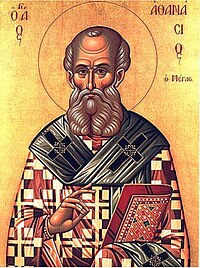 Today is the feast day of St. Athanasius, whose chops as an opponent of heresy are second to none; and for that reason, and because of some of the reading I've been doing for the conclusion of our Christology class, as well as some recent news stories in which the Church is unnecessarily type-cast as the antagonist, I have been pondering a bit this phenomenon of increasing open, vocal, assertive, brazen anti-Christian rhetoric and posturing. It certainly verges on discrimination, although it's not yet formally entrenched anywhere in the US, merely materially ascendant in certain places.
Dominus Iesus (2000) hit the nail squarely on the head in listing, in a very general sort of way, the nature of the erroneous thinking involved here:
4. The Church's constant
missionary proclamation is endangered today by relativistic theories which seek
to justify religious pluralism, not only de
facto but also de iure (or in
principle). As a consequence, it is held that certain truths have been
superseded; for example, the definitive and complete character of the revelation
of Jesus Christ, the nature of Christian faith as compared with that of belief
in other religions, the inspired nature of the books of Sacred Scripture, the
personal unity between the Eternal Word and Jesus of Nazareth, the unity of the
economy of the Incarnate Word and the Holy Spirit, the unicity and salvific
universality of the mystery of Jesus Christ, the universal salvific mediation of
the Church, the inseparability "while recognizing the distinction" of the
kingdom of God, the kingdom of Christ, and the Church, and the subsistence of
the one Church of Christ in the Catholic Church.
The roots of these problems are to be found in certain presuppositions of
both a philosophical and theological nature, which hinder the understanding and
acceptance of the revealed truth. Some of these can be mentioned: the conviction
of the elusiveness and inexpressibility of divine truth, even by Christian
revelation; relativistic attitudes toward truth itself, according to which what
is true for some would not be true for others; the radical opposition posited
between the logical mentality of the West and the symbolic mentality of the
East; the subjectivism which, by regarding reason as the only source of
knowledge, becomes incapable of raising its "gaze to the heights, not daring
to rise to the truth of being"; the difficulty in understanding
and accepting the presence of definitive and eschatological events in history;
the metaphysical emptying of the historical incarnation of the Eternal Logos,
reduced to a mere appearing of God in history; the eclecticism of those who, in
theological research, uncritically absorb ideas from a variety of philosophical
and theological contexts without regard for consistency, systematic connection,
or compatibility with Christian truth; finally, the tendency to read and to
interpret Sacred Scripture outside the Tradition and Magisterium of the Church.
But I think we shouldn't underestimate the consequences of muddled thought in and of itself. Moral relativism is taught daily in our public schools, sometimes overtly, often by default; subjectivism is everywhere, with its stupid but powerful idea that truth is best recognized by an observable emotional response; the problem of "metaphysical emptying" is everywhere, quite apart from its Christological and ecclesiological implications, teaching people to accept lower order goods and to accept division in place of unity; eclecticism makes rational argumentation much harder than it needs to be; and so forth. The net effect of all of these incomplete or inadequate ways of thinking is that most people are more or less convinced that what's good for them (often in a reductive and/or immediate sense) is the same as the common good; and therefore if others disagree with them, these others must be opposed to them, in the manner of trying to deny them some good.
St. Athanasius, for all his trials and struggles for the apostolic faith of the Church, didn't have this problem to deal with. His opponents were, by and large, at least rational. Arius thought he was solving the difficult problem of divine impassibility in the Incarnation. Constantius thought he was doing what was good and necessary for the unity of the Empire. That they were mistaken about these things didn't mean they couldn't be reasoned with, and indeed, eventually, the process of rational argument did secure the apostolic teaching and the rejection of Arianism fairly definitively.
In our evangelization today, at the individual level, I think we still need to do this. How we talk about the faith, about our worldly and spiritual experiences, our consistency of word and action, and so on, constitute a kind of argument about most basic principles which is readily apparent to those around us. And since people are not usually attracted by philosophy (a systematic presentation of the truth as ideas) but by holiness (a very different but no less systematic presentation of the truth in action), this is the right way to proceed.
For those who think we are opposed to them personally merely because we disagree with them about ideas, it is the witness of consistent and joyful imitation of Christ by those who are known to them which has a chance to convince of our goodwill, even if conversion never follows.
But at the wider level, this kind of personal approach doesn't work. Here the clash of ideas and perceptions happens in a separate way from our personal witness. Consistency and joy still matter here, but somehow it needs to be translated to that more impersonal level. Here, martyrial witness is a powerful kind of argument. Those who are willing to suffer for Christ (in whatever sense; in other words, to carry the Cross in daily life, without complaint, even when it is unjust) are appealing in this sense. But the appeal rests on the coherence of the tradition or identity - in this case, the apostolic Tradition and the identity of bearing Christ's name as Christians. If that tradition and identity is not generally perceived as internally coherent - in other words, if Christians are generally perceived to be disloyal to their own tradition, for whatever reason - at one level, it doesn't even matter if it's true or not - then the quality of the witness is badly undermined.
So as St. Athanasius knew so well, a well-formed Church is really necessary for the project of evangelization. The weakness of our evangelization in the West in the past three-four generations is a symptom of insufficient internal coherence, consistency, joy, and zeal in bearing the Name and the Cross of our Redeemer. John Paul II wrote the same:

The Catechism of the Catholic Church is a major step in the right direction. So is a coherent anthropology at the root of our formation programs (four pillars of human, spiritual, intellectual, and pastoral formation). So is the plethora of solid and orthodox Bible studies which use well all the tools available to us, without abusing the historical critical method in the manner which leads to supplanting Christian identity with some mere political ideology. So is the new Missal's use of a consciously sacral language for worship. So is Friday abstinence and the daily Rosary, as universally shared elements of a clear, Catholic identity. And so on... these are the things, when used well and often, that build up our conviction, our faith, our zeal, and therefore our ability to evangelize the increasingly unfamiliar world around us.
Subscribe to:
Posts (Atom)