Showing posts with label Gospel of John. Show all posts

Monday, January 19, 2015

Homily for Sunday 18 Jan 2015 (II post Epiphaniam)

This weekend, I preached at the 7:30 EF Mass.  The Collect is the same as the OF:

Omnipotens sempiterne Deus, qui celestia simul et terrena moderaris, supplicationes populi tui clementer exaudi: et pacem tuam nostris concede temporibus. Per Dominum nostrum...

Almighty ever-living God, who govern all things, both in Heaven and on earth, mercifully hear the pleading of your people and bestow your peace on our times. Through our Lord...

Given this plea for the divine gift of peace, and the proximity to the awful anniversary of the repugnant Roe v. Wade decision this Thursday (1/22), I chose to preach on the obvious topic. The Epistle is Rom 12:6-16, and I expounded on the verse, "Let your love be without pretense. Hate the evil, adhere to the good."  The Gospel is Jn 2:1-11, the wedding at Cana, and I preached the verses, "Do whatever He tells you," and "His disciples believed in Him."  Here's my homily, as closely as I can reconstruct it.

All across the country, this weekend and this week, in different places, hundreds of thousands of

March for Life 2014
people will be marching for life.  I read this week, we now have over 80 Marches, Vigils, and Rallies for Life taking place in different cities.  And hundreds of thousands more, perhaps even millions more, will be praying along with them for an end to abortion.

I'm sure I don't have to recount for you the terrible evil that abortion is.  I'm sure we know that abortion kills an innocent human being, a baby in the womb; and that it destroys the spiritual and emotional health of mothers and fathers, of entire families; and that it corrupts our culture and our laws, and justifies other kinds of evils, too.  Abortion is the most urgent, the gravest evil of our times, and it falls to us, to our generations, to fight it.

Our readings today give us inspiration and courage to carry out this moral struggle.

St. Paul tells us, "Let your love be without pretense.  Hate the evil, and adhere to the good."  For us, this means that we must root out from our hearts the pretenses, the compromises, the little evils and sins that we sometimes indulge in.  We must make regular examination of conscience, and go to Confession often, so that our hearts will be full of pure love.  If our love is true and pure in the little things, the daily things, then we can also love without pretense in the larger things.  This is very important, because the world wants to paint us as hypocrites.  We need to be able to show that our love and our actions are consistent, so that our witness can reveal the love of Christ.
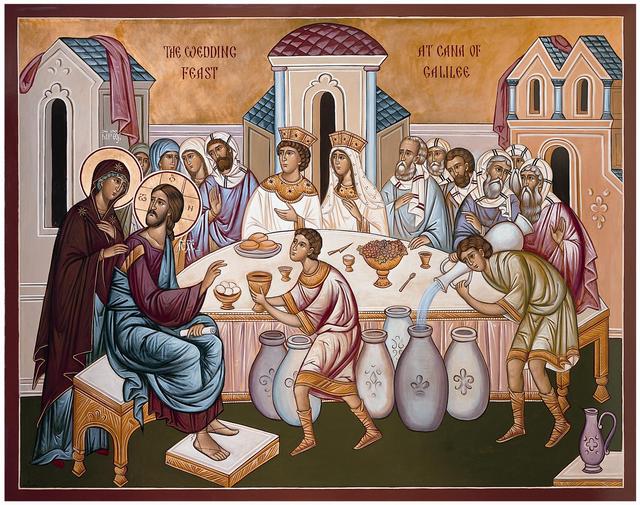
Orthodox icon of the wedding at Cana
In the Gospel, the beautiful story of the wedding at Cana, St. John gives the words of Mary, "Do whatever He tells you."  We might notice that these are the last words the Gospels record Mary saying.  Her whole life of perfect faith, perfect obedience to the Father, perfect love for her Son, is, in a sense, summed up in these words: "Do whatever He tells you."  We, too, then, need to strive to imitate our blessed Mother's perfections, by constantly "doing whatever He tells" us.  This points us to our vocation - for the great majority of us, the vocation to married life and to parenthood.  There are also vocations to priestly life and religious life, of course, but most of us are called to marriage.

And in our married life, we are called to a holy, loving union that is both chaste and fruitful.  What this means for us, then, is that we must reject contraception in our Catholic marriages.  Contraception leads to abortion, through what we can call the "contraceptive lifestyle."  Pope Paul VI showed us this link in his encyclical, "Humanae Vitae."  When we contracept, we reject the will of God in our marital union.  Whether we understand this or not, we are making ourselves the masters of life and creation.  It's only a small step, then, to try to make ourselves the masters of death, also, to set ourselves up in the place of God, choosing who can live and who will die. 

Those who work for the culture of death know this link, too.  For example, make people who have left working for Planned Parenthood report that they want to have access to public schools, to teach our teenagers (and even younger children) to use contraception, because they know that contraception will lead to abortion, and they want that business.

We need to challenge this root of abortion, and make our Catholic marriages once again free of contraception.

And the last verse of the Gospel today: "His disciples believed in Him."  We need to pray for an end

St. John at the foot of the Cross (14th c., St. Michael and All Angels Parish, Wales)
to abortion.  We need to have greater faith, that the love and mercy of Jesus Christ can overcome the evil of abortion.  We need to live with greater hope and deeper prayer, in all the spiritual aspects of this struggle.  If we live with growing love for Christ in the Church and in her sacraments, and if we live with greater fidelity to our vocations, we will also have greater faith.  We will have hearts more open to receive His infinite mercy, and also more open to the need, the longing, for that mercy in the world around us, where we can share it by our faithful and loving actions. 

The daily witness we give to the power of His mercy, like the many March for Life events, is the way to change minds and hearts about the evils in the world.  Our hope and our joy in Jesus Christ are not just for ourselves, they are for others.  We can only share as much of that mercy, hope, faith, and joy as we are open to receive from our Savior.  But as we grow closer to the Lord, our hearts are more open, and we can receive more and offer more to those around us. 

If we are faithful in these ways, we will make a difference.  We will overcome the evil of abortion, by the power of Christ's love.  Our progress may be slow, because the evil is great, but we will advance.  We have this hope.  We have this faith.  So let Christ work in us, ever more deeply, so that our witness may be stronger, to overcome evil in the world.


Wednesday, October 17, 2012

Homily for Oct 17 - St. Ignatius, Bishop and Martyr

In the second century, the Roman Empire had a growing problem.  There were increasing numbers of these "Christians" everywhere, and they just would not cooperate with how the Empire did things.  And the Romans simply could not understand why the Christians held themselves apart like that.

Emperor Trajan
About the year 106, the Emperor Trajan, in thanksgiving for a great military victory, passed a law that all the people of Syria should offer a sacrifice to the traditional Roman gods.  But in the middle of Syria was the capital, Antioch, and the Bishop of Antioch was Ignatius.  St. Ignatius preached loudly, in his pulpit and in the streets, that Christians could not obey this law.

The Romans simply did not understand this.  Why couldn't the Christians do what everybody else did - offer the public sacrifice once, and then go home and follow their own religion in private?  Why couldn't the Christians compartmentalize their faith, like everybody else?

In our own time, our government increasingly acts the same way toward Christians.  There are many examples, but one of the most important instances is the HHS Mandate: that all employers must offer their employees, in their health insurance plans, the benefits - and "benefits" are in quotation marks - of contraception, sterilization, and chemical abortions.  And our government simply doesn't understand why we Christians cannot compartmentalize our faith, and perform our economic duties over here, in accordance with the law, and our religious duties over there, in private, however we want.

In the Gospel today, Jesus teaches us that, "Unless a grain of wheat falls to the ground and dies, it remains only a grain of wheat.  But if it dies, it brings forth much fruit." (Jn 12:24-5)  St. Ignatius used this very Gospel passage in a letter to the Church in Rome.  He pointed to himself, saying, "I am the grain of wheat."  He called the teeth of the wild animals which would kill him in the arena, the "millstones" grinding the wheat into bread, a bread like Christ's own Body, that would nourish the faith of others.  He wanted to be that bread, to nourish the Church and to change the Roman world.

St. Ignatius in the arena
And that's exactly what he did as a martyr.  The witness of his death for the crime of being a Christian and not committing idolatry nourished the faith of others.  It took two hundred years, and thousands of martyrs dying for Christ, to change the Roman Empire, but it happened.  In the fourth century, the Roman Empire became the Christian Roman Empire. 


That's why, when our own government was founded in the 18th century, it could be founded as a Christian government.  But if we want to keep it a Christian government and a Christian country, we need to change the hearts and minds of our neighbors, by the witness of our lives.  We may not be called to "red" martyrdom, but we still preach about Christ, or not, by the actions of our lives every day.  Our actions show what are our priorities, and the daily witness of our charity shows whether we love God and neighbor. 

We are the only Christ, that those who don't yet know Him, can learn about Him by.  We are the grains of wheat, and our daily witness for Him grinds us into bread.  Will we be a tasteless and worthless bread of no value?  Or will we be the bread that we really are as the Body of Christ - the bread that nourishes the faith of others?

Wednesday, May 2, 2012

Homily, Memorial of St. Athanasius (May 2)

This is more or less what I preached today, for the Memorial of St. Athanasius; it's not word for word, but I think it's pretty close.  The Gospel is John 12:44-50.

There are two kinds of unity we experience in this life. 

The first is the kind that Jesus is talking about in today's Gospel.  It is the unity of light with light, and against darkness.  It is the unity of God the Son with God the Father in their one divinity.  It is the unity of Jesus with us also, in His humanity.  It is the kind of unity we call "communion."

The invitation to communion with Jesus in the Church is given to everyone.  But, as Jesus says, not everyone accepts it.  Jesus does not condemn those who reject His word.  But in the same way that light is clearly divided from darkness, His word judges those who do not accept.  When a light is turned on, it is on, and there is no darkness; when the light is off, it is off, and there is no light.  This is how His word judges; either one accepts it, and is united with Christ, or not.

The second kind of union we experience in our families, towns, and nation.  It is a political and social unity, of the kind we call "community."

"Community" is not the same as "communion."  At its best, political or social unity can reflect the light of Christ from our communion with Him.  We want to have a Christian nation, built on the foundation of His light and His word.  We want to have Christian families, built on the same foundation.  But that foundation only comes from communion.  It's not inherently part of our communities.

So, when our communities go bad, they can go very bad indeed.  At their worst, when communities do not reflect the light of Christ, all the grave social evils of history, and of today, creep in: evils such as slavery, racism, abortion, the erosion of marriage, and the trampling of religious freedom.  These are the works of darkness, not of the light.

St. Athanasius, whose feast we celebrate today, is a great example to us of how to fight against the darkness in our communities.  He was a great champion of the light and the truth of Christ, when the government of his day, the Roman Emperor Constantius, adopted the falsehood of Arianism to promote political unity.  Arianism denies the full divinity of Christ; and so it denies that "whoever sees me, sees the one who sent me."  It denies the communion of the Son with the Father, and therefore of the Son with us.  Athanasius would not agree to this falsehood as a basis for public policy, and denounced it constantly - so much so that he was exiled from his see on five separate occasions, totally 17 years.  This was a heavy cost to pay, but he paid it willingly, because he kept his communion with Christ and the Church as his solid foundation.

Our own government today is doing exactly the same thing - attempting to build political unity on falsehood.  The HHS Mandate threatens our religious freedom.  It tries to play our community against our communion, which is always a sign of the darkness creeping in.  Our bishops are fighting against this, fighting to keep the light of Christ reflecting in our community, too. 

One of the things that supported St. Athanasius was the faith of his people.  I ask you to support our bishops.  You do this most and best just as you are right now - by coming to Holy Mass, and receiving the sacraments, especially Confession and the Eucharist; by contemplating the Word of God, and praying on it at home; by living your faith courageously with your family, and at work, and in the world.  This is what we are called to by our baptism; and when we live this way, as holy people of God, we enable our bishops to be more courageous and forthright in defending the light and the truth of Christ.

May the example of St. Athanasius strengthen our faith in the light and the truth of Christ, and encourage us to live it with more zeal every day.

Wednesday, August 24, 2011

Saint Bartholomew, Apostle and Martyr

Jesus said to him, "Before Philip called you, when you were under the fig tree, I saw you." Nathanael [=Bartholomew] answered him, "Rabbi, you are the Son of God! You are the King of Israel!" (Jn 1:48-9)

Many of the Old Testament prophets use the fig tree as a symbol of the Covenant. If it's barren, the fig tree can mean that the People of God are not living up to the Covenant, as for example in Jeremiah 8: "How will you say, 'We are wise, and the law of the Lord is with us?' In vain have the scribes used a false pen. The wise men are ashamed, and alarmed, and taken, because they have rejected the word of the Lord. What wisdom is there in them? ...There are no grapes on the vines, and no figs on the fig trees, and the leaves have fallen off."

But if the fig tree is flourishing, it can mean that the fullness of God's grace abounds, as for example in Micah 4: "And at the last days, the mountain of the Lord shall be manifest, and established above the mountains and exalted above the hills... for out of Zion shall go forth a law, and the word of the Lord from Jerusalem. And he shall judge among many peoples, and shall rebuke strong nations afar off; and they shall beat their swords into ploughshares and their spears into sickles... And everyone shall rest under his vine, and everyone under his fig tree, and there shall be none to alarm them, for the mouth of the Lord Almighty has spoken these words."

Philip and Bartholomew are looking and longing for the Messiah, "him of whom Moses in the law, and also the prophets, wrote" (Jn 1:"45). His heart is "without guile" (1:47), and therefore is open to God satisfying his desire. Philip, who has witnessed John the Baptist baptize Jesus, tells Bartholomew to "Come and see" (1:46) the one who fulfills these prophecies. So when Jesus tells Bartholomew, "I saw you under the fig tree," the prophets' use of the fig tree leaps to mind. Bartholomew recognizes that this man, who knows his mind and heart so intimately and immediately, is from God, and is God - the Son of God and King of Israel, the "word of the Lord from Jerusalem" of whom Micah spoke.

Bartholomew believes because Jesus identifies Himself to him in this very intimate and personal way. Because he believes, he sacrifices all to follow Him. He becomes one of the Twelve, and eventually a great preacher and martyr who established the Church in India.

Jesus identifies Himself to us with the same immediate, intimate, and personal love. In baptism, and confession, and Eucharist, He calls us to follow Him. How do we let Jesus see us? Are our hearts "without guile" for Him? Do we rest under the fig tree - seeking union with Him in Scripture, and in the sacraments, and in prayer? Do we hold firmly to our hope and faith in His victory over sin and death? Do we recognize Him? Are we ready to hear and respond?