Showing posts with label justice. Show all posts

Wednesday, February 12, 2014

Homily for 12 Feb 2014, Wednesday of the Fifth Week in Ordinary Time

The Old Testament reading today is the visit of the Queen of Sheba to King Solomon, 1 Kgs 10:1-10.  Here's the homily I preached, as well as I can remember and reconstruct.
Lavinia Fontana. The Visit of the Queen of Sheba to Solomon. c. 1600. Dublin, National Gallery of London.

In our first reading today, King Solomon stands as a type of Christ.  We are particularly invited in this
passage to consider first his wisdom, like that of Christ.  King Solomon's wisdom of course was exceptional, although merely human, while Christ's wisdom is divine and perfect.  But Solomon's wisdom is of God, and points us toward the more perfect wisdom of our Lord.  Because of his wisdom, he kept his kingdom in peace for many years, and gave justice and good laws.  Christ does the same, more perfectly, for His Church and for His kingdom.

We're also invited to consider Solomon as the builder of the temple in Jerusalem.  Again, he foreshadows the temple Christ builds, which is His Church, His own Body.  We want to participate in the worship that takes place in Christ's temple, and so here we are at this Holy Mass.

This passage also offers us the figure of the Queen of Sheba.  She is a more worldly ruler than Solomon, very rich and powerful and successful in her own kingdom.  But she's not a negative example of the world, because she does come to Solomon to exchange gifts and confirm peace.  Rather, she stands in relation to Solomon in very much the way we stand in relation to Christ.  She's heard of his extraordinary wisdom, his goodness and justice, and she's interested, but she can't quite believe that all this could be completely true.  We too sometimes hesitate to believe fully in the perfect wisdom, mercy, and goodness of Jesus Christ - although we have faith, certainly; yet sometimes we're reluctant to lower our guard, to set aside our reservations, and give ourselves totally to Christ.  Like her, it may seem to us that the forgiveness or the providence of Christ is just too good to be true.

So the queen comes to Solomon to test him, to see if he really is what has been reported.  And she is convinced by what she finds, and so she gives him all the gifts that she has prepared for him, if it turns out to be true.  We can do the same.  We don't need to test Christ, but we can come to him and listen to His wisdom, to His Word, and see how it satisfies us.  We can come before Him with our faith, and strive to set aside our worldly defenses and hesitations.  We can do the hard work of deeper interior conversion in order to be more open to Him, to His grace and His perfect will.  And we do this especially in prayer, and in the sacraments.

The Adoration of the Magi *
When we do this, we usually see that Christ really is our perfect king and savior.  What is reported of Him is not exaggerated!  He is the one, the only one, who can offer us pure mercy, the redemption of our sins.  And therefore, like the queen, we should give Him the gifts we have prepared.  It's significant that she gives to Solomon gifts of gold and spices - the same gifts which the Magi offer to the infant Christ in Bethlehem.  In both cases, the gift of gold represents Christ's kingship, and therefore to give Christ our gold is to give Him our allegiance and obedience.  Because He is our only savior, to grow in faith means to grow in our readiness and willingness to do only His will, to follow His laws which He enacts through His Church.

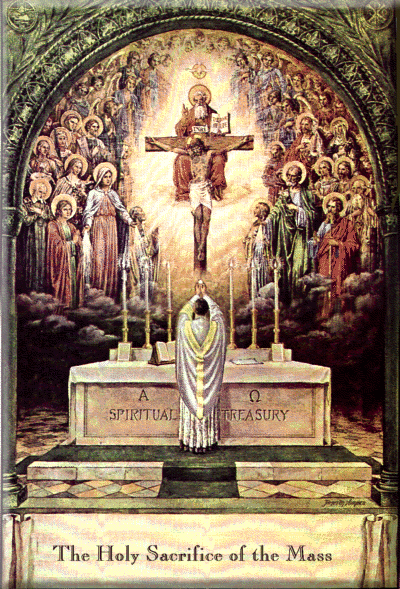
source **
In the same way, the gift of spices represents Christ's priesthood, His saving sacrifice of the Cross and
His holy passion.  To give Christ our spices is to participate in His priesthood, especially through the sacraments, which again, He offers us only through His Church.  Because He is the one High Priest, to grow in faith means to grow in desire for His grace and mercy in receiving and living out all the sacraments, as well as to grow in prayer and devotions.

When we do this - when we expose ourselves to Christ in order to receive more deeply all His gifts for us, and then give back to Him a deeper faith, obedience, and devotion - then we also show the love and mercy of God to all those around us.  We show why the ways of the world don't lead to salvation or real happiness, and what a difference it truly makes to be close to our Lord Jesus Christ.  We show this by the quality of our lives.  We preach simply and without confrontation, heart directly to heart, about our true faith and joy in Christ, our Lord and Savior.

So let us pray to the Holy Spirit for the courage to be defenseless before Jesus Christ.  Let us pray that we may receive everything He wills to give us, and that we may willingly give back to Him everything we have and are.  In this way, may we always offer the light of Christ to those in darkness.


* http://bible-belt-catholic.blogspot.com/2012/01/magis-new-work.html 
** http://catholicapologetics.info/library/directory/holymass.gif

Monday, January 7, 2013

Pope Benedict XVI, on peace (Address to the Diplomatic Corps, 1/7/13)

This morning, Pope Benedict gave his annual address to the group of international ambassadors and representatives to the Holy See.  The full address was quickly translated and released by Vatican Radio.  Some of his more urgent or important points:

His general theme is that of peace:

The Gospel of Luke recounts that on Christmas night the shepherds heard choirs of angels who gave glory to God and invoked peace on mankind. The Evangelist thus emphasizes the close relationship between God and the ardent desire of the men and women of every age to know the truth, to practice justice and to live in peace (cf. Blessed John XXIII, Pacem in Terris: AAS 55 [1963], 257). These days, we are sometimes led to think that truth, justice and peace are utopian ideals, and mutually exclusive. To know the truth seems impossible, and efforts to affirm it appear often to lead to violence. On the other hand, according to a now widespread way of thinking, peacemaking consists solely in the pursuit of compromises capable of ensuring peaceful coexistence between different peoples or between citizens within a single nation. Yet from the Christian point of view, the glorification of God and human peace on earth are closely linked, with the result that peace is not simply the fruit of human effort, but a participation in the very love of God. It is precisely man’s forgetfulness of God, and his failure to give him glory, which gives rise to violence. ...  The consequences of forgetfulness of God cannot be separated from those resulting from ignorance of his true countenance, the root of a baneful religious fanaticism which, again in 2012, reaped victims in some countries represented here. As I have often observed, this is a falsification of religion itself, since religion aims instead at reconciling men and women with God, at illuminating and purifying consciences, and at making it clear that each human being is the image of the Creator. 

He lists a number of places in the world where various sorts of violence are now taking place, without casting any particular blame.  Then he goes on:

The building of peace always comes about by the protection of human beings and their fundamental rights. This task, even if carried out in many ways and with varying degrees of intensity, challenges all countries and must constantly be inspired by the transcendent dignity of the human person and the principles inscribed in human nature. Foremost among these is respect for human life at every stage.

I am inspired by such clarity of thought!  He talks again about particular examples, such as changes in particular countries' laws regarding euthanasia or abortion.  He talks about proper understanding of human rights versus falsely-understood autonomy (license), and discusses things like education as platforms for the development of peace.  Then he hits hard at another constant theme:

 I would like to add that peace in society is also put at risk by certain threats to religious liberty: it is a question sometimes of the marginalization of religion in social life; sometimes of intolerance or even of violence towards individuals, symbols of religious identity and religious institutions. It even happens that believers, and Christians in particular, are prevented from contributing to the common good by their educational and charitable institutions. In order effectively to safeguard the exercise of religious liberty it is essential to respect the right of conscientious objection. This “frontier” of liberty touches upon principles of great importance of an ethical and religious character, rooted in the very dignity of the human person. They are, as it were, the “bearing walls” of any society that wishes to be truly free and democratic. 

Great analogy of our common "edifice" in society.   Without these "[weight-]bearing walls" of proper defense of religious liberty, especially in pluralistic democracies such as we know today, the edifice threatens to collapse.  Pray for our Pope! 
  

Tuesday, November 27, 2012

Papal Nuncio, Archbishop Vigano, on Persecution of the Church in the Modern World - updated 11/28

Earlier in November, the Institute for Church Life at the University of Notre Dame hosted a conference on the current global persecution of Christians.  Archbishop Vigano, the Apostolic Nuncio to the United States, was the keynote speaker.  (Additional presentations available.)  Here's his excellent, accurate, and unapologetic talk (and as PDF):


Here's his thesis (italic text indicates quotation from the PDF linked above): [I]t is crucial to see that in the world of the present age, persecution of the faithful can manifest itself in a variety of forms, some obvious, but others less so. While it is necessary to remind ourselves of the obvious, we must also consider the not-so-obvious, for great danger to the future of religious freedom lies with religious persecution that appears inconsequential or seems benign but in fact is not. (emphasis added)

In this talk, he separates the interrelated ideas of martyrdom, persecution, and religious freedom.  Martyrdom, he notes, depends on two things: the fidelity of the believer who refuses to compromise the demands of the faith, and the intention of the persecutor: [T]he intention underlying the objectives of the persecutor is important to understand: it was to eradicate the public witness to Jesus Christ and His Church. An accompanying objective can be the incapacitation of the faith by enticing people to renounce their beliefs, or at least their public manifestations, rather than undergo great hardships that will be, or can be, applied if believers persist in their resistance to apostasy. The plan is straightforward: if the faith persists, so will the hardships. (emphasis added)  He also notes that the "hardships" can be not only legal or physical, but also social (ridicule, social isolation, marginalization).

Persecution is a slightly larger set of actions than those that end in martyrdom: Persecution is typically associated with the deeds preceding those necessary to make martyrs for the faith. While acts of persecution can mirror those associated with martyrdom, other elements can be directed to sustaining difficulty, annoyance, and harassment that are designed to frustrate the beliefs of the targeted person or persons rather than to eliminate these persons. It would seem, then, that the objective of persecution is to remove from the public square the beliefs themselves and the public manifestations without necessarily eliminating the persons who hold the beliefs. The victimization may not be designed to destroy the believer but only the belief and its open manifestations. From the public viewpoint, the believer remains but the faith eventually disappears. (emphasis added)  This is just the same distinction between "public" and "private" faith that we are seeing, as an attempt to change the meaning of the First Amendment's guarantee of freedom of religion (i.e., limiting it to freedom of worship only, but not freedom of practice of all the moral consequences of that worship).

In opposition to martyrdom and persecution, Religious freedom is the exercise of fidelity to God and His Holy Church without compromise.  He rightly makes the classic distinction, best made by St. Augustine in the "City of God," between the "two cities" of God and of man: At the core of this fidelity is the desire to be a good citizen of the two cities where we all live: the City of Man and the City of God.  Baptism makes us citizens of the City of God, but we remain "sojourners" in the world.  Worldly justice, then, requires making the worldly city resemble more (it will never do so perfectly) the true freedom and true justice of the heavenly city.  Freedom of religion, then, is simply that set of attitude and priorities, enshrined into positive law to the extent necessary, that allows one to be "good citizens" of both cities at the same time.  Without religious freedom, the inherent difference between the two cities results in opposition, hostility, and therefore persecution and martyrdom.

Abp Vigano puts his finger right on this point: The problem of persecution begins with this reluctance to accept the public role of religion in these affairs, especially but not always when the protection of religious freedom involves beliefs that the powerful of the political society do not share.  This is precisely the heart of the issue.  A secular worldview assumes that religion is, in itself, problematic for the "city of man."  It rejects that religion in general, and Christianity in particular, ought to influence the culture, the laws, the State, etc., in the direction of "resembling more" Christ's true freedom and true justice.  Thus, the more forceful or radical the secular view, the more it is at odds with the Church; the less it can value religious freedom (replacing it with mere "freedom of worship" and vacuous "toleration"), and the more likely it is to persecute Christians, even to the point of martyrdom.

Abp Vigano lists several current examples of that sort of persecution, not yet to the point of martyrdom, and builds to this crescendo: An Englishman who found his way to the United States, Christopher Dawson (who became a Catholic in his early adulthood) still reminds us that the modern state, even the democratic one, can exert all kinds of pressure on authentic religious freedom. Dawson insightfully explained that the modern democratic state can join the totalitarian one in not being satisfied with “passive obedience” when “it demands full cooperation from the cradle to the grave.” He identified the challenges that secularism and secular societies can impose on Christians which surface on the cultural and the political levels. Dawson thus warned that “if Christians cannot assert their right to exist” then “they will eventually be pushed not only out of modern culture, but out of physical existence.” He acknowledged that this was not only a problem in the totalitarian and non-democratic states, but “it will also become the issue in England and America if we do not use our opportunities while we still have them.” (citing Christopher Dawson, “The Challenge of Secularism”, Catholic World (1956); emphasis added)

He then cites the same point made by Pope John Paul II in Christifideles Laici (1988) and Centesimus Annus (1991), and concludes very strongly: We are still a far cry from fully embracing the Holy Father’s encouraging exhortation [i.e. Christifideles Laici] when we witness in an unprecedented way a platform being assumed by a major political party, having intrinsic evils among its basic principles, and Catholic faithful publicly supporting it. There is a divisive strategy at work here, an intentional dividing of the Church; through this strategy, the body of the Church is weakened, and thus the Church can be more easily persecuted.  His last two paragraphs are an exhortation to resist this division, remain united to the life-giving vine that is Christ, and to protect religious freedom by living the Faith deeply and authentically in every area of our life.

Update (11/28) - The Holy Father touched on the theme of making the city of man resemble more the city of God, in his Wednesday audience today.  His approach is that of evangelization: Speaking about God, therefore, means enabling others to understand through words and acts that God is not a competitor in our existence but rather its true guarantor, the guarantor of the greatness of the human person. Thus we return to the beginning: speaking about God means communicating, with power and simplicity, through words and the life we lead, that which is essential: the God of Jesus Christ, the God Who showed us a love so great that He took on human flesh, died and rose again for us; the God Who asks us to follow Him and to allow ourselves to be transformed by His immense love in order to renew our lives and our relationships; the God Who gave us the Church, to allow us to journey together and, through the Word and the Sacraments, to renew the entire City of Man so that it might become the City of God.  Anthony Esolen also had a relevant article in Crisis Magazine recently.


Tuesday, September 11, 2012

9/11 anniversary reflections

Fr. Robert Barron had an excellent reflection a year ago, on the tenth anniversary of 9/11, on righteous anger, charity, forgiveness, and redemption:


He strongly makes the point here that the main difference between righteous anger and sinful anger is its connection with charity.  Anger at injustice, that compels more strongly the willing of the good of the other, is righteous anger, of the sort (as he points out) that the Bible ascribes to God.  But anger at injustice that clings to the harm done leads rather to some sort of vengeance, than to forgiveness.

One of the further things this distinction entails is a purification of memory.  As we know from our experience, we retain the memory of sin, both as sinner and as sinned-against, even after sacramental confession.  These memories can be powerful, and can affect our charity, often for ill.  It's very easy, in fact, to cling to the memory of the harm done, and to allow that memory to tempt us back into sin.  Often, when the sin is our own, we move from the memory back into the same sin, seeking even despite our (struggling) will and (incomplete) desire for God the fleeting sweetness of sin's illicit pleasure. 

But it's also too often true, when we have been harmed by sin, that, as we remember the harm done, we are tempted against charity to desire a comparable harm to the one who harmed us (or, perhaps, to a substitute "them").  In short, as Fr. Barron says, we desire vengeance, not justice.  Vengeance is so much easier than justice, both because vengeance doesn't require me also to change, the way justice does; and also because vengeance contains that same illicit sweetness of sin. 

I believe this is in fact extremely common.  Most of the time, it leads us to petty and instant vengeance, like yelling at a child who's disobeyed or dropped their dinner on the floor, or like cursing the driver who's just cut us off.  Most of the time, we recognize both that further acts of vengeance would be themselves a completely unjust escalation of the original harm, and that we don't truly desire that kind of harm to the other.  Clearly, this is good, in the sense that we are resisting the temptation to greater sin, even if we are giving in to the temptation to the lesser sin.

But that's precisely the issue, for those who belong to Jesus Christ.  If we thus justify at a personal level the lesser sin of "verbal vengeance," we cultivate the habit of anger separated from justice and charity, and we put ourselves in a very poor spiritual position.  We reflect very poorly the beatitude of meekness (the absence of anger, if not from our reaction to injustice, as we've seen, then at least from our motive in responding).  Socially, we slowly escalate the level of "verbal vengeance" that is acceptable, and therefore that is necessary to portray.  The more socially necessary it is to speak violently, the more abused and dominated are those who cannot do so (convincingly).  At some point, this tips from verbal to physical actions, and the cycle of domination continues apace.  This aptly describes our culture, in fact, and represents a key measure of the marginalization of our Christian heritage.

Thus, as followers of Christ, we need to practice a purification of our memory.  This can be part of our regular examination of conscience.  If we cultivate in the memory of the daily, petty harms inflicted on us the habit of letting righteous anger move to charity, rather than to self-serving vengeance, then we might be capable of the same in remember the more significant harms.  Likewise, when we are the ones harming, if we cultivate a desire to seek forgiveness and redemption in the memory of the little things, we might be able to do so in the more significant.

Tuesday, January 31, 2012

Pray for our Bishops

Thomas Peters at CatholicVote.org has a thorough list of bishops who have spoken out recently against the (unconstitutional, illegal) mandate of the HHS about insurance policies. Please acquaint yourselves with what they are saying. They need our support in this - most especially our constant and fervent prayers, but also some positive encouragement to keep up the zeal they need to lead and defend us.

There is still a good possibility for a legislative solution, that is, that Congress could legislate the defense of First Amendment rights into the HHS policy, which it currently lacks. To that end, the bishops through the USCCB advocate writing to your Congress members:

"To correct the threats to religious liberty and rights of conscience posed by PPACA, the Respect for Rights of Conscience Act has been introduced in Congress (H.R. 1179, S. 1467). This measure will ensure that those who participate in the health care system “retain the right to provide, purchase, or enroll in health coverage that is consistent with their religious beliefs and moral convictions.” It is more important than ever that Members of Congress be urged to co-sponsor this measure. For co-sponsors, please check H.R. 1179 and S. 1467 at: thomas.loc.gov."

Another possibility is the judicial one, overturning the mandate on First Amendment and/or other grounds. It's hard to imagine how this mandate could survive in court, but stranger things have happened; we can't take it for granted that it would be overturned. And it would take time to go through the process, probably all the way to the Supreme Court. In the meantime, we'd still be on the hook to compromise our faith.

The third possibility I can imagine is the civil disobedience one. With a sufficiently high measure of unity and commitment among faithful Catholics, Orthodox Jews, Evangelicals, and other affected groups, this strategy could well be successful. Most likely it would work best in combination with a judicial or legislative (more permanent) solution.

There's a lot at stake in this. It's not just a moral issue that affects a small number of us anachronisms who "cling to our guns and religion." The fundamental issue here is about the Constitution and the nature of the government our children and grandchildren will deal with. Will we keep to the essential vision of the Founding Fathers (i.e., limited (more or less) government, separation of powers, checks and balances, civil law still within hailing distance of the natural law, and the sovereignty of the people), or will we become what we have been drifting slowly toward: subjects beholden to a government wielding unchecked and arbitrary power behind a facade of electoral pseudo-consent? This coercion, if it succeeds, is a big step toward the latter.

Therefore, brothers, pray.

Wednesday, May 25, 2011

R. R. Reno on the Preferential (Moral) Option for the Poor

From First Things' online Public Square:

Want to help the poor? By all means pay your taxes and give to agencies that provide social services. By all means volunteer in a soup kitchen or help build houses for those who can’t afford them. But you can do much more for the poor by getting married and remaining faithful to your spouse. Have the courage to use old-fashioned words such as chaste and honorable. Put on a tie. Turn off the trashy reality TV shows. Sit down to dinner every night with your family. Stop using expletives as exclamation marks. Go to church or synagogue.

In this and other ways, we can help restore the constraining forms of moral and social discipline that don’t bend to fit the desires of the powerful—forms that offer the poor the best, the most effective and most lasting, way out of poverty. That’s the truest preferential option—and truest form of respect—for the poor.


Full essay here.

Wednesday, August 25, 2010

25 August - Excursus on Saint Louis IX of France

25 August, the memorial of St. Louis IX of France. St. Louis (1215-1270) was a contemporary of St. Thomas Aquinas and St. Bonaventure, and, as a king, one of the better examples of medieval ideas of law and justice in practice. A short excursus into his life will perhaps help put some flesh to the ideas of law we’re getting from the Summa.

His mother, Blanche of Castile, one of the many grandchildren of the great Eleanor of Aquitaine, was worthy of her parentage. She was a very forceful person, an excellent organizer and administrator, and fierce in defending her family. When, in 1215-16 (remember the Magna Carta?), the English barons in revolt against King John offered the throne of England to Louis VIII, she organized the army and navy for the invasion of England to receive it, but in a land battle and a naval battle, the English forces loyal to John and his son Henry defeated them. She put down rebellions of French barons, and later defeated an English invasion of France in 1230. (The “English” and “French” barons tended to hold lands on both sides of the Channel; and the kings tended to be barons of each other, also, so the politics were rather convoluted; hence all the mutual “invasions” until the end of the Hundred Years War.) She protected and expanded the power of the French kings against the other great dukes and kings of England, France, and Germany. She was also a great papist in the various ecclesial politics of the day. She was, no surprise, chosen to be her son’s regent when Louis VIII died in 1226, and she continued to guide and support her son vigorously after his majority and marriage in 1234. She was regent again when St. Louis was crusading in Egypt, 1248-50.

St. Louis emulated these same qualities. He was politically astute and vigorous. But, he did not pursue royal power merely for the sake of accumulating more power. He was intent on using that power for the purposes everyone agreed he had it: to protect the poor and the Church against the abuses of the powerful; to govern with justice; to maintain peace as far as possible. He used diplomacy as much as he could, but he didn’t shy away from using force when necessary. He notably avoided a couple of “wars,” in France and in Sicily, that he could have pursued (and that someone like his grandfather, Philippe Auguste, would not have hesitated to pursue). He was not a great legislator, but he respected the laws and customs of his day, and extended the reach and the reliability of royal courts of justice. He himself sat as judge regularly, and his “king’s justice” was available even to the poorest peasants.

His own faith and devotion were very strong. As was the norm then, he used his power to curb abuses within the Church, and to fight against the Albigensian heresy (the “Albigensian crusade”). He built the fabulous Sainte Chappelle in Paris (pictures just don’t do it justice), and funded Robert of Sorbonne in founded the university that bears his name (originally as a theology school). His personal library numbered in the hundreds of books, and was one of the great collections of the day. He also pursued two extensive Crusades in Egypt, to defend the Holy Land by securing its approaches from the south. These were understood as wars of self-defense for Christendom. Both were ultimately unsuccessful.

If you read the Office of Readings this morning, you might have noted these ideas in the letter to his son which is the second reading for today. Faith comes first; from faith comes justice and right; and the king rules best when he serves as God’s instrument for the common good. “My dearest son, my first instruction to you is that you should love the Lord your God with all your heart and all your strength. Without this there is no salvation…. If the Lord has permitted you some trial, bear it willingly and with gratitude…. Listen to the divine office with pleasure and devotion…. Be kindhearted to the poor, the unfortunate, and the afflicted. Give them as much help and consolation as you can…. Be just to your subjects, swaying neither to right nor to left, but holding the line of justice. Always side with the poor rather than with the rich, until you are certain of the truth. See that all your subjects live in justice and peace…. Work to remove all sin from your land, particularly blasphemies and heresies.”

That core definition of justice as “remove all sin from your land” is the point where faith fundamentally shaped politics. This goal is not mere human justice, a crude measure of “approximately fair;” the absence of sin is the only true justice there can be. Of course, if Christ is the unique Savior, then the absence of sin can only be achieved by the conversion of everyone, and therefore, quite unlike today, the medieval standard of justice judged the use of the state’s coercive power to defend and support orthodoxy to be not only licit, but even required. As we mentioned in class last time, it was not until the Reformation, Counter-reformation, and the devastations of the Wars of Religion and the 30-Years’ War that this idea really changed. Basically, before then, the consequences of not using the coercive power of the state in this way were thought to be worse than using it; but afterwards, the costs of using it became obviously higher than the costs of not using it.

Aside from these kinds of historical differences, St. Louis was justly renowned for being a strong king, but not abusing his power; regulating his royal courts for the rule of law, and being accessible himself as a judge, even to the very poor; leading with diplomacy, resorting to war only when necessary; self-restraint in his governing; patronizing the arts, learning, and so on; supporting the clergy while curbing abuses; and loving the Church and the poor. These are the sorts of actions which St. Thomas is implying in his definition of law as a rational, objective, and universal “rule and measure” of acts, enacted and promulgated by the sovereign and accepted as legitimate, for the common good.

Tuesday, August 24, 2010

Moral Theology 3 - Aquinas on Law cont'd: Qu. 90, art 4

Aquinas finishes his qu. 90, on the nature or essence of law, with Article 4: “Whether promulgation is essential to a law?”

As usual, wrong answer first: “It seems promulgation is not essential to a law,” because:

Objection 1: natural law binds without formal promulgation;
Objection 2: law binds or obliges not only those to whom it is promulgated, but also others;
Objection 3: some of those others are future persons who will be subject to the law, but promulgation takes place only in the present.

On the contrary, from Gratian’s (“The Jurist”) Decretals (a major compilation of canon law in the 12th cent.), “laws are established when they are promulgated.”

Given what he’s said about the rational (and therefore objective and universal) nature of law, it follows that laws that remain unpromulgated can’t be objective, and therefore can’t be law. Gratian is correct, in other words. If law is a “rule and measure,” Aquinas argues, then it must be applied in some way in order to regulate and measure. The promulgation is the application of the yardstick to the situation. Without the promulgation, the yardstick is only leaning in the corner, not doing anything.

Aquinas goes on to note that promulgation is not only functionally necessary for law, it’s also part of the nature/essence/definition. He puts all these four articles together thus:

Law is nothing other than “an ordinance of reason for the common good, made by him who has care of the community, and promulgated.” That is, law is rational, implying also objective and universal; law is properly made by the sovereign, not by private interests; law is for the common good, implying that partisan laws are unjust, along with various forms of discriminatory laws; and law must be promulgated.

From this, his replies to the objections are fairly obvious.

Again, remember that his use of terms can be a bit different than ours, especially in things like “common good.”

Discussion: What do you think about this definition of law? Does it work today? If not, what would be a better definition? Do the laws we make at national, state, and local levels generally aim at this standard? If not, why not? What are the implications here for what we call “checks and balances”?

Saturday, August 21, 2010

Moral Theology 2 - Aquinas on Law cont'd: Qu. 90, art 2-3

II-Ie.90.2: Whether law is always something directed to the common good?

Having offered in Article 1 a definition of law as a rational, objective “rule and measure of acts” which operates on the will to regulate and form, Aquinas now turns in Article 2 to another fundamental question. As usual, he starts with the wrong answer: “It would seem that the law is not always directed to the common good as to its end.”

Objection 1, from the difference between individual goods and the common good: concrete laws aim at some individual good, but not at the common good per se.

Objection 2, from the same, but with reference to the human actor: concrete human actions regulated by laws aim at particular goods, not the common good per se.

Objection 3, from authority: “Isidore [St. Isidore of Seville] says (Etym. v, 3): ‘If the law is based on reason, whatever is based on reason will be a law.’ But reason is the foundation not only of what is ordained to the common good, but also of that which is directed private good.” Therefore law might aim at either private or common good, and therefore not always the common good.

You might predict already that this difference between the private and the common good is going to be part of the answer as well. Specifically, how are they related? Is it possible to aim at the private good, without also implying a contribution to the common good? Modern notions of “the common good” and “the private good” generally allow that implication to be absent. But, remember that he’s not working with a modern definition of the “private good,” which opposes the private good of individuals against each other. He’s not Hobbes or Rousseau, positing a “zero-sum game.” To be good, even the private good must exclude real harm of others, and be compatible, not in competition, with the private good of others. The appearance of competition or exclusion comes rather from human imperfection and sin, than from the imperfection of law as such.

And indeed, this is the argument he deploys. Individual goods are related to the common good as parts to the whole, or as imperfect to perfect. Because individual laws aim at individual goods specifically as part of the common good, law as a whole must aim at the totality of individual goods, which is the common good.

He continues in Article 3 with the same thrust: Whether the reason of any man is competent to make laws? In other words, how is law in its nature related to the individual?

Wrong answer first: “It seems the reason of any man is competent to make laws.”

Objection 1, from Paul: Gentiles don’t have the OT Law, so they are “a law unto themselves.” (Rom 2:14). He means this generally, and so man’s reason can make laws.

Objection 2, from Aristotle: the intention of lawmaking is to lead men to virtue (by forming good habits and inhibiting the formation of vices), which (at least in a natural sense) any person can in theory do for another.

Objection 3, from analogy: the governor of a state makes laws for a state; the head of a household makes laws for the household in the same way.

These objections are pretty forceful. For us in the modern world, the analogy argument is particularly potent, because who wouldn’t agree with the basic justice of a “rule of law” and accountability of the lawmakers to their subjects? And to have that kind of basic structure of justice, you need the human competence to make law. You assume it, in fact, because without it the whole modern project of classical liberalism (democracy, no legally-privileged aristocracy, parliamentary rule, religious freedom, personal freedom for the sake of the common good, and so on) just falls apart.

So how does Aquinas respond to these objections? He starts with his “on the contrary,” another interesting quote from the same Isidore: “A law is an ordinance of the people [the sovereign], whereby something is sanctioned by the Elders [the governing elite, whether they form a class or not] together with the Commonalty [the citizen-voters].” In other words, a law must be accepted to be law; it must be agreed to, as part of the shared vision of the common good and how to get there.

This is a fundamental point, even to the objections. Even if you argue for a basic human competence to make laws, you’re still presuming that this understanding of law includes its legitimacy, along with its rationality and its goodness.

But what this means, he argues in his “I answer that,” is that the only “person” competent to make legitimate (and therefore just) laws is the sovereign. And the sovereign is not a human person at all, but a “body politic.” Even in the case of monarchy, when the sovereign is reduced to one in the person of the king, one still distinguishes between the king as a person, and the king as sovereign. (This is why the power of monarchical kingship can in fact be shared, as by Diocletian, or as by crowning an heir even before the king’s death, for example in order to prevent a civil war.) This was a basic point of medieval political theory, and its echoes in our familiar system of representative democracy surprise us only in the antiquity of their origins.

In saying, then, that any man’s reason is not competent to make laws, Aquinas is not saying that only God may make laws – he’ll get to the relationship between human and divine law in qu. 91 – but rather that laws made by just any man are necessarily arbitrary, rather than sovereign and legitimate; and if they are arbitrary, then they are neither rational, nor aimed at the common good, and therefore not truly law at all.

Thursday, August 19, 2010

Moral Theology 1 - Aquinas on Law

Starting your reading of the Summa Theologica with this question (II-Ie.90.1, if you’re keeping score) is not a terribly painful place to begin. His first question on the law is: “Whether law is something pertaining to reason?” In other words, is there something inherently rational and objective about the law, or is it arbitrary, or is it merely self-referential?

Remember, here, Plato’s insistence that justice (we’ll come back to how justice relates to law) can’t only be the limited, somewhat erratic, merely human kind of justice we strive for at our best – much less the “might makes right” kind of justice so often actually acted on. Remember also the status of “Law” in the Scriptures, as revealed by God for a certain end. This is the foundational heritage Aquinas receives, and he has no interest at all in changing it. What he’s trying to do is define it, using an Aristotelian language and framework.

First, the objections: “It seems that law is not something pertaining to reason.” (This is the wrong answer, but he tries to establish it first, as I explained about his method in class.)

Objection 1, from St. Paul: “I see another law in my members, etc.” He takes this quite literally: if law is “in” the members, it can’t be inherently rational, since reason is not anything “in” any bodily organ.

Objection 2, from the nature of reason: reason is composed of power, habit, and act (he’s taking this from Aristotle, of course). But law is not any of power, habit, or act, for the reasons he lists. So it’s not inherently related to reason.

Objection 3, from the nature of law: law moves its subjects to right action, that is to say, in their will. Therefore law pertains to will, not to reason.

None of these objections, probably, will strike us as particularly forceful or concrete. Frankly, I think he’s fishing for objections here, because, given what he’s already established all through the first part and most of the first-of-the-second part, it should be pretty obvious that law, taken as an ideal or type, is derived from the Logos, therefore it is indeed something pertaining to reason. Indeed, his “on the contrary” doesn’t even need to cite a more authoritative source than the Summa itself! But he’s trying to be completely consistent in his method, so he proceeds as usual.

In fact, Objection 2 is not that weak a counter-argument. If the nature of reason does not overlap with the nature of law at all, then how can they pertain to each other in any way? But of course, the rebuttal is also fairly self-evident: law acts on the subject through reason’s power (law limits it), habit (law forms it), and act (law regulates it).

His “I answer that” always introduces the meat of the argument. “Law is a rule and measure of acts, whereby man is induced to act or is restrained from acting…” with respect to some end (toward a good, away from an evil). But the nature of man is reason, and the end of man is toward perfect reason (he doesn’t say so here, but of course we know this is the Logos). So reason itself is the fundamental “rule and measure” of all man’s acts; therefore law, as part of that “rule and measure,” pertains to reason.

Then he replies to the objections. To objection 1, he distinguishes the literal “in” versus the metaphorical “in.” To objection 2, he rebuts as above, laying out with considerable precision exactly what parts of the rational faculties are involved, and how. This is pretty meaty, itself. To objection 3, he notes the rational nature of the will itself.

So we conclude, then, not only that the law pertains to reason, but also have an idea of how it pertains. It is referential to the Logos; that is, law is, in its own nature, divine, and we know it by means of “natural law” and “revealed law,” exactly parallel to “natural revelation” and “special revelation” of other aspects of the divine Will and Persons. Law is non-arbitrary, therefore, and has an objective content that can be known. (He’ll get into that much more in question 91.) Law acts on the will of the subject, both directing (“Hey, there, Will, you should eat vegetables before dessert.”) and limiting (“Will, if you grab that cookie, you’ll get 5 lashes!”).

Ultimately, all of this hangs on his definitions of what reason is (the Logos, and its reflections in the created world, both personally, in my reason, and impersonally, in the intelligibility of stuff), and what law is ("a rule and measure of acts"). His definition of reason is pretty secure. But do you agree with his definition of law? What other definitions are possible, and do they still lead to the same conclusion, or to a different one?

Thursday, July 1, 2010

Models of Revelation - Excursus on the origins of Faith

Back in the first chapter (p. 14), Dulles indicated that he was assuming the question of the origins of faith. In other words, he takes as given the remote past of the faith, and the successive layers of covenants between God and man - i.e., Adam both before and after the Fall, Noah, Abraham, Moses; then the successive renewal of the Mosaic covenant down to the Incarnation. This allows him to look at the big-enough topic "what is revelation" without having to parse repeatedly the even-bigger question "what is the relationship between revelation and faith." That would be too difficult a project.

But Tom and Dennis are raising the question, so let's step out of the book for a moment to consider that more closely.

There is a traditional apologetic answer to this question -- Augustine's masterpiece "On the City of God" is an excellent example -- which I think is still really the clearest and fullest one. It is the one Dulles is in fact assuming. It boils down to a fairly simple theology of the Fall, its corrosive effects on various created natures, and their redemption in Christ.

(1) Adam sinned by an act of disobedience. Thereby he lost the gift of the possibility of not sinning. We his children, therefore, inherit a corrupt nature, carrying the not-possibility of not-sinning. We call this concupiscence. It affects our will (we sin) and our intellect (we can't grasp God properly).

(2) He did not, however, lose either his status as a creature (God still loves him and us in the same way) or his purpose as a creature ("to know, love, and serve God in this life, and to be with Him eternally in the next").

Moreover, the goodness of creation is still good. It still reflects the goodness of God.

(3) So, despite concupiscence, our purpose of loving God still draws us to those aspects of His creation that fulfill, even if only partially, that purpose. These we call "natural virtues," such as the "Big Four:" prudence, temperance, justice, fortitude. We know these are good from our experience, and from any reasonable analysis of the outcomes of actions based on these versus the alternatives.

God uses these, then, to call us to him. This is the underlying, "historical," layer of faith: a choice to respond with prudence, temperance, justice, and fortitude to the goodness of creation.

(4) Those who make this choice are therefore open to a further step in "knowing, loving, and serving God in this life, and being with Him eternally in the next." Outside of the specific revelation to Israel, there were and are naturally virtuous people, even lacking any clear knowledge of God's person: Augustine and other apologists point to some of the early patriarchs, philosophers like Plato or Cato the Elder, statesmen like Cincinnatus, lawgivers like Solon, etc. And of course ordinary people too, about whom we may know nothing.

Within the specific revelation to Israel, knowledge of God slowly became more clear: rooted in this "natural revelation" but gradually adding more and more specificity about who God is as Father, and what He desires from us as His children. This reaches its fullest point in the Incarnation. Christ leaves this fullness in the Church He wills, etc.

(5) Like every good thing from God, faith is, therefore, first and foremost a gift. In the general sense, it is the invitation to respond with natural -- and, eventually, supernatural -- virtue to the goodness of creation, and of the gift of being itself. We are free to respond positively or negatively. In the specific sense, it is the grace of God in me, against the impulse of concupiscence, strengthening and guiding my intellect and will, so that I may choose more positively than negatively. But even under the action of grace, I remain free to believe or reject. (This is quite a separate mystery, btw.)

As gift, faith is prior to revelation. It can be received even by infants, and so we not only practice but strongly encourage infant baptism. But, in another sense, revelation leads us to faith, which is why adult conversion (and baptism) is always possible.