Showing posts with label proclamation of the Gospel. Show all posts

Friday, November 3, 2017

What is the "Deposit of Faith?"

 
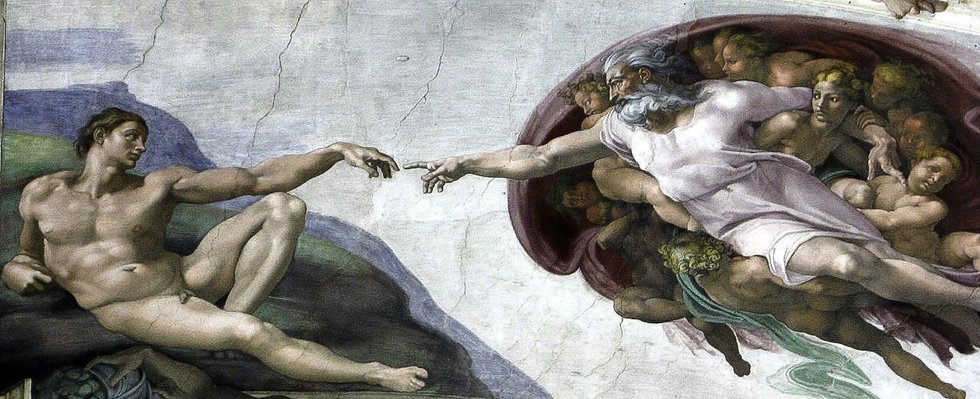
Michaelangelo's "Creation of Man"
#1 God, infinitely perfect and blessed in himself, in a plan of sheer goodness, freely created man to make him share in his own blessed life. For this reason, at every time and in every place, God draws close to man. He calls man to seek him, to know him, to love him with all his strength. He calls together all men, scattered and divided by sin, into the unity of his family, the Church. To accomplish this, when the fullness of time had come, God sent his Son as Redeemer and Saviour. In his Son and through him, he invites men to become, in the Holy Spirit, his adopted children and thus heirs of his blessed life.
 
#2 So that this call should resound throughout the world, Christ sent forth the apostles he had chosen, commissioning them to proclaim the gospel: "Go therefore and make disciples of all nations, baptizing them in the name of the Father and of the Son and of the Holy Spirit, teaching them to observe all that I have commanded you; and lo, I am with you always, to the close of the age."4 Strengthened by this mission, the apostles "went forth and preached everywhere, while the Lord worked with them and confirmed the message by the signs that attended it."5
 
Christ teaching the Apostles
#3 Those who with God's help have welcomed Christ's call and freely responded to it are urged on by love of Christ to proclaim the Good News everywhere in the world. This treasure, received from the apostles, has been faithfully guarded by their successors. All Christ's faithful are called to hand it on from generation to generation, by professing the faith, by living it in fraternal sharing, and by celebrating it in liturgy and prayer.6


There is a lot of talk in the Church these days about "changing teaching."  This kind of talk is dangerous, especially when it fails to make clear the critical distinction between what is changeable, and what is not, among the Church's many teachings.
 
The whole of the "deposit of faith" is not changeable.  As the quote from the beginning of the CCC shows, it is precisely this core content, revealed by God in the Incarnation, life, Passion, death, and Resurrection of Jesus Christ, as well as in Scripture and Apostolic Tradition, that must be kept whole and intact, and passed on to future generations.  Christ Himself commanded that the Apostles (and their successors) do exactly that: preserve and hand on, without change, the teachings ("deposit of faith") He taught them.
 
St Bede the Venerable,
preserving and proclaiming
A certain bishop recently said, "We're not a Church of preservation, but rather a Church of proclamation."  This is misleading.  We certainly are a Church of proclamation, but the only thing we have authority (given by Christ) to proclaim is precisely what has been preserved, namely the apostolic deposit of faith.  We're not free to add to it or subtract from it, to alter it, to rearrange its parts into a more pleasing pattern, to hide parts of it behind other parts of it, etc.  We are given the mandate by Christ Himself to preserve it, and to hand it on.  So, we are also a Church of preservation - not for the sake of preserving as an end in itself, but precisely for the sake of proclaiming something real and true.
 
So what constitutes that deposit of faith?  Here's a brief schematic (following CCC #84 ff):
  • Scripture and Tradition - the unchangingness of revealed/inspired Scripture is generally unquestioned, but some modern translations implicitly change the meaning by subordinating the actual text to (transient) cultural norms; "Tradition" tends to be understood rather nebulously, rather than as the concrete set of things the Apostles actually did and taught, and therefore passed on to their immediate successors to be received as essential to faith in Christ.  The problem is precisely that Tradition is not written down.  But, the synthesis of the Pastristic Fathers and the witness of the medieval and early modern Church does a good job of demonstrating in practice what Tradition really means.
  • An ecumenical council:
    pope and bishops together
    Magisterium - the teaching authority of the Church.  It has two and only two explicit duties, for which Christ has given His authority, namely, the preservation of the deposit of faith, and the interpretation of it across time and cultures.  There is no authority given to innovate.
  • defined Dogma - Some aspects of faith are so overarching that they "crystalize" in dogmatic form.  Dogma must be present from the beginning, as part of the deposit of faith, but may be demonstrated either from Scripture or from Tradition.  Having been defined with full magisterial authority, dogma cannot be changed, and we should not lightly change the formula in which the dogma is expressed.  Here's a short list (not trying to be comprehensive):
    • Trinity - God is three persons in one substance; God is both transcendent and immanent
    • Incarnation - Christ is both fully God and fully man; "remaining what He was, He became what He was not;" He truly suffered and died for our sins; His sacrifice on the Cross is sufficient for our redemption; He truly rose from the dead and took again the body he had previously assumed, now perfected and glorified; He founded the Church He intended to found; etc
    • Church - "One, holy, Catholic, and apostolic," with a divinely-intended mission and "constitution," including the authority of the papacy and the episcopate
    • Seven Sacraments - hence also the fullness of the liturgy, sacramental grace, the reality of sin and conversion, the necessity of baptism; the baptismal call to holiness; the revealed definition of marriage; the mission of the laity in the world as witnesses and disciples; the clergy
    • Four Last Things
    • Etc - all of these defined dogmas have numerous further implications for doctrine (positively expressed but not defined with highest authority), which likewise can't be contradicted without calling the dogma into question, as well as for pastoral practice, which likewise can't be contradicted (although there is generally a wide range of pastoral options that don't contradict the dogma)
  • "sensus fidei," the actual unity of faith experienced as the instinctive acceptance of what is consistent with Catholic faith, and the instinctive rejection of what isn't - this is a sure guide, to the extent that it matches up with "what Catholics believe, always, everywhere, and by everyone"
    • It is a greatly damaging modern conceit that only Catholics today matter, because Catholics in the past weren't "mature" or were "superstitous" or the like.  This idea must be rejected as a grave sin of pride, and as a contradiction of the deposit of faith.
  • "faith seeking understanding," the actual fullness of truth (sufficient for salvation) of the whole of the one faith, experienced as longing to know and love God by faith, contemplation, and study (study does not have to be formal; pious practices like reading the lives of the saints are also study, in this sense)
The Lamb of God
All this content of the deposit of faith is ultimately received from God.  Willfully to reject it, modify it, or subordinate it to personal whims or cultural demands is to commit the same sin of pride that caused the fall of the lost angels.  (We sometimes do that not willfully, because we are finite beings, and because we are always under pressure from the world, the flesh, and the devil to make compromises.  This is what we mean we say "The Church is always in need of reform.")  To be faithful to Christ means that we must make every possible effort to receive the deposit of faith entire and uncorrupt (which is given to us with supernatural power in the sacraments and in the Magisterium of all time, so we can actually know it), and also to pass it on by our teaching, our witness, and our piety, likewise entire and uncorrupt. 


Tuesday, January 31, 2017

Prescient 1958 Article by then-Fr. Ratzinger

Fr. Kenneth Baker, SJ, editor-emeritus of Homiletic and Pastoral Review has recently translated and made available an outstanding, and prescient, article from then-Father Joseph Ratzinger (now Pope-Emeritus Benedict XVI), first published in 1958.

It is notable to what extent the problems we continue to wrestle with today were already noticeable in the Church of the "pre-Vatican II" decades.  It is also more than noteworthy, with what consistency Ratzinger/Benedict has approached these sorts of issues over the past five decades.  What an outstanding thinker and teacher for the Church.

In this article, he supports the now-common practice of admitting to the Sacraments (when no obstacles exist) those weakly or improperly formed Catholics whom he calls "secularized" (I often use the phrase "formed more by the world than by the Church"), when they ask for them.  The request itself constitutes some evidence of faith and desire to belong to the Church, however imperfect it may be, and the grace of the Sacraments certainly can aid them in growing in faith over time.

He also notes that this secularization of believers constitutes a tangible challenge for many believers, in that, if a very basic and worldly level of moral commitment, with occasional sacramental participation, is truly sufficient for salvation, then the higher level of commitment to Biblical morality and consistent sacramental participation (including frequent Confession) can be experienced as a burden rather than a grace.  The long-term solution for this, he argues, is for the Church to relinquish its "medieval" assumptions of social prestige and place in the world, and return to a "martyrial" distinctiveness - not an opposition to the world, as if all the world outside the Church is evil and bad, but a distinctiveness of "the few" as witness and fulcrum for the lifting up of "the many."  He calls this a "de-secularization" of the Church, and notes three (simultaneous) levels or steps:

(1) the sacramental, in which the distinctiveness of the Church's true worship stands over against any materialistic, "magical" thinking about sacramental participation, and therefore invites to a deeper level of conversion;

(2) the proclamation of the faith, in which the distinctiveness of the Church once again supports a clear difference in mode of preaching, between the catechetical (to those in the Church), and the missionary (to those not yet deeply converted) - and this mode has not been heard in the West in many centuries; and

(3) the personal witness, in which the distinctiveness of how the believer lives in the world, especially in the midst of rejection, ridicule, and suffering, stands as clear evidence of the reality and effectiveness of grace.

This core, missionary, and witnessing Church, then, serves ultimately as "priestly people" for the whole world, bringing the salvation of Jesus Christ to the whole world, even those baptized who remain quite worldly, and even those outside the Church, who might respond in any way to the power of God:

"If men and women, indeed the greater number of persons are saved, without belonging in the full sense to the community of the faithful, so then it takes place only because the Church herself exists as the dynamic and missionary reality, because those who have been called to belong to the Church are performing their duty as the few..." (third-to-last paragraph).

If, however, the Church has no such core, no such missionary impulse in the modern world, no such capacity for witness to grace (i.e., "the spirit of Vatican II" church), how shall Christ be proclaimed?  If the Church's only mode of worshipping, proclaiming, and living, is "worldly," more or less indistinguishable from everyone else, what is there to inspire to a deeper and greater love? 

Friday, August 26, 2016

Lessons of the Early Church

I am the Catholic I am, in large part because of the martyrs of the early Church.  Their faith shamed my lack of faith, and understanding why they felt it was worth sacrificing the world for the sake of Heaven gave me the impetus to return to the Church as the only way to salvation.  Now, the Church needs their witness again, as the world around us seems primed to descend into a new paganism.

Martyrdom of St. Polycarp - "Away with the atheists!"
The Christian refusal to cooperate with pagan Roman society was rooted in three connected things: (1) The Roman Empire was inherently idolatrous.  Civic participation required participation in pagan ritual worship.  Oaths of office required the same, to be a soldier, a teacher, etc., not just for politicians.  (2) The reality of (unjust) persecution.  Romans persecuted Christians mostly because they saw Christian faith as "atheism" and "innovation," two things that threatened the stability and success of the Empire as a whole.  But as Tertullian famously pointed out in his Apologeticum, forcing Christians to worship other gods by violence made that worship ineffective for the good of the Empire.  (3) Idolatry and unjust persecution represented abuses of power by the Empire.  All worldly authority comes ultimately from God, as Paul argued.  Its uses must therefore conform at least to natural law standards of justice.  That the Empire abused its power in these (and other) ways justified Christian non-participation.

This line of argument, which permeated Christian thought for two centuries, has been buried under other understandings of the Church's relationship to a world seemingly cooperative rather than repressive.  The successful evangelization of the West and the creation of Christendom meant that we didn't need to think much about things that support a Christianity of non-participation.  But we have this treasure somewhere in the attic, not entirely lost or forgotten.  If we confront the increasingly hostile world only with the lessons of cooperative Christendom, we will probably lose.  We need the lessons of conflict as well, distilled from that earlier Christian experience of martyrdom.

Here are three of those critical lessons.

1. The world can never provide an avenue of salvation.  This should be obvious to Christ's disciples.  Only God can forgive sins; only God can save souls; our ultimate homeland is not earth, but Heaven.  But in contrast, it's a key plank of modernism, more or less obvious in all three of its branches (liberal democracy, Communism, and fascism), that the State aspires to become all-in-all, the "savior," in a sense.  In fascism, it does so directly.  In Communism, it does so as the mediating institution of the people's revolutionary will.  In liberal democracy, it does so more subtly, as the mediating institution between conflicts of rights and powers; but over time, its mediation inevitably expands and coems to dominate everything else. In all three, "scientism" promises imminent salvation from all the suffering and evils of the world.

Reductio ad absurdum of acceptance of modernism.
Any uncritical acceptance of modernism, then, implicitly accepts the (false) claim that the State exercises the highest and most decisive form of authority.  This claim tends to be not merely political, but also moral (i.e., abusing God-given authority!).  It rejects, more or less explicitly, a traditional, Bible-informed moral vision.  Acceptance of modernism therefore also means accepting the relegation of religion to the private sphere only.  The moral verities and priorities of the culture (which are, in terms of Christian Revelation, not true) come to be enforced as true, and any serious objection to them is firmly punished, at least socially (loss of status, respect, jobs, friends, etc), possibly legally (fines, jail, the police showing up in the middle of the night to investigate your family, etc), and even (sometimes) fatally. 

A different acceptance of modernism - no less absurd.
If we accept, even implicitly, that the world offers salvation within itself, we cannot be Christians.  We must stand firmly and intentionally in the core Christian claim of salvation through Christ alone.  Short of martyrdom, we do this especially in our (public) worship. Worship focused on God (as in traditional modes) demonstrates our conviction, and teaches spiritual salvation.  Worship focused on ourselves (as in "theater in the round" church design, or hymns all about us or making us speak in God's first person voice, etc.) opens the door to implicit acceptance of the lie of the world saves itself. 

2. Forms of idolatry must be clearly rebuked.  The Church of the martyrs taught clearly and consistently to all its members that cooperation with idolatry leads to loss of saving relationship with Christ.  It wasn't just pagan rituals that were identified, it was a whole host of public or civic activities or positions that were inherently idolatrous - teachers and soldiers, attending theater or civic games, etc etc.  This process of identifying and rebuking forms of participation in idolatry was very successful.

Pope St. John Paul II, for one example, did an excellent job throughout his pontificate (and even before) of doing the equivalent for us today.  We don't tend to think in terms of "idolatry" today, but the moral equivalent corrupting the Church and society is "secularism" (and similar labels).  A creeping domination of "secular" ideas in all spheres of life is intent on displacing any Biblical or natural-law-based cultural patrimony in the West.  This is especially apparent at the moment in issues of sexuality and family, or education policy, for example.  Pope St. John Paul II showed us how to parse the good and the bad in all such conflicts, and having identified the elements or ideas inconsistent with truth and therefore unacceptable to Christians, he rebuked ideas without condemning people. 


March for Life 2013 - excellent example of rebuking without condemning

The more we conform ourselves to the mores of the world, the more this creeping secularism insinuates itself into our faith.  Pope St. John Paul II told us constantly, "Be not afraid!"  Short of martyrdom, we can be clear and consistent in our rejection of modern forms of idolatry by fearlessly knowing the truth (virtue of faith), living the truth (virtue of hope), and speaking the truth (virtue of love) - always with charity and mercy.  It is, in fact, the visibility of the true charity and mercy of Christ in our lives that can attract those mired in worldly idolatry.

3. Faith in Christ is the greatest treasure.  If we look to the world for our salvation (even unconsciously), and fall into secular (idolatrous) modes of thinking, we will inevitably undervalue our faith.  This doesn't necessarily mean we will lose our faith entirely, but we won't have much motive for living it out consistently.  We will be "secular Christians," who, even when we go every Sunday to worship God, live the rest of the week as if Christ doesn't matter to us.  We will be "formed by the culture" rather than "formed by the Church."  We will have fallen into the trap of privatizing our faith - which is precisely what the totalizing, secular world demands of us.

Pope Benedict XVI Adoring our Lord Jesus Christ
Pope Benedict XVI understood this dynamic deeply.  So much of his pontificate was aimed at enflaming our faith anew, at helping us realize just what an inestimable treasure faith in Christ actually is.  Nobody is attracted to a faith that seems not to matter even to its regular practitioners!  Only those who are on fire for God have the chance to spread the fire to others.  Only those who, by how they live in every sphere of life, clearly value above other things the love of God can proclaim the value of that love. 


If it's true, finally, that "the blood of the martyrs is the seed of the Church," then our evangelizing efforts can only bear fruit if we first die to self, and to the world, and live only in Christ. 


Friday, September 20, 2013

"Jesuit" Interview with Pope Francis

Yesterday, America magazine released the English-language translation of the "official" interview with Pope Francis by Jesuit priest Fr. Antonio Spadaro, SJ.  The original Italian (which I have not looked at) was published in La Civilta Catholica.

Just two thoughts on this interview for now.  One, the main-stream press is trying very hard to use anything possible which they can glean from this interview to drive wedges into the Church.  Fr. Z, among others, makes this point most ably.  Just one example: Here's the AP report on the publication of the interview, copied in a great many places.  Notice how they lead with what they imagine will be the most provocative part, even though it's clearly not the most important part, and even then, they have to misconstrue by taking significantly out of context, to make it seem to say what they want it to say.  The caption under the photo takes it thusly:

VATICAN CITY (AP) -- Pope Francis is warning that the Catholic Church's moral edifice might "fall like a house of cards" if it doesn't balance its divisive rules about abortion, gays and contraception with the greater need to make the church a merciful, more welcoming place for all.

The article's lead point (second-to-fourth third paragraphs) makes the same maneuver:

In the 12,000-word article, Francis expands on his ground-breaking comments over the summer about gays and acknowledges some of his own faults...

But his vision of what the church should be stands out, primarily because it contrasts so sharply with many of the priorities of his immediate predecessors John Paul II and Benedict XVI. They were both intellectuals for whom doctrine was paramount, an orientation that guided the selection of generations of bishops and cardinals around the globe.

Francis said the dogmatic and the moral teachings of the church were not all equivalent.


Compare that with what Francis actually said about these topics, in the section labelled "The Church as Field Hospital:"

Pope Francis begins by showing great affection and immense respect for his predecessor: “Pope Benedict has done an act of holiness, greatness, humility. He is a man of God.

“I see clearly,” the pope continues, “that the thing the church needs most today is the ability to heal wounds and to warm the hearts of the faithful; it needs nearness, proximity. I see the church as a field hospital after battle...

“How are we treating the people of God? I dream of a church that is a mother and shepherdess. The church’s ministers must be merciful, take responsibility for the people and accompany them like the good Samaritan, who washes, cleans and raises up his neighbor. This is pure Gospel. God is greater than sin...

“Instead of being just a church that welcomes and receives by keeping the doors open, let us try also to be a church that finds new roads, that is able to step outside itself and go to those who do not attend Mass, to those who have quit or are indifferent...

“A person once asked me, in a provocative manner, if I approved of homosexuality. I replied with another question: ‘Tell me: when God looks at a gay person, does he endorse the existence of this person with love, or reject and condemn this person?’ We must always consider the person...

“This is also the great benefit of confession as a sacrament: evaluating case by case and discerning what is the best thing to do for a person who seeks God and grace...

“We cannot insist only on issues related to abortion, gay marriage and the use of contraceptive methods. This is not possible. I have not spoken much about these things, and I was reprimanded for that. But when we speak about these issues, we have to talk about them in a context. The teaching of the church, for that matter, is clear and I am a son of the church, but it is not necessary to talk about these issues all the time.

“The dogmatic and moral teachings of the church are not all equivalent. The church’s pastoral ministry cannot be obsessed with the transmission of a disjointed multitude of doctrines to be imposed insistently. Proclamation in a missionary style focuses on the essentials, on the necessary things: this is also what fascinates and attracts more, what makes the heart burn, as it did for the disciples at Emmaus. We have to find a new balance; otherwise even the moral edifice of the church is likely to fall like a house of cards, losing the freshness and fragrance of the Gospel. The proposal of the Gospel must be more simple, profound, radiant. It is from this proposition that the moral consequences then flow."

This is very nearly the opposite of what the AP article attempts to portray.  Nothing in all this can reasonably be construed as any sort of novelty, or break with the priorities of Pope Benedict, or change in what the Church is teaching or trying to do.  Pope Francis wants the Church to be successful at getting people to love God, go to Mass and Confession, and live the content of the faith.  Whudathunkit??

It also shows very clearly my second point in this post: Pope Francis, like his predecessors, and with a deep personal urgency and simplicity, really emphasizes the proclamation of the Gospel.  That's what this interview is mostly about; he comes back to it again and again in different contexts.  In this section, he's talking especially about the initial proclamation, the invitation to hear the Good News of Jesus Christ.  As Pope Paul VI, Pope John Paul II, and Pope Benedict XVI also said, our world is increasingly in need of this initial proclamation.  Actions speak louder than words, and the most fundamental kind of invitation to the Gospel, both in actions and words, is to demonstrate to someone that they are worthy of love, by actually loving them.  This is the grace that heals, and from that being loved comes the desire to love, to experience conversion and growth in faith.  That's the only real basis for living up to God's standards of freedom and dignity, the revealed moral law.  

 Pope Francis said essentially the same things in his address to the bishops of Brazil, back in July.  The talk and the interview are both worth a good read and reflection, if nothing else just to be able to refute the even more intense barrage of false claims about his vision and goals that we're going to face now.

PS - Today, Pope Francis addressed a meeting of medical professionals and preached about the evil of abortion, against "throwing away" the lives of children.  He made the explicit point that this is not only a religious idea, but also the clear conclusion of both reason and science.  After trying to suggest yesterday in their depiction of the contents of the interview that Pope Francis doesn't really think that's very important, the main-stream media are beside themselves today.