On the first day of the youth synod, Archbishop Chaput gave two excellent, incisive interventions (i.e., brief speeches to start the ball rolling, as it were). Here are two articles about them, with the full text at the bottom of each article.
One, on how using secular terminology already gives away too much of what is in dispute.
Two, on the "moral adolensence" of Western materialist culture.
This is what leadership looks like.
UPDATE - 10/18 - Excellent interview with Abp. Chaput. An excerpt:
"Augusto Del Noce, the late Italian philosopher, described our situation best in his essay, “Technological Civilization and Christianity.” It’s worth reading. As “postmoderns,” we’ve tried to overcome our despair with science and technology, and they produce many good things. But they also focus us radically on this world and away from the supernatural. As a result, man’s religious dimension, our sense of the transcendent, slowly dries up and disappears. Technological civilization doesn’t persecute religion, at least not directly. It doesn’t need to. It makes God irrelevant.
"The Church will survive and continue her mission. But to do that, she first needs to acknowledge that the culture she helped create now has no use for her — and why. As a Church, we don’t yet see our reality clearly and critically enough. For example, the current synod’s instrumentum laboris (IL) talks about young people and the effects of social media and the “digital continent.” But it has no grasp of the deeper dynamics of technology that Del Noce names.
"The IL, in its original form, is a collection of dense social science data with very little evangelical zeal. It speaks constantly about accompaniment, which is important, but it contains almost no confident teaching. It can’t and won’t convert anybody. Hopefully, the synod fathers will fix this."
Friday, October 5, 2018
Tuesday, August 21, 2018
Mini-round-up of responses to renewed sexual abuse scandal - Updated
Best response so far - Bishop Robert Morlino of Madison - must read
Bishop Nickless's response
Pope Francis's strongly worded "Letter to the People of God" (praying that his actions in the near future will match these words)
Cardinal DiNardo's response as head of USCCB (praying that these reforms can be carried through effectively, but also spiritually and not just legalistically)
NCRegister seems to be keeping their roundup mostly current, too.
UPDATE - 8/27 - Archbishop and retired US Nuncio Vigano published a scathing summary (translation, in full) of what he claims to know and surmise about the highest levels in the Church covering up sexual abuse, not excluding even Pope Francis (in relation to the McGarrick scandal) . If true, this information suggests that numerous resignations-in-disgrace could be the most positive outcome still open. Vigorous attempts at character assassination of Vigano began immediately (which perhaps lends credence to his allergations), while Cardinal Burke (and a very few others, so far) are calling for independent investigation to establish the truth. Pope Francis, incredibly, completely dropped the ball in responding to questions about the Vigano letter during his press conference yesterday.
Bishop Nickless's response
Pope Francis's strongly worded "Letter to the People of God" (praying that his actions in the near future will match these words)
Cardinal DiNardo's response as head of USCCB (praying that these reforms can be carried through effectively, but also spiritually and not just legalistically)
NCRegister seems to be keeping their roundup mostly current, too.
UPDATE - 8/27 - Archbishop and retired US Nuncio Vigano published a scathing summary (translation, in full) of what he claims to know and surmise about the highest levels in the Church covering up sexual abuse, not excluding even Pope Francis (in relation to the McGarrick scandal) . If true, this information suggests that numerous resignations-in-disgrace could be the most positive outcome still open. Vigorous attempts at character assassination of Vigano began immediately (which perhaps lends credence to his allergations), while Cardinal Burke (and a very few others, so far) are calling for independent investigation to establish the truth. Pope Francis, incredibly, completely dropped the ball in responding to questions about the Vigano letter during his press conference yesterday.
Monday, March 5, 2018
Archdiocese of Washington DC offers "Amoris Laetitia: Pastoral Plan"
This weekend, the Archdiocese of Washington DC released a longish document on their implementation of Amoris Laetitia. Like the exhortation itself, this "Amoris Laetitia: Pastoral Plan" offers (mostly) a straightforward recapitulation of the Church's teaching about marriage, some good advice about strengthening marriage prep (both remote and proximate), and a call for conversion and stability. We all know that our culture is increasingly anti-marriage, both in terms of more and more radical individualism and relativism, and in terms of failing to support marriage in ways both practical (tax laws, welfare state policies, etc) and theoretical (no fault divorce, education policy, court-driven custody rulings, etc). Having a solid biblical, Catholic, Christ-centered vision of what marriage is, and of what the common problems in marriage stem from, and of how to recognize and respond to those issues in healthy and faithful ways, is critical, and I applaud anything that helps build up the culture of marriage and helps actual couples live their marriages well in Christ.
There are, however, two things about this pastoral plan that strike me as failing to aim at that goal from the outset. This doesn't necessarily take away from the practical wisdom contained in the document, but it does invite us to think more deeply about our vision and how we communicate it.
The first is the problem of failing to articulate clearly the relationship of eros to agape. The document states:
never ends. This "desire to love and be loved" is eros-love. Eros is often where we start, not only in marriage but in many things we pursue. Eros is not inherently wrong or evil; it is about choices we make at the level of the "appetitive soul." If, however, our desire and ends remain only at this level, they tend to stagnate into selfishness and idolatry, addiction and neurosis.
As Pope Benedict taught so clearly in Deus Caritas Est, natural eros must always be purified by divine agape in order to pursue the good rather than the self. Agape is that "self-giving love, reflected in the divine plan." It is love that imitates Christ's perfect love from the Cross. It therefore transcends the appetitive soul, through the action of a well-formed (not an eros-formed) conscience and divine grace, allowing the rational soul to perceive and choose the authentic good for others.
What is unclear in the above paragraph is precisely that agapic love is not "natural" to us as humans. We must learn how to love this way. While it's true in a sense that God has written the desire for agape into our hearts (as St. Augustine wrote, "Our heart is restless until it rests in you, O Lord"), we do not have natural means to engage this. We require grace to transcend eros-love and be converted to love with Christ's agapic love. To fail to distinguish this grace-for-conversion here leaves the entire pastoral plan resting on an insecure foundation. Anyone who imagines that more eros (natural desire) can solve the problems created by unrefined eros (selfish desire) is bound to fail, but this is the conclusion being (inadvertently) invited here.
Sacramental marriage gives grace precisely to transform eros into agape. No matter how kind and loving I am to my spouse and children, if I continue to treat them as objects of desire (i.e., they must fulfill me, they are in my life for my happiness), I am not responding to this sacramental grace. Eros transformed into agape means I live my vocation to married life as Christ crucified - that everything I am and do is for them, rather than the reverse. From eros fulfilled comes mere happiness; from agape fulfilling others comes joy and union with Christ.
Therefore, while it is certainly true that "That (divine) plan offers a profound 'yes' to true joy in love," it must also be stated that deviations from the divine plan offer an (at least implicit) 'no' to the same conversion, joy, and agape-love. We must not conclude what the document leaves open to us (and what Amoris Laetitia, too, often seems to suggest), that deviations from the divine plan for marriage and family contain a partial 'yes' to God and grace. This might be true, only if the deviations result entirely from ignorance and weakness. When they result from a deliberate choice to pursue eros-love instead of agape-love (even when that choice is less than fully informed), they do not represent authentic modes of encountering Christ's grace, and they are therefore contrary to the divine plan. Eliding this distinction does not serve anyone well.
The second problem risks being even more corrosive. It suggests that the Church's doctrine is not itself useful or practical, and that lived experience is needed to understand, or interpret, or even correct that doctine.
begin first with the richness of the Church’s
experience and life....
At one level, this distinction is not problematic. I am not trying to suggest that lived experience is irrelevant to doctrine, or that the reception of doctrine is not fraught with difficulties stemming from our human weakness and falibility, or stemming from cultural presumptions at odds with the Gospel, etc. Even given this, however, it is tendentious in the extreme to suggest that the Church's pastoral care has ever attempted to engage with actual situations merely by "restating doctrine," or that, say, St. John Paul II failed to appreciate the complexities presented to the Church by contemporary culture (see e.g. Familiaris Consortio or Veritatis Splendor, or for a different vocational context, Pastores Dabo Vobis). Should we now discard the entire Code of Canon Law, beacuse it "limits us to faith statements?" At this level, the dichotomy becomes a blatant lie, pitting "mercy" (which now means making excuses for deviations from the divine plan for marriage and family) against "doctrine" (which now means cruelly expecting people to be unrealistically perfect).
If this is our vision of marriage, "our faith is vain," as St. Paul says, because this vision of marriage is indistinguishable from the world's - eros without agape (love with sacrifice, happiness without personal cost), inherently self-centered, and "mercifully" lacking any possible leverage to modify behavior which is actually inimical to marriage, to the dignity of persons, or to salvation.
I don't actually believe that the Archdiocese of Washington is promoting this cultural vision of marriage. But, by including these two ambiguities, it weakens the vision which it is trying to offer and sustain, of Christ's sacramental marriage. And our culture has already weakened that vision enough; we don't need to weaken our presentation of it still futher.
There are, however, two things about this pastoral plan that strike me as failing to aim at that goal from the outset. This doesn't necessarily take away from the practical wisdom contained in the document, but it does invite us to think more deeply about our vision and how we communicate it.
The first is the problem of failing to articulate clearly the relationship of eros to agape. The document states:
The desire to love and to be loved is a deep,
enduring part of our human experience. God
has written onto each human heart the desire for
self-giving love, reflected in the divine plan for
marriage and family. That plan offers a profound
“yes” to true joy in love. It gives us an invitation to
experience Christian hope in the love of God that
never ends. This "desire to love and be loved" is eros-love. Eros is often where we start, not only in marriage but in many things we pursue. Eros is not inherently wrong or evil; it is about choices we make at the level of the "appetitive soul." If, however, our desire and ends remain only at this level, they tend to stagnate into selfishness and idolatry, addiction and neurosis.
As Pope Benedict taught so clearly in Deus Caritas Est, natural eros must always be purified by divine agape in order to pursue the good rather than the self. Agape is that "self-giving love, reflected in the divine plan." It is love that imitates Christ's perfect love from the Cross. It therefore transcends the appetitive soul, through the action of a well-formed (not an eros-formed) conscience and divine grace, allowing the rational soul to perceive and choose the authentic good for others.
What is unclear in the above paragraph is precisely that agapic love is not "natural" to us as humans. We must learn how to love this way. While it's true in a sense that God has written the desire for agape into our hearts (as St. Augustine wrote, "Our heart is restless until it rests in you, O Lord"), we do not have natural means to engage this. We require grace to transcend eros-love and be converted to love with Christ's agapic love. To fail to distinguish this grace-for-conversion here leaves the entire pastoral plan resting on an insecure foundation. Anyone who imagines that more eros (natural desire) can solve the problems created by unrefined eros (selfish desire) is bound to fail, but this is the conclusion being (inadvertently) invited here.
Sacramental marriage gives grace precisely to transform eros into agape. No matter how kind and loving I am to my spouse and children, if I continue to treat them as objects of desire (i.e., they must fulfill me, they are in my life for my happiness), I am not responding to this sacramental grace. Eros transformed into agape means I live my vocation to married life as Christ crucified - that everything I am and do is for them, rather than the reverse. From eros fulfilled comes mere happiness; from agape fulfilling others comes joy and union with Christ.
Therefore, while it is certainly true that "That (divine) plan offers a profound 'yes' to true joy in love," it must also be stated that deviations from the divine plan offer an (at least implicit) 'no' to the same conversion, joy, and agape-love. We must not conclude what the document leaves open to us (and what Amoris Laetitia, too, often seems to suggest), that deviations from the divine plan for marriage and family contain a partial 'yes' to God and grace. This might be true, only if the deviations result entirely from ignorance and weakness. When they result from a deliberate choice to pursue eros-love instead of agape-love (even when that choice is less than fully informed), they do not represent authentic modes of encountering Christ's grace, and they are therefore contrary to the divine plan. Eliding this distinction does not serve anyone well.
The second problem risks being even more corrosive. It suggests that the Church's doctrine is not itself useful or practical, and that lived experience is needed to understand, or interpret, or even correct that doctine.
Reflecting on the implementation of Amoris
Laetitia in the Archdiocese of Washington, we
begin first with the richness of the Church’s
perennial teaching on love, marriage, family,
faith and mercy.... Secondly, we need to remember that our task is
not complete if we only limit ourselves to faith
statements. The goal is the salvation of souls
and it is a far more complex effort than simply
restating Church doctrine. For this reason, it is
essential to recognize that our teaching is received
by individuals according to their own situation,
experience and life....
At one level, this distinction is not problematic. I am not trying to suggest that lived experience is irrelevant to doctrine, or that the reception of doctrine is not fraught with difficulties stemming from our human weakness and falibility, or stemming from cultural presumptions at odds with the Gospel, etc. Even given this, however, it is tendentious in the extreme to suggest that the Church's pastoral care has ever attempted to engage with actual situations merely by "restating doctrine," or that, say, St. John Paul II failed to appreciate the complexities presented to the Church by contemporary culture (see e.g. Familiaris Consortio or Veritatis Splendor, or for a different vocational context, Pastores Dabo Vobis). Should we now discard the entire Code of Canon Law, beacuse it "limits us to faith statements?" At this level, the dichotomy becomes a blatant lie, pitting "mercy" (which now means making excuses for deviations from the divine plan for marriage and family) against "doctrine" (which now means cruelly expecting people to be unrealistically perfect).
If this is our vision of marriage, "our faith is vain," as St. Paul says, because this vision of marriage is indistinguishable from the world's - eros without agape (love with sacrifice, happiness without personal cost), inherently self-centered, and "mercifully" lacking any possible leverage to modify behavior which is actually inimical to marriage, to the dignity of persons, or to salvation.
I don't actually believe that the Archdiocese of Washington is promoting this cultural vision of marriage. But, by including these two ambiguities, it weakens the vision which it is trying to offer and sustain, of Christ's sacramental marriage. And our culture has already weakened that vision enough; we don't need to weaken our presentation of it still futher.
Friday, November 3, 2017
What is the "Deposit of Faith?"
From the Catechism of the Catholic Church:
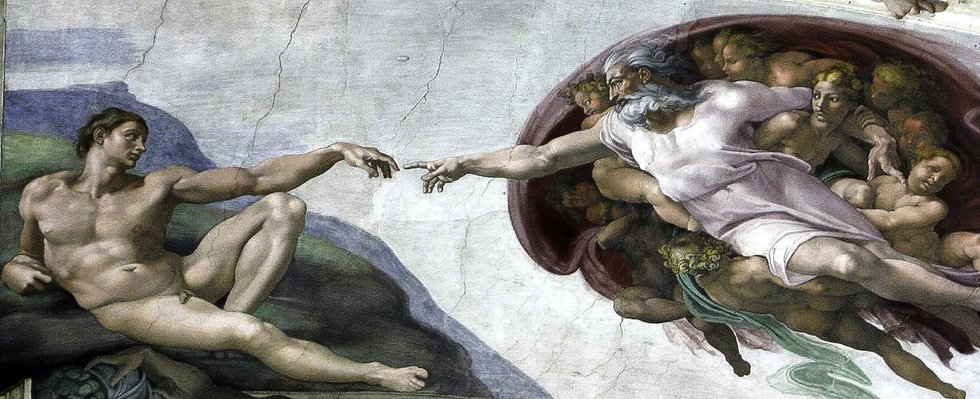 |
| Michaelangelo's "Creation of Man" |
#1 God, infinitely perfect and blessed in himself, in a plan of sheer goodness, freely created man to make him share in his own blessed life. For this reason, at every time and in every place, God draws close to man. He calls man to seek him, to know him, to love him with all his strength. He calls together all men, scattered and divided by sin, into the unity of his family, the Church. To accomplish this, when the fullness of time had come, God sent his Son as Redeemer and Saviour. In his Son and through him, he invites men to become, in the Holy Spirit, his adopted children and thus heirs of his blessed life.
#2 So that this call should resound throughout the world, Christ sent forth the apostles he had chosen, commissioning them to proclaim the gospel: "Go therefore and make disciples of all nations, baptizing them in the name of the Father and of the Son and of the Holy Spirit, teaching them to observe all that I have commanded you; and lo, I am with you always, to the close of the age."4 Strengthened by this mission, the apostles "went forth and preached everywhere, while the Lord worked with them and confirmed the message by the signs that attended it."5
 |
| Christ teaching the Apostles |
#3 Those who with God's help have welcomed Christ's call and freely responded to it are urged on by love of Christ to proclaim the Good News everywhere in the world. This treasure, received from the apostles, has been faithfully guarded by their successors. All Christ's faithful are called to hand it on from generation to generation, by professing the faith, by living it in fraternal sharing, and by celebrating it in liturgy and prayer.6
There is a lot of talk in the Church these days about "changing teaching." This kind of talk is dangerous, especially when it fails to make clear the critical distinction between what is changeable, and what is not, among the Church's many teachings.
The whole of the "deposit of faith" is not changeable. As the quote from the beginning of the CCC shows, it is precisely this core content, revealed by God in the Incarnation, life, Passion, death, and Resurrection of Jesus Christ, as well as in Scripture and Apostolic Tradition, that must be kept whole and intact, and passed on to future generations. Christ Himself commanded that the Apostles (and their successors) do exactly that: preserve and hand on, without change, the teachings ("deposit of faith") He taught them.
 |
| St Bede the Venerable, preserving and proclaiming |
A certain bishop recently said, "We're not a Church of preservation, but rather a Church of proclamation." This is misleading. We certainly are a Church of proclamation, but the only thing we have authority (given by Christ) to proclaim is precisely what has been preserved, namely the apostolic deposit of faith. We're not free to add to it or subtract from it, to alter it, to rearrange its parts into a more pleasing pattern, to hide parts of it behind other parts of it, etc. We are given the mandate by Christ Himself to preserve it, and to hand it on. So, we are also a Church of preservation - not for the sake of preserving as an end in itself, but precisely for the sake of proclaiming something real and true.
So what constitutes that deposit of faith? Here's a brief schematic (following CCC #84 ff):
- Scripture and Tradition - the unchangingness of revealed/inspired Scripture is generally unquestioned, but some modern translations implicitly change the meaning by subordinating the actual text to (transient) cultural norms; "Tradition" tends to be understood rather nebulously, rather than as the concrete set of things the Apostles actually did and taught, and therefore passed on to their immediate successors to be received as essential to faith in Christ. The problem is precisely that Tradition is not written down. But, the synthesis of the Pastristic Fathers and the witness of the medieval and early modern Church does a good job of demonstrating in practice what Tradition really means.

An ecumenical council:
pope and bishops togetherMagisterium - the teaching authority of the Church. It has two and only two explicit duties, for which Christ has given His authority, namely, the preservation of the deposit of faith, and the interpretation of it across time and cultures. There is no authority given to innovate.- defined Dogma - Some aspects of faith are so overarching that they "crystalize" in dogmatic form. Dogma must be present from the beginning, as part of the deposit of faith, but may be demonstrated either from Scripture or from Tradition. Having been defined with full magisterial authority, dogma cannot be changed, and we should not lightly change the formula in which the dogma is expressed. Here's a short list (not trying to be comprehensive):
- Trinity - God is three persons in one substance; God is both transcendent and immanent
- Incarnation - Christ is both fully God and fully man; "remaining what He was, He became what He was not;" He truly suffered and died for our sins; His sacrifice on the Cross is sufficient for our redemption; He truly rose from the dead and took again the body he had previously assumed, now perfected and glorified; He founded the Church He intended to found; etc
- Church - "One, holy, Catholic, and apostolic," with a divinely-intended mission and "constitution," including the authority of the papacy and the episcopate
- Seven Sacraments - hence also the fullness of the liturgy, sacramental grace, the reality of sin and conversion, the necessity of baptism; the baptismal call to holiness; the revealed definition of marriage; the mission of the laity in the world as witnesses and disciples; the clergy
- Four Last Things
- Etc - all of these defined dogmas have numerous further implications for doctrine (positively expressed but not defined with highest authority), which likewise can't be contradicted without calling the dogma into question, as well as for pastoral practice, which likewise can't be contradicted (although there is generally a wide range of pastoral options that don't contradict the dogma)
- "sensus fidei," the actual unity of faith experienced as the instinctive acceptance of what is consistent with Catholic faith, and the instinctive rejection of what isn't - this is a sure guide, to the extent that it matches up with "what Catholics believe, always, everywhere, and by everyone"
- It is a greatly damaging modern conceit that only Catholics today matter, because Catholics in the past weren't "mature" or were "superstitous" or the like. This idea must be rejected as a grave sin of pride, and as a contradiction of the deposit of faith.
- "faith seeking understanding," the actual fullness of truth (sufficient for salvation) of the whole of the one faith, experienced as longing to know and love God by faith, contemplation, and study (study does not have to be formal; pious practices like reading the lives of the saints are also study, in this sense)

 |
| The Lamb of God |
All this content of the deposit of faith is ultimately received from God. Willfully to reject it, modify it, or subordinate it to personal whims or cultural demands is to commit the same sin of pride that caused the fall of the lost angels. (We sometimes do that not willfully, because we are finite beings, and because we are always under pressure from the world, the flesh, and the devil to make compromises. This is what we mean we say "The Church is always in need of reform.") To be faithful to Christ means that we must make every possible effort to receive the deposit of faith entire and uncorrupt (which is given to us with supernatural power in the sacraments and in the Magisterium of all time, so we can actually know it), and also to pass it on by our teaching, our witness, and our piety, likewise entire and uncorrupt.
Monday, August 28, 2017
Pope Francis on "irreversible" liturgical reform
Last week, Pope Francis gave a short talk to a gathering of Italian liturgists. (The Vatican website has posted the text of the speech in Italian only, so far.)
(Three excellent takes on this talk are Fr. Hunwicke's, Fr. Zuhlsdorf's, and Dr. Ed Peter's.)
Much of what the Holy Father said is unexceptional, even inspiring. He began with a brief summary of the process of liturgical reform, noting such luminaries as Pius X, Pius XII and the 1947 encyclical Mediator Dei (a marvelous and inspiring work), and the sacred consitution on the liturgy of the Second Vatican Council, Sacrosanctum Concilium. And he concluded with some thoughts about the "vivifying" character of the liturgy, particularly of the Holy Mass, noting especially (1) our Eucharistic participation in Christ's life-giving victory over sin and death, (2) the unity of the Church which flows from the sacraments (uniting peoples with peoples, and laity with clergy, and whole Church with Christ her Head), and (3) the importance of "mystagogical catechesis" (as of the Fathers, he noted) for revealing and sustaining our personal and corporate relationship with Christ. All this was quite good.
And yet, as he too often does, Pope Francis managed to say something that sounded immensely important, but with a great degree of ambiguity and confusion.
Following his summary of Sacrosanctum Concilium, he talked about the implementation of the liturgical reforms by Pope Paul VI. He said, "It's not enough to reform the books, in order to renew the (liturgical) mentality." He twice insisted on the identity (!!) of the enacted reforms with the intentions of the Council Fathers and text of SC. And he stated that "...we can affirm with security and magisterial authority that the litugical reform is irreversible."
I agree that the liturgical mentality in the Church in much of the 19th and 20th centuries needed to be renewed. Under the cultural pressures of the Revolution(s) and the Enlightenment, the mentality of the Church became constricted, in several areas. Low Mass became the norm, rather than High Mass; minor orders fell into disuse in nearly all parishes; Gregorian chant became ossified, and congregations were little able to sing their parts; and so on. Against these trends, the Liturgical Movement was attempting precisely to renew the Church's culture of worship, starting with the refounding of the great abbey of Solemnes after its destruction during the French Revolution, and the renewal of its monastic liturgy. It slowly gained momentum before Vatican II.
It's impossible, however, not to notice that much (not all, certainly, but much) of the implementation of the postconciliar reforms changed the nature and the direction of that Movement. It's also impossible not to notice that, on several significant points, the implementation of the reforms did or attempted things not called for in SC, and also did or attempted things contrary to what SC called for. The result has not been a renewal of a vital litugical mentality, but the further erosion of what vitality remains. Where immediately before the Council, liturgy was very often done hastily, carelessly (of the Latin, of the reverence expected, etc), and therefore sloppily, immediately after the implementation of reforms, liturgy came to be done "experimentally," iconclastically, "self-referentially" (ironically, one of Pope Francis's more significant criticisms of the modern Church), and still more sloppily. The "Low Mass" mentality that prevailed was not renewed, it was cemented, and the spirit of modern lawlessness was added to it.
Pope Benedict XVI understood these trends profoundly. He grasped, and taught repeatedly, both that the practical implementation of the Council's vision of liturgical renewal had failed on several points, and needed to be very carefully reviewed, reconsidered, and corrected (this is often dubbed "the reform of the reform"), and that the Church will never be able to evangelize effectively in the modern world, with banal liturgy (!!!). On the first point, he led by example, and also gave the Church the gift of Summorum Pontificum, not out of a sense of nostalgia, but as a "restart" of the intended renewal. If we can remember the right way to undertake the liturgy in the "extraordinary form" -- that is, reverently, in union with Tradition and with the angelic, Heavenly liturgy, and in a manner that elevates hearts and minds to God -- then we can apply that to the "ordinary form," and find or develop the intended renewal there. On the second point, he preached loudly and incessantly about worldly banality as the prototypical illness of modernity, and that the medicine to cure it is true, deep, personal encounter with Christ, divine Love personified - best found in a vital, authentic, devoutly Catholic worship.
It is, therefore, very difficult to understand quite what the Holy Father means by asserting "irreversibility." It seems that the statement must either be a tautology, or else factually false.
Like so much else in the contemporary Church, that falsity is directly the fruit of the poor practical implementation of the desired reforms of SC. Fortunately, a good part of that needed "reform of the reform" has already begun, at least in some places; for example, a return to Gregorian chant (sometimes with classical Latin pieces, but even more so with new, vernacular plain-chant); a rejection of ugly, polyester vestments and burlap banners, and a retrieval of more beautiful and fitting vestments, church adornment, etc; a rejection of side-lining Christ in the tabernacle, and a return to "front and center" placement; the related re-emergence of Adoration and similar devotions; and so on. None of this means a rejection of Vatican II's liturgical reform and renewal. It _is_ the renewal. And, God willing, it will indeed prove "irreversible."
(Three excellent takes on this talk are Fr. Hunwicke's, Fr. Zuhlsdorf's, and Dr. Ed Peter's.)
Much of what the Holy Father said is unexceptional, even inspiring. He began with a brief summary of the process of liturgical reform, noting such luminaries as Pius X, Pius XII and the 1947 encyclical Mediator Dei (a marvelous and inspiring work), and the sacred consitution on the liturgy of the Second Vatican Council, Sacrosanctum Concilium. And he concluded with some thoughts about the "vivifying" character of the liturgy, particularly of the Holy Mass, noting especially (1) our Eucharistic participation in Christ's life-giving victory over sin and death, (2) the unity of the Church which flows from the sacraments (uniting peoples with peoples, and laity with clergy, and whole Church with Christ her Head), and (3) the importance of "mystagogical catechesis" (as of the Fathers, he noted) for revealing and sustaining our personal and corporate relationship with Christ. All this was quite good.
And yet, as he too often does, Pope Francis managed to say something that sounded immensely important, but with a great degree of ambiguity and confusion.
Following his summary of Sacrosanctum Concilium, he talked about the implementation of the liturgical reforms by Pope Paul VI. He said, "It's not enough to reform the books, in order to renew the (liturgical) mentality." He twice insisted on the identity (!!) of the enacted reforms with the intentions of the Council Fathers and text of SC. And he stated that "...we can affirm with security and magisterial authority that the litugical reform is irreversible."
I agree that the liturgical mentality in the Church in much of the 19th and 20th centuries needed to be renewed. Under the cultural pressures of the Revolution(s) and the Enlightenment, the mentality of the Church became constricted, in several areas. Low Mass became the norm, rather than High Mass; minor orders fell into disuse in nearly all parishes; Gregorian chant became ossified, and congregations were little able to sing their parts; and so on. Against these trends, the Liturgical Movement was attempting precisely to renew the Church's culture of worship, starting with the refounding of the great abbey of Solemnes after its destruction during the French Revolution, and the renewal of its monastic liturgy. It slowly gained momentum before Vatican II.
It's impossible, however, not to notice that much (not all, certainly, but much) of the implementation of the postconciliar reforms changed the nature and the direction of that Movement. It's also impossible not to notice that, on several significant points, the implementation of the reforms did or attempted things not called for in SC, and also did or attempted things contrary to what SC called for. The result has not been a renewal of a vital litugical mentality, but the further erosion of what vitality remains. Where immediately before the Council, liturgy was very often done hastily, carelessly (of the Latin, of the reverence expected, etc), and therefore sloppily, immediately after the implementation of reforms, liturgy came to be done "experimentally," iconclastically, "self-referentially" (ironically, one of Pope Francis's more significant criticisms of the modern Church), and still more sloppily. The "Low Mass" mentality that prevailed was not renewed, it was cemented, and the spirit of modern lawlessness was added to it.
Pope Benedict XVI understood these trends profoundly. He grasped, and taught repeatedly, both that the practical implementation of the Council's vision of liturgical renewal had failed on several points, and needed to be very carefully reviewed, reconsidered, and corrected (this is often dubbed "the reform of the reform"), and that the Church will never be able to evangelize effectively in the modern world, with banal liturgy (!!!). On the first point, he led by example, and also gave the Church the gift of Summorum Pontificum, not out of a sense of nostalgia, but as a "restart" of the intended renewal. If we can remember the right way to undertake the liturgy in the "extraordinary form" -- that is, reverently, in union with Tradition and with the angelic, Heavenly liturgy, and in a manner that elevates hearts and minds to God -- then we can apply that to the "ordinary form," and find or develop the intended renewal there. On the second point, he preached loudly and incessantly about worldly banality as the prototypical illness of modernity, and that the medicine to cure it is true, deep, personal encounter with Christ, divine Love personified - best found in a vital, authentic, devoutly Catholic worship.
It is, therefore, very difficult to understand quite what the Holy Father means by asserting "irreversibility." It seems that the statement must either be a tautology, or else factually false.
Like so much else in the contemporary Church, that falsity is directly the fruit of the poor practical implementation of the desired reforms of SC. Fortunately, a good part of that needed "reform of the reform" has already begun, at least in some places; for example, a return to Gregorian chant (sometimes with classical Latin pieces, but even more so with new, vernacular plain-chant); a rejection of ugly, polyester vestments and burlap banners, and a retrieval of more beautiful and fitting vestments, church adornment, etc; a rejection of side-lining Christ in the tabernacle, and a return to "front and center" placement; the related re-emergence of Adoration and similar devotions; and so on. None of this means a rejection of Vatican II's liturgical reform and renewal. It _is_ the renewal. And, God willing, it will indeed prove "irreversible."
Wednesday, March 1, 2017
Archbishop Gomez pastoral letter on Human Person
 |
| Archbishop Gomez - photo from www.la-archdiocese.org/archbishop |
Tuesday, January 31, 2017
Prescient 1958 Article by then-Fr. Ratzinger
Fr. Kenneth Baker, SJ, editor-emeritus of Homiletic and Pastoral Review has recently translated and made available an outstanding, and prescient, article from then-Father Joseph Ratzinger (now Pope-Emeritus Benedict XVI), first published in 1958.
It is notable to what extent the problems we continue to wrestle with today were already noticeable in the Church of the "pre-Vatican II" decades. It is also more than noteworthy, with what consistency Ratzinger/Benedict has approached these sorts of issues over the past five decades. What an outstanding thinker and teacher for the Church.
In this article, he supports the now-common practice of admitting to the Sacraments (when no obstacles exist) those weakly or improperly formed Catholics whom he calls "secularized" (I often use the phrase "formed more by the world than by the Church"), when they ask for them. The request itself constitutes some evidence of faith and desire to belong to the Church, however imperfect it may be, and the grace of the Sacraments certainly can aid them in growing in faith over time.
He also notes that this secularization of believers constitutes a tangible challenge for many believers, in that, if a very basic and worldly level of moral commitment, with occasional sacramental participation, is truly sufficient for salvation, then the higher level of commitment to Biblical morality and consistent sacramental participation (including frequent Confession) can be experienced as a burden rather than a grace. The long-term solution for this, he argues, is for the Church to relinquish its "medieval" assumptions of social prestige and place in the world, and return to a "martyrial" distinctiveness - not an opposition to the world, as if all the world outside the Church is evil and bad, but a distinctiveness of "the few" as witness and fulcrum for the lifting up of "the many." He calls this a "de-secularization" of the Church, and notes three (simultaneous) levels or steps:
(1) the sacramental, in which the distinctiveness of the Church's true worship stands over against any materialistic, "magical" thinking about sacramental participation, and therefore invites to a deeper level of conversion;
(2) the proclamation of the faith, in which the distinctiveness of the Church once again supports a clear difference in mode of preaching, between the catechetical (to those in the Church), and the missionary (to those not yet deeply converted) - and this mode has not been heard in the West in many centuries; and
(3) the personal witness, in which the distinctiveness of how the believer lives in the world, especially in the midst of rejection, ridicule, and suffering, stands as clear evidence of the reality and effectiveness of grace.
This core, missionary, and witnessing Church, then, serves ultimately as "priestly people" for the whole world, bringing the salvation of Jesus Christ to the whole world, even those baptized who remain quite worldly, and even those outside the Church, who might respond in any way to the power of God:
"If men and women, indeed the greater number of persons are saved, without belonging in the full sense to the community of the faithful, so then it takes place only because the Church herself exists as the dynamic and missionary reality, because those who have been called to belong to the Church are performing their duty as the few..." (third-to-last paragraph).
If, however, the Church has no such core, no such missionary impulse in the modern world, no such capacity for witness to grace (i.e., "the spirit of Vatican II" church), how shall Christ be proclaimed? If the Church's only mode of worshipping, proclaiming, and living, is "worldly," more or less indistinguishable from everyone else, what is there to inspire to a deeper and greater love?
It is notable to what extent the problems we continue to wrestle with today were already noticeable in the Church of the "pre-Vatican II" decades. It is also more than noteworthy, with what consistency Ratzinger/Benedict has approached these sorts of issues over the past five decades. What an outstanding thinker and teacher for the Church.
In this article, he supports the now-common practice of admitting to the Sacraments (when no obstacles exist) those weakly or improperly formed Catholics whom he calls "secularized" (I often use the phrase "formed more by the world than by the Church"), when they ask for them. The request itself constitutes some evidence of faith and desire to belong to the Church, however imperfect it may be, and the grace of the Sacraments certainly can aid them in growing in faith over time.
He also notes that this secularization of believers constitutes a tangible challenge for many believers, in that, if a very basic and worldly level of moral commitment, with occasional sacramental participation, is truly sufficient for salvation, then the higher level of commitment to Biblical morality and consistent sacramental participation (including frequent Confession) can be experienced as a burden rather than a grace. The long-term solution for this, he argues, is for the Church to relinquish its "medieval" assumptions of social prestige and place in the world, and return to a "martyrial" distinctiveness - not an opposition to the world, as if all the world outside the Church is evil and bad, but a distinctiveness of "the few" as witness and fulcrum for the lifting up of "the many." He calls this a "de-secularization" of the Church, and notes three (simultaneous) levels or steps:
(1) the sacramental, in which the distinctiveness of the Church's true worship stands over against any materialistic, "magical" thinking about sacramental participation, and therefore invites to a deeper level of conversion;
(2) the proclamation of the faith, in which the distinctiveness of the Church once again supports a clear difference in mode of preaching, between the catechetical (to those in the Church), and the missionary (to those not yet deeply converted) - and this mode has not been heard in the West in many centuries; and
(3) the personal witness, in which the distinctiveness of how the believer lives in the world, especially in the midst of rejection, ridicule, and suffering, stands as clear evidence of the reality and effectiveness of grace.
This core, missionary, and witnessing Church, then, serves ultimately as "priestly people" for the whole world, bringing the salvation of Jesus Christ to the whole world, even those baptized who remain quite worldly, and even those outside the Church, who might respond in any way to the power of God:
"If men and women, indeed the greater number of persons are saved, without belonging in the full sense to the community of the faithful, so then it takes place only because the Church herself exists as the dynamic and missionary reality, because those who have been called to belong to the Church are performing their duty as the few..." (third-to-last paragraph).
If, however, the Church has no such core, no such missionary impulse in the modern world, no such capacity for witness to grace (i.e., "the spirit of Vatican II" church), how shall Christ be proclaimed? If the Church's only mode of worshipping, proclaiming, and living, is "worldly," more or less indistinguishable from everyone else, what is there to inspire to a deeper and greater love?
Wednesday, December 28, 2016
Is the indissolubility of marriage a *dogmatic* teaching?
The Church has always taught that marriage, validly entered (i.e., with true and free consent of both spouses) and consummated, is indissoluble - that is, bluntly, "What God has joined together, let no man put asunder" (Mt 19:6, Mk 10:9). This is true both of natural marriage (i.e., between unbaptized persons), and of sacramental marriage (i.e., between baptized persons). A quick glance at, say, the index of Denzinger's or the footnotes of the Catechism of the Catholic Church will show how often this teaching has been repeated.
But, one might ask, is this perennial teaching doctrinal (could be divinely revealed, or is at least consistent with apostolic teaching and practice, yet possibly subject to revision), or dogmatic (divinely revealed in Scripture and Tradition, defined as clearly as possible/necessary with full authority, and not subject to revision as far as the definition goes)?
Doctrine and dogma are not opposed to each other, in the sense that the first is optional and the second not. Both are to be received as fully as humanly possible, for living and believing with "the mind of Christ," and for not living "according to this age" (Rom 12:2, etc). There's no difference of truth between them, but there is a difference of clarity and of finality. Dogmatic teaching is the highest level of exercising the teaching authority of the Church (Magisterium); doctrinal teaching is the ordinary level of the same.
To asnwer the question posed, consider a small sample of points:
Moreover, all these sources consistently present a clear and compelling theological reason why marriage ought to be indissoluble; namely, that God, in establishing the natural of marriage, does so on the pattern of the divine covenant. This is a thoroughly Scriptural and Traditional claim (e.g., Jer 31:31, Dan 2:44, Eph 5, etc.). Since God's covenant is indissoluble, marriage must also be. To claim that marriage is soluble is to claim that the divine covenant is also soluble, that God could change His mind about the promises of salvation; or in other words, that Christ died, but not for our sins (!). If marriage has any spiritual reality at all, it must, then, necessarily be indissoluble.
Given all this sort of evidence, it seems to me very difficult to claim that the indissolubility of marriage is merely a doctrinal, but not a dogmatic, teaching.
But, one might ask, is this perennial teaching doctrinal (could be divinely revealed, or is at least consistent with apostolic teaching and practice, yet possibly subject to revision), or dogmatic (divinely revealed in Scripture and Tradition, defined as clearly as possible/necessary with full authority, and not subject to revision as far as the definition goes)?
Doctrine and dogma are not opposed to each other, in the sense that the first is optional and the second not. Both are to be received as fully as humanly possible, for living and believing with "the mind of Christ," and for not living "according to this age" (Rom 12:2, etc). There's no difference of truth between them, but there is a difference of clarity and of finality. Dogmatic teaching is the highest level of exercising the teaching authority of the Church (Magisterium); doctrinal teaching is the ordinary level of the same.
To asnwer the question posed, consider a small sample of points:
- The quote in the first paragraph, above, shows without ambiguity that the indissolubility of marriage is taught by Christ Himself, directly.
- The 24th session of the Council of Trent (Nov, 1563) dealt with marriage, and its decrees and canons were accepted and promulgated by Pope Pius IV. It certainly appears to be a formal, solemn, and intended-to-be-dogmatic definition of marriage, including its indissolubility.
- Pope Pius XI, in the encyclical Casti Connubi (1930), refers to that definition of Trent as a "solemn definition," and repeats the unchanging teaching of indissolubility with great clarity.
- The Second Vatican Council, in its sacred consititution Gaudium et Spes, repeats the same (e.g. #48, albeit without the same verbal markers of dogmatic intent; it does, however, cite Casti Connubi, which seems to imply dogmatic intent, given that document's clarity).
- The Catechism of the Catholic Church repeats the same again (e.g. #1639, 1640, etc), without ambiguity. It cites the same biblical passage above, and GS #48.
Moreover, all these sources consistently present a clear and compelling theological reason why marriage ought to be indissoluble; namely, that God, in establishing the natural of marriage, does so on the pattern of the divine covenant. This is a thoroughly Scriptural and Traditional claim (e.g., Jer 31:31, Dan 2:44, Eph 5, etc.). Since God's covenant is indissoluble, marriage must also be. To claim that marriage is soluble is to claim that the divine covenant is also soluble, that God could change His mind about the promises of salvation; or in other words, that Christ died, but not for our sins (!). If marriage has any spiritual reality at all, it must, then, necessarily be indissoluble.
Given all this sort of evidence, it seems to me very difficult to claim that the indissolubility of marriage is merely a doctrinal, but not a dogmatic, teaching.
Wednesday, December 7, 2016
Thoughts on "rigidity" and orthodoxy
Twice in as many months (e.g., here and here), Pope Francis has inveighed against "rigid" believers. He uses very negative language against this perceived phenomenon: “They appear good because they follow the Law; but behind, there is something that does not make them good. Either they're bad, hypocrites, or they are sick. They suffer!” Such people are "enslaved," they "lead a double life." They exhibit the opposite of the beatitudes: "Rigidity is not a gift of God. Meekness is; goodness is; benevolence is; forgiveness is. But rigidity isn’t!" He attaches the same label and language to those who know, love, and respect the traditional liturgy: "Pope Francis told Father Spadaro he wonders why some young people, who were not raised with the old Latin Mass, nevertheless prefer it. 'And I ask myself: Why so much rigidity? Dig, dig, this rigidity always hides something, insecurity or even something else. Rigidity is defensive. True love is not rigid.'"
Certainly, the temptation to this sort of "pharisaical" attitude exists in the Church. It is something always to be guarded against. Because of our sacramental forms and theology, it is easy at times to get caught up in the details of the liturgy, and miss the forest (interior and spiritual realities) for the trees (exterior and physical forms, words, symbols). Likewise with the nuances of our moral theology. One can, in this sense, fall into "rigidity." And it is true that rigidity is not loving, and that rigidity resists Christ and grace.
But there is another sort of "rigidity" not often adverted to, although it appears to be far more common, currently. It consists in putting one's own will before God's, insisting that one is right while Tradition, the Church, the Bible, and God Himself must be wrong. St. James says, "Submit yourself to God... If you judge the law, you are not subject to the law." (Jms 4:7, 11). Those who are rigid in this sense judge the law of faith, and do not submit to God in their hearts.
The path of faith always involves conversion. After our initial conversion (which might be as an infant or child in Baptism), we continue to experience "ongoing conversion," as we strive over our whole life to conform our hearts and minds, our loves and desires, to those of Christ. To be united with Christ in this conformity, "putting on the mind of Christ" (Rom 2:12, etc), is precisely what it means to live as a Christian.
The heart experiencing conversion must be humble. It must recognize and accept (even when there is struggle actually to do - concupiscence is a real thing) that what the believer desires, of himself, is likely not what God desires for him, and therefore that one must learn to desire instead what God desires. This softness and pliability of the heart in respect to God's Law, Revelation, commandments and precepts, personal vocation, moral law, and Tradition is properly understood as a sign of strong faith. As the Rule of St. Benedict says in its very first words, "Listen carefully, my son, to the Master's instructions, and attend to them with the ear of your heart... The labor of obedience will bring you back to Him from whom you have drifted by the sloth of disobedience." This is the opposite of rigidity. (See e.g. the parable of the Pharisee and the publican, Lk 18:9-14.)
Rigidity, then, is not only clinging to the exterior forms of religion, which Pope Francis (rightly) decries. The willful rejection of Tradition is equally a form of rigidity (see e.g. Dei Verbum #7-8, etc). It is a hardness of heart with respect to God's calling the believer. It is spiritual pride, asserting in effect that this generation (or even this individual!) knows better what is good for souls than all prior generations, than all prior saints, doctors, mystics of the Church. I don't think it's too strong to say that there's more than a touch of idolatry, of self-worship, in this attitude. (It remains true that much of the rejection and loss of Tradition and faith in the last century is not willful, but from ignorance and weakness.)
Thus, one might correctly say: The idea that external or physical forms (e.g., the construction of a church, the placement of the Tabernacle, the beauty of vestments and statues, etc) don't matter to internal or spiritual realities (faith, union with God, repentance and conversion) is false (e.g. Sacrosanctum Concilium #8, 112-3, 122-5, etc). To cling to this idea in the face of Tradition and correction is to be rigid.
Idem: The idea that Christ did not and does not will the seven Sacraments for the Church, as the primary means of salvific grace for believers, is false (e.g. SC #5-8, Lumen Gentium #7, 11, etc). To cling stubbornly to the opposite idea, that we can meddle with the Sacraments or deny their efficacy, in the face of Tradition and correction, is to be rigid.
Idem: The ideas of moral relativism and religious indifferentism are false (e.g. Dominus Iesus, Fides et Ratio, etc). To insist, in the face of Tradition and correction, that they are true, is to be rigid.
And so forth.... In short, modernism is rigid, but Tradition properly received and loved ("the living faith of the dead," as one great Church historian noted) is life with Christ.
Certainly, the temptation to this sort of "pharisaical" attitude exists in the Church. It is something always to be guarded against. Because of our sacramental forms and theology, it is easy at times to get caught up in the details of the liturgy, and miss the forest (interior and spiritual realities) for the trees (exterior and physical forms, words, symbols). Likewise with the nuances of our moral theology. One can, in this sense, fall into "rigidity." And it is true that rigidity is not loving, and that rigidity resists Christ and grace.
But there is another sort of "rigidity" not often adverted to, although it appears to be far more common, currently. It consists in putting one's own will before God's, insisting that one is right while Tradition, the Church, the Bible, and God Himself must be wrong. St. James says, "Submit yourself to God... If you judge the law, you are not subject to the law." (Jms 4:7, 11). Those who are rigid in this sense judge the law of faith, and do not submit to God in their hearts.
The path of faith always involves conversion. After our initial conversion (which might be as an infant or child in Baptism), we continue to experience "ongoing conversion," as we strive over our whole life to conform our hearts and minds, our loves and desires, to those of Christ. To be united with Christ in this conformity, "putting on the mind of Christ" (Rom 2:12, etc), is precisely what it means to live as a Christian.
The heart experiencing conversion must be humble. It must recognize and accept (even when there is struggle actually to do - concupiscence is a real thing) that what the believer desires, of himself, is likely not what God desires for him, and therefore that one must learn to desire instead what God desires. This softness and pliability of the heart in respect to God's Law, Revelation, commandments and precepts, personal vocation, moral law, and Tradition is properly understood as a sign of strong faith. As the Rule of St. Benedict says in its very first words, "Listen carefully, my son, to the Master's instructions, and attend to them with the ear of your heart... The labor of obedience will bring you back to Him from whom you have drifted by the sloth of disobedience." This is the opposite of rigidity. (See e.g. the parable of the Pharisee and the publican, Lk 18:9-14.)
Rigidity, then, is not only clinging to the exterior forms of religion, which Pope Francis (rightly) decries. The willful rejection of Tradition is equally a form of rigidity (see e.g. Dei Verbum #7-8, etc). It is a hardness of heart with respect to God's calling the believer. It is spiritual pride, asserting in effect that this generation (or even this individual!) knows better what is good for souls than all prior generations, than all prior saints, doctors, mystics of the Church. I don't think it's too strong to say that there's more than a touch of idolatry, of self-worship, in this attitude. (It remains true that much of the rejection and loss of Tradition and faith in the last century is not willful, but from ignorance and weakness.)
Thus, one might correctly say: The idea that external or physical forms (e.g., the construction of a church, the placement of the Tabernacle, the beauty of vestments and statues, etc) don't matter to internal or spiritual realities (faith, union with God, repentance and conversion) is false (e.g. Sacrosanctum Concilium #8, 112-3, 122-5, etc). To cling to this idea in the face of Tradition and correction is to be rigid.
Idem: The idea that Christ did not and does not will the seven Sacraments for the Church, as the primary means of salvific grace for believers, is false (e.g. SC #5-8, Lumen Gentium #7, 11, etc). To cling stubbornly to the opposite idea, that we can meddle with the Sacraments or deny their efficacy, in the face of Tradition and correction, is to be rigid.
Idem: The ideas of moral relativism and religious indifferentism are false (e.g. Dominus Iesus, Fides et Ratio, etc). To insist, in the face of Tradition and correction, that they are true, is to be rigid.
And so forth.... In short, modernism is rigid, but Tradition properly received and loved ("the living faith of the dead," as one great Church historian noted) is life with Christ.
Friday, August 26, 2016
Lessons of the Early Church
I am the Catholic I am, in large part because of the martyrs of the early Church. Their faith shamed my lack of faith, and understanding why they felt it was worth sacrificing the world for the sake of Heaven gave me the impetus to return to the Church as the only way to salvation. Now, the Church needs their witness again, as the world around us seems primed to descend into a new paganism.
The Christian refusal to cooperate with pagan Roman society was rooted in three connected things: (1) The Roman Empire was inherently idolatrous. Civic participation required participation in pagan ritual worship. Oaths of office required the same, to be a soldier, a teacher, etc., not just for politicians. (2) The reality of (unjust) persecution. Romans persecuted Christians mostly because they saw Christian faith as "atheism" and "innovation," two things that threatened the stability and success of the Empire as a whole. But as Tertullian famously pointed out in his Apologeticum, forcing Christians to worship other gods by violence made that worship ineffective for the good of the Empire. (3) Idolatry and unjust persecution represented abuses of power by the Empire. All worldly authority comes ultimately from God, as Paul argued. Its uses must therefore conform at least to natural law standards of justice. That the Empire abused its power in these (and other) ways justified Christian non-participation.
This line of argument, which permeated Christian thought for two centuries, has been buried under other understandings of the Church's relationship to a world seemingly cooperative rather than repressive. The successful evangelization of the West and the creation of Christendom meant that we didn't need to think much about things that support a Christianity of non-participation. But we have this treasure somewhere in the attic, not entirely lost or forgotten. If we confront the increasingly hostile world only with the lessons of cooperative Christendom, we will probably lose. We need the lessons of conflict as well, distilled from that earlier Christian experience of martyrdom.
Here are three of those critical lessons.
1. The world can never provide an avenue of salvation. This should be obvious to Christ's disciples. Only God can forgive sins; only God can save souls; our ultimate homeland is not earth, but Heaven. But in contrast, it's a key plank of modernism, more or less obvious in all three of its branches (liberal democracy, Communism, and fascism), that the State aspires to become all-in-all, the "savior," in a sense. In fascism, it does so directly. In Communism, it does so as the mediating institution of the people's revolutionary will. In liberal democracy, it does so more subtly, as the mediating institution between conflicts of rights and powers; but over time, its mediation inevitably expands and coems to dominate everything else. In all three, "scientism" promises imminent salvation from all the suffering and evils of the world.
Any uncritical acceptance of modernism, then, implicitly accepts the (false) claim that the State exercises the highest and most decisive form of authority. This claim tends to be not merely political, but also moral (i.e., abusing God-given authority!). It rejects, more or less explicitly, a traditional, Bible-informed moral vision. Acceptance of modernism therefore also means accepting the relegation of religion to the private sphere only. The moral verities and priorities of the culture (which are, in terms of Christian Revelation, not true) come to be enforced as true, and any serious objection to them is firmly punished, at least socially (loss of status, respect, jobs, friends, etc), possibly legally (fines, jail, the police showing up in the middle of the night to investigate your family, etc), and even (sometimes) fatally.
If we accept, even implicitly, that the world offers salvation within itself, we cannot be Christians. We must stand firmly and intentionally in the core Christian claim of salvation through Christ alone. Short of martyrdom, we do this especially in our (public) worship. Worship focused on God (as in traditional modes) demonstrates our conviction, and teaches spiritual salvation. Worship focused on ourselves (as in "theater in the round" church design, or hymns all about us or making us speak in God's first person voice, etc.) opens the door to implicit acceptance of the lie of the world saves itself.
2. Forms of idolatry must be clearly rebuked. The Church of the martyrs taught clearly and consistently to all its members that cooperation with idolatry leads to loss of saving relationship with Christ. It wasn't just pagan rituals that were identified, it was a whole host of public or civic activities or positions that were inherently idolatrous - teachers and soldiers, attending theater or civic games, etc etc. This process of identifying and rebuking forms of participation in idolatry was very successful.
Pope St. John Paul II, for one example, did an excellent job throughout his pontificate (and even before) of doing the equivalent for us today. We don't tend to think in terms of "idolatry" today, but the moral equivalent corrupting the Church and society is "secularism" (and similar labels). A creeping domination of "secular" ideas in all spheres of life is intent on displacing any Biblical or natural-law-based cultural patrimony in the West. This is especially apparent at the moment in issues of sexuality and family, or education policy, for example. Pope St. John Paul II showed us how to parse the good and the bad in all such conflicts, and having identified the elements or ideas inconsistent with truth and therefore unacceptable to Christians, he rebuked ideas without condemning people.
The more we conform ourselves to the mores of the world, the more this creeping secularism insinuates itself into our faith. Pope St. John Paul II told us constantly, "Be not afraid!" Short of martyrdom, we can be clear and consistent in our rejection of modern forms of idolatry by fearlessly knowing the truth (virtue of faith), living the truth (virtue of hope), and speaking the truth (virtue of love) - always with charity and mercy. It is, in fact, the visibility of the true charity and mercy of Christ in our lives that can attract those mired in worldly idolatry.
3. Faith in Christ is the greatest treasure. If we look to the world for our salvation (even unconsciously), and fall into secular (idolatrous) modes of thinking, we will inevitably undervalue our faith. This doesn't necessarily mean we will lose our faith entirely, but we won't have much motive for living it out consistently. We will be "secular Christians," who, even when we go every Sunday to worship God, live the rest of the week as if Christ doesn't matter to us. We will be "formed by the culture" rather than "formed by the Church." We will have fallen into the trap of privatizing our faith - which is precisely what the totalizing, secular world demands of us.
Pope Benedict XVI understood this dynamic deeply. So much of his pontificate was aimed at enflaming our faith anew, at helping us realize just what an inestimable treasure faith in Christ actually is. Nobody is attracted to a faith that seems not to matter even to its regular practitioners! Only those who are on fire for God have the chance to spread the fire to others. Only those who, by how they live in every sphere of life, clearly value above other things the love of God can proclaim the value of that love.
If it's true, finally, that "the blood of the martyrs is the seed of the Church," then our evangelizing efforts can only bear fruit if we first die to self, and to the world, and live only in Christ.
 |
| Martyrdom of St. Polycarp - "Away with the atheists!" |
This line of argument, which permeated Christian thought for two centuries, has been buried under other understandings of the Church's relationship to a world seemingly cooperative rather than repressive. The successful evangelization of the West and the creation of Christendom meant that we didn't need to think much about things that support a Christianity of non-participation. But we have this treasure somewhere in the attic, not entirely lost or forgotten. If we confront the increasingly hostile world only with the lessons of cooperative Christendom, we will probably lose. We need the lessons of conflict as well, distilled from that earlier Christian experience of martyrdom.
Here are three of those critical lessons.
1. The world can never provide an avenue of salvation. This should be obvious to Christ's disciples. Only God can forgive sins; only God can save souls; our ultimate homeland is not earth, but Heaven. But in contrast, it's a key plank of modernism, more or less obvious in all three of its branches (liberal democracy, Communism, and fascism), that the State aspires to become all-in-all, the "savior," in a sense. In fascism, it does so directly. In Communism, it does so as the mediating institution of the people's revolutionary will. In liberal democracy, it does so more subtly, as the mediating institution between conflicts of rights and powers; but over time, its mediation inevitably expands and coems to dominate everything else. In all three, "scientism" promises imminent salvation from all the suffering and evils of the world.
 |
| Reductio ad absurdum of acceptance of modernism. |
 |
| A different acceptance of modernism - no less absurd. |
2. Forms of idolatry must be clearly rebuked. The Church of the martyrs taught clearly and consistently to all its members that cooperation with idolatry leads to loss of saving relationship with Christ. It wasn't just pagan rituals that were identified, it was a whole host of public or civic activities or positions that were inherently idolatrous - teachers and soldiers, attending theater or civic games, etc etc. This process of identifying and rebuking forms of participation in idolatry was very successful.
Pope St. John Paul II, for one example, did an excellent job throughout his pontificate (and even before) of doing the equivalent for us today. We don't tend to think in terms of "idolatry" today, but the moral equivalent corrupting the Church and society is "secularism" (and similar labels). A creeping domination of "secular" ideas in all spheres of life is intent on displacing any Biblical or natural-law-based cultural patrimony in the West. This is especially apparent at the moment in issues of sexuality and family, or education policy, for example. Pope St. John Paul II showed us how to parse the good and the bad in all such conflicts, and having identified the elements or ideas inconsistent with truth and therefore unacceptable to Christians, he rebuked ideas without condemning people.
March for Life 2013 - excellent example of rebuking without condemning
The more we conform ourselves to the mores of the world, the more this creeping secularism insinuates itself into our faith. Pope St. John Paul II told us constantly, "Be not afraid!" Short of martyrdom, we can be clear and consistent in our rejection of modern forms of idolatry by fearlessly knowing the truth (virtue of faith), living the truth (virtue of hope), and speaking the truth (virtue of love) - always with charity and mercy. It is, in fact, the visibility of the true charity and mercy of Christ in our lives that can attract those mired in worldly idolatry.
3. Faith in Christ is the greatest treasure. If we look to the world for our salvation (even unconsciously), and fall into secular (idolatrous) modes of thinking, we will inevitably undervalue our faith. This doesn't necessarily mean we will lose our faith entirely, but we won't have much motive for living it out consistently. We will be "secular Christians," who, even when we go every Sunday to worship God, live the rest of the week as if Christ doesn't matter to us. We will be "formed by the culture" rather than "formed by the Church." We will have fallen into the trap of privatizing our faith - which is precisely what the totalizing, secular world demands of us.
 |
| Pope Benedict XVI Adoring our Lord Jesus Christ |
If it's true, finally, that "the blood of the martyrs is the seed of the Church," then our evangelizing efforts can only bear fruit if we first die to self, and to the world, and live only in Christ.
Friday, November 20, 2015
Pope Francis addresses Deacons at International Deacon Centre
dear Brothers in the Presbyterate and Episcopate,
dear wives of deacons,
dear participants in the Jubilee of the International Diaconate Centre,
 |
| www.diaconia-idc.org |
 |
| St Stephen the Protomartyr exercising the original diaconate www.catholicsaints.info |
I thank you from the bottom of my heart for this commitment. At the same time I ask you to accompany me and my ministry with prayer. I also promise to take your concerns to the Lord and cordially impart to you my Apostolic Blessing.
From the Vatican, on 20 October 2015
FRANCIS
Wednesday, September 30, 2015
Bishop Olmstead (Phoenix) - "Into the Breach"
Yesterday, Bishop Olmstead published an apostolic exhortation to men to step "into the breach" of faith and spiritual life. His exhortation is excellent! Please read it. It's entirely relevant to deacons and those of you in deacon formation, too. The main point is about a revival of Catholic manliness by:
- a rejection of postmodern culture's confusion about anthropology and gender, and an embrace of traditional and Biblical norms for masculinity (i.e., strength with gentleness, justice with mercy, wisdom and humility, basic courtesy, boldness to face down evil and to lead to the good, protection of others, especially those who can't protect themselves, the Biblical "widows and orphans" - in a word, chivalry),
- chastity,
- fidelity for fathers and husbands (and a deliberate promotion of the necessary norms for being good fathers and husbands, over against the self-indulgent decadence of the culture and the scourge of divorce),
- return to the Mass and the sacrament of Confession,
- prayer and personal devotion.
Thursday, September 24, 2015
Pope Francis in America - Homily, Midday Prayer with the Bishops, 9/23
This is, I think, the clearest, most comprehensive articulation that I've seen, of what Pope Francis is trying to do as Pope. Some of his actions and words have, at times, been seen with confusion and ambiguity. His "style" can be abrupt and imprecise, especially in comparison with his two immediate predecessors. But here, there is nothing unclear or objectionable in what he's laying out, and there is a full embrace of Tradition, just as I also embrace, believe, and strive to act. Especially, his words here are full of charity and joy, as he invites his brother bishops (and, through them, all of us) again to work with him in the vineyard of Christ. Read the whole thing at the above link.
Some highlights:
The heart of the Pope expands to include everyone. To testify to the immensity of God’s love is the heart of the mission entrusted to the Successor of Peter, the Vicar of the One who on the cross embraced the whole of mankind. May no member of Christ’s Body and the American people feel excluded from the Pope’s embrace. Wherever the name of Jesus is spoken, may the Pope’s voice also be heard to affirm that: “He is the Savior”! From your great coastal cities to the plains of the Midwest, from the deep South to the far reaches of the West, wherever your people gather in the Eucharistic assembly, may the Pope be not simply a name but a felt presence, sustaining the fervent plea of the Bride: “Come, Lord!” Whenever a hand reaches out to do good or to show the love of Christ, to dry a tear or bring comfort to the lonely, to show the way to one who is lost or to console a broken heart, to help the fallen or to teach those thirsting for truth, to forgive or to offer a new start in God… know that the Pope is at your side, the Pope supports you. He puts his hand on your own, a hand wrinkled with age, but by God’s grace still able to support and encourage.
Some highlights:
 |
| www.gettyimages.com |
I speak to you as the Bishop of Rome, called by God in old age, and from a land which is also American, to watch over the unity of the universal Church and to encourage in charity the journey of all the particular Churches toward ever greater knowledge, faith and love of Christ. Reading over your names, looking at your faces, knowing the extent of your churchmanship and conscious of the devotion which you have always shown for the Successor of Peter, I must tell you that I do not feel a stranger in your midst. I am a native of a land which is also vast, with great open ranges, a land which, like your own, received the faith from itinerant missionaries. I too know how hard it is to sow the Gospel among people from different worlds, with hearts often hardened by the trials of a lengthy journey. Nor am I unaware of the efforts made over the years to build up the Church amid the prairies, mountains, cities and suburbs of a frequently inhospitable land, where frontiers are always provisional and easy answers do not always work. What does work is the combination of the epic struggle of the pioneers and the homely wisdom and endurance of the settlers. As one of your poets has put it, “strong and tireless wings” combined with the wisdom of one who “knows the mountains”.
 |
| www.gettyimages.com |
We are bishops of the Church, shepherds appointed by God to feed his flock. Our greatest joy is to be shepherds, and only shepherds, pastors with undivided hearts and selfless devotion. We need to preserve this joy and never let ourselves be robbed of it. The evil one roars like a lion, anxious to devour it, wearing us down in our resolve to be all that we are called to be, not for ourselves but in gift and service to the “Shepherd of our souls” (1 Pet 2:25). The heart of our identity is to be sought in constant prayer, in preaching (Acts 6:4) and in shepherding the flock entrusted to our care (Jn 21:15-17; Acts 20:28-31). Ours must not be just any kind of prayer, but familiar union with Christ, in which we daily encounter his gaze and sense that he is asking us the question: “Who is my mother? Who are my brothers?” (Mk 3:31-34). One in which we can calmly reply: “Lord, here is your mother, here are your brothers! I hand them over to you; they are the ones whom you entrusted to me”. Such trusting union with Christ is what nourishes the life of a pastor.
The great mission which the Lord gives us is one which we carry out in communion, collegially. The world is already so torn and divided, brokenness is now everywhere. Consequently, the Church, “the seamless garment of the Lord” cannot allow herself to be rent, broken or fought over. Our mission as bishops is first and foremost to solidify unity, a unity whose content is defined by the Word of God and the one Bread of Heaven. With these two realities each of the Churches entrusted to us remains Catholic, because open to, and in communion with, all the particular Churches and with the Church of Rome which “presides in charity”. It is imperative, therefore, to watch over that unity, to safeguard it, to promote it and to bear witness to it as a sign and instrument which, beyond every barrier, unites nations, races, classes and generations.
Thursday, July 30, 2015
Is the "deaconess" a female deacon?
Deacon Greg Kandra on Deacon's Bench notes today a recently-published interview with Austrian theologian Dietmar Winkler of Salzburg University. The English version is picked up by the Tablet, hardly a reliable source, and my German isn't up to reading the original. Dr. Winkler is reported to have said, among other things,
“Married priests and women deacons should be reintroduced as soon as possible. That would bring new dynamism to the Church”, the future dean of Salzburg University’s Catholic theological faculty, Professor Dietmar Winkler, told the Austrian daily Salzburger Nachrichten…
What Dr. Winkler and so many who promote the ordination of women to the diaconate don't know (or at least don't seem to know) is that the ancient order of "deaconess" was never seen by the Latin Church as a female version of the Order of Deacons. Rather, it was parallel to the Lector - a ministry, certainly, but not a consecrated ministry of the sort reserved to the sacrament of Holy Orders. Deaconesses did not ever receive that sacrament. Deaconesses had several roles, nearly all of which were serving other women in situations where it would be improper or scandalous for men to do so. The most common role was in the baptism of women, which was often done disrobed; from that also came a catechetical roles forming those women. Other liturgical roles, like reading and ushering, were predominantly in women's monastic houses or groups, where men (apart from priests) were not present.
This distinction is deeply embedded in the liturgical texts of the "ordination" of deaconesses. (One can, in the broad sense, speak of "ordination" of a deaconess. The root meaning of "ordination" is simply "induction into an order," and no one is arguing that deaconesses did not constitute an order, like that of the Order of Widows, say. But this should never be confused with the special sense of "ordination" which means "induction into one of the orders of the sacrament of Holy Orders.") Even if the symbols of the diaconate (laying on of hands, giving of a stole) could be used for deaconesses sometimes, the words (and therefore the meaning) of the rituals remain quite different. For example, here's the earliest known pair of ritual texts, from the Apostolic Constitutions from Syria in the 4th century (Book III has other interesting info on deacons and deaconesses):
Prayer for a deacon: "...[H]ear our prayer, Lord, and give ear to our supplication, and let your face shine on this your servant who is appointed to you for ministry, and fill him with spirit and power, as you filled Stephen the protomartyr and imitator of the sufferings of your Christ. And grant that he, acceptably performing the sacred ministry entrusted to him, may be worthy of a higher rank through the mediation of your Christ..."*
Prayer for a deaconess: "Eternal Father..., creator of man and woman, who filled with the Spirit Miriam and Deborah and Anna and Huldah; who did not disdain that your only-begotten Son should be born of a woman; who also in the tent of the testimony and in the temple appointed women to be guardians of your holy gates: now look upon this your servant who is being appointed for your ministry, and give her the Holy Spirit and cleanse her from every defilement of body and spirit so that she may worthily complete the work committed to her, to your glory and the praise of your Christ..."*
Note the key distinctions. The ministry of the deacon is "sacred," it is done "with spirit and power," and it may lead to "a higher rank" (namely the priesthood). The ministry of the deaconess is simply "ministry," not sacred (Holy Orders) ministry, it is done with the spirit but not "power," and it is completed worthily without any indication of "higher rank." The text for a lector from the same source uses, for a lector, the same "ministry" (not sacred ministry) and the same "spirit" (not spirit and powe), but then does indicate the "higher rank" that follows.
One might also note that the Old Testament typology and the New Testament roots of the deaconess are likewise completely different from those of deacons, as elaborated in other version of the rituals. So there's really no question that deaconesses are not female versions of the Holy Orders rank of deacon, but rather female versions of something like the lector, with a few differences specific to their unique context (lectors don't baptize, for example, except in case of emergency, but they do catechize). Finally, one might point out that, in fact, we have already "restored" the deaconess in the modern Church - they're now called "Lay Ecclesial Ministers."
*(Source: Paul Bradshaw, Ordination Rites of the Ancient Churches of East and West (New York, 1990) 116-7.)
“Married priests and women deacons should be reintroduced as soon as possible. That would bring new dynamism to the Church”, the future dean of Salzburg University’s Catholic theological faculty, Professor Dietmar Winkler, told the Austrian daily Salzburger Nachrichten…
What Dr. Winkler and so many who promote the ordination of women to the diaconate don't know (or at least don't seem to know) is that the ancient order of "deaconess" was never seen by the Latin Church as a female version of the Order of Deacons. Rather, it was parallel to the Lector - a ministry, certainly, but not a consecrated ministry of the sort reserved to the sacrament of Holy Orders. Deaconesses did not ever receive that sacrament. Deaconesses had several roles, nearly all of which were serving other women in situations where it would be improper or scandalous for men to do so. The most common role was in the baptism of women, which was often done disrobed; from that also came a catechetical roles forming those women. Other liturgical roles, like reading and ushering, were predominantly in women's monastic houses or groups, where men (apart from priests) were not present.
This distinction is deeply embedded in the liturgical texts of the "ordination" of deaconesses. (One can, in the broad sense, speak of "ordination" of a deaconess. The root meaning of "ordination" is simply "induction into an order," and no one is arguing that deaconesses did not constitute an order, like that of the Order of Widows, say. But this should never be confused with the special sense of "ordination" which means "induction into one of the orders of the sacrament of Holy Orders.") Even if the symbols of the diaconate (laying on of hands, giving of a stole) could be used for deaconesses sometimes, the words (and therefore the meaning) of the rituals remain quite different. For example, here's the earliest known pair of ritual texts, from the Apostolic Constitutions from Syria in the 4th century (Book III has other interesting info on deacons and deaconesses):
Prayer for a deacon: "...[H]ear our prayer, Lord, and give ear to our supplication, and let your face shine on this your servant who is appointed to you for ministry, and fill him with spirit and power, as you filled Stephen the protomartyr and imitator of the sufferings of your Christ. And grant that he, acceptably performing the sacred ministry entrusted to him, may be worthy of a higher rank through the mediation of your Christ..."*
Prayer for a deaconess: "Eternal Father..., creator of man and woman, who filled with the Spirit Miriam and Deborah and Anna and Huldah; who did not disdain that your only-begotten Son should be born of a woman; who also in the tent of the testimony and in the temple appointed women to be guardians of your holy gates: now look upon this your servant who is being appointed for your ministry, and give her the Holy Spirit and cleanse her from every defilement of body and spirit so that she may worthily complete the work committed to her, to your glory and the praise of your Christ..."*
Note the key distinctions. The ministry of the deacon is "sacred," it is done "with spirit and power," and it may lead to "a higher rank" (namely the priesthood). The ministry of the deaconess is simply "ministry," not sacred (Holy Orders) ministry, it is done with the spirit but not "power," and it is completed worthily without any indication of "higher rank." The text for a lector from the same source uses, for a lector, the same "ministry" (not sacred ministry) and the same "spirit" (not spirit and powe), but then does indicate the "higher rank" that follows.
One might also note that the Old Testament typology and the New Testament roots of the deaconess are likewise completely different from those of deacons, as elaborated in other version of the rituals. So there's really no question that deaconesses are not female versions of the Holy Orders rank of deacon, but rather female versions of something like the lector, with a few differences specific to their unique context (lectors don't baptize, for example, except in case of emergency, but they do catechize). Finally, one might point out that, in fact, we have already "restored" the deaconess in the modern Church - they're now called "Lay Ecclesial Ministers."
*(Source: Paul Bradshaw, Ordination Rites of the Ancient Churches of East and West (New York, 1990) 116-7.)
Wednesday, July 8, 2015
Homily outline for Wednesday 7/8/15 - Evangelization
Here's today's Gospel (Mt 10:1-7):
Jesus summoned his Twelve disciples
and gave them authority over unclean spirits to drive them out
and to cure every disease and every illness.
The names of the Twelve Apostles are these:
first, Simon called Peter, and his brother Andrew;
James, the son of Zebedee, and his brother John;
Philip and Bartholomew,
Thomas and Matthew the tax collector;
James, the son of Alphaeus, and Thaddeus;
Simon the Cananean, and Judas Iscariot
who betrayed Jesus.
Jesus sent out these Twelve after instructing them thus,
“Do not go into pagan territory or enter a Samaritan town.
Go rather to the lost sheep of the house of Israel.
As you go, make this proclamation: ‘The Kingdom of heaven is at hand.’”
For my homily, I gave St. Jerome's two-point interpretation of this passage from the Catena Aurea. Here's the quick summary.
First point - Scripture doesn't contradict itself. So, this sending of the Apostles only to their fellow Jews is not in contradiction with the later sending to "all nations" (Mt 28:19). Rather, it's two steps in the fulfillment of God's one plan for salvation. The Jews already had their special status as God's preistly people, and the Revelation of Scripture, to prepare them for this proclamation of the Kingdom; and indeed, many of them did hear and respond, not least the Apostles themselves. The Gentiles, lacking this relationship with God, would wait for the Resurrection to have the whole Gospel proclaimed to them.
Second point flows from this. Since Scripture doesn't contradict itself, we can't read this passage as any kind of limit on where and when we ourselves proclaim the Kingdom. We're sent everyone by our Baptism and Confirmation, and for the ordained, by our Orders. But, St. Jerome says, the verse should be read spiritually, as an indication of how we proclaim. If we live our lives in the manner of those who don't know Christ ("Gentiles"), or who have accepted only part of the Gospel ("Samaritans"), we can't evangelize effectively. We have to live entirely as disciples of Christ, and evangelize from that standpoint first and foremost, by how we live. Thus we may show in our daily actions, even before we may have a chance to speak, the joy, mercy, grace, and hope of Jesus Christ, to a world starving for His love.
 |
| https://en.wikipedia.org/wiki/File:Apostles_capp.JPG |

and gave them authority over unclean spirits to drive them out
and to cure every disease and every illness.
The names of the Twelve Apostles are these:
first, Simon called Peter, and his brother Andrew;
James, the son of Zebedee, and his brother John;
Philip and Bartholomew,
Thomas and Matthew the tax collector;
James, the son of Alphaeus, and Thaddeus;
Simon the Cananean, and Judas Iscariot
who betrayed Jesus.
Jesus sent out these Twelve after instructing them thus,
“Do not go into pagan territory or enter a Samaritan town.
Go rather to the lost sheep of the house of Israel.
As you go, make this proclamation: ‘The Kingdom of heaven is at hand.’”
For my homily, I gave St. Jerome's two-point interpretation of this passage from the Catena Aurea. Here's the quick summary.
First point - Scripture doesn't contradict itself. So, this sending of the Apostles only to their fellow Jews is not in contradiction with the later sending to "all nations" (Mt 28:19). Rather, it's two steps in the fulfillment of God's one plan for salvation. The Jews already had their special status as God's preistly people, and the Revelation of Scripture, to prepare them for this proclamation of the Kingdom; and indeed, many of them did hear and respond, not least the Apostles themselves. The Gentiles, lacking this relationship with God, would wait for the Resurrection to have the whole Gospel proclaimed to them.
Second point flows from this. Since Scripture doesn't contradict itself, we can't read this passage as any kind of limit on where and when we ourselves proclaim the Kingdom. We're sent everyone by our Baptism and Confirmation, and for the ordained, by our Orders. But, St. Jerome says, the verse should be read spiritually, as an indication of how we proclaim. If we live our lives in the manner of those who don't know Christ ("Gentiles"), or who have accepted only part of the Gospel ("Samaritans"), we can't evangelize effectively. We have to live entirely as disciples of Christ, and evangelize from that standpoint first and foremost, by how we live. Thus we may show in our daily actions, even before we may have a chance to speak, the joy, mercy, grace, and hope of Jesus Christ, to a world starving for His love.
Monday, May 4, 2015
Order of Penitents
Dominican Father Thomas Michelet has written an intriguing article in Nova et Vetera, (English
translation) arguing that a reclaiming of something like the ancient Order of Penitents could be pastorally useful today. For those who find themselves in irregular situations with respect to the sacramental disciplines of the Church, such as the divorced-and-civilly-remarried or those who have fallen away from the Church, it could provide both a concrete position in the Church, instead of the often-nebulous injunction not to present oneself for Communion; and a predictable structure for offering them pastoral care and a path of conversion and regularization. What he has sketched out in the article appears to remain consistent with Scripture and Tradition, and the current discipline of the Sacraments, while attempting a bridge between where people are (away from the Sacraments) and returning them to full communion. Notably, Fr. Michelet argues for the importance of reaching out to those most in need of penance, in order to bring them to an interior understanding of their sins and need for conversion, rather than (as we too often do) just waiting for them to show up, contrite.
 |
| Christ the Good Shepherd( from St. John's Icon Studio) |
Friday, January 30, 2015
Cardinal Rodriguez Maradiaga, "Church of Mercy of Pope Francis," response in several parts - Part Four (and last)
This continues my explication and response to Cardinal Rodriguez Maradiaga's essay and talk, "The Church of Mercy of Pope Francis." Previous parts are here and here and here.
“The Church of Mercy with Pope Francis” (cont'd)
“The Church of Mercy with Pope Francis” (cont'd)
3. To Bear Witness to
God’s Mercy is to Commit to Man
The best testimony of charity and mercy is found especially
in the saints, in their high level of Christian life and in the maturity of the
live idea of God [True; but, their witness is also
witness to “traditional” spirituality, and the apostolic and sacramental order
inherent in the Church. To invoke them
is to defend that “traditional” spirituality which he seems want to change, and
thus undermines his putative argument.]. The God loved and worshiped by
saints reveals Himself gradually along with the fidelity and contemplative
growth of the believer [“no one knows who the Son is except the Father, or who
the Father is except the Son and anyone to whom the Son chooses to reveal him.”
(Luke 10: 22)].
The biblical God is not the God of Theodicy or of pure
rationality [Not sure what he means by this. Does he mean this in a “traditional” way,
namely, that, while our reason applied to the created world can find evidence
that reveals God’s nature as Creator, reason alone cannot know God without the
gift of faith? Or does he mean something
else, such as that “traditional” theology (often disparagingly called
“onto-theology” should be rejected as “triumphalist” and “domesticating” of
God?]: it is a God that has to be found, that has to be received as a
gift and as a revelation. It is a different God… The Christian God is not
exactly the God of the philosophers, of the logic and of the Theists. [Augustine and Aquinas, e.g., would certainly agree with
this.] Just believing in God does
not make you a Christian. [“Faith without works is
dead.”] A Christian is someone
who has discovered the biblical God; the God of Abraham, of Moses, of the
Prophets, that revealed Himself in plenitude in the God of Jesus. [I assume he does not mean to imply, by the parallelism (God
of Abraham = God of Moses = God of Jesus), that Jesus is not God.] Through the history of Salvation,
there is a gradual revelation of the face of the true and only God [i.e., Jesus Christ, true God and true man, who gave us the
Church and the Sacraments as the primary means of salvation, and sends thereby
the Holy Spirit to unite us to Himself and the Father]. The way of the
Church’s pastoral conversion today is to guide individuals and cultures through
that gradual revelation, though in different contexts and experiences. [This is a false dichotomy, if meant in contradistinction to
some “traditional” method of pastoral conversion, imagined not to introduce to others that same face of God in Jesus Christ
through appropriate contexts and experiences.]
Nothing reveals God more than love. Therefore, Pope Francis says
(speech of November 14, 2013) that, “The Church’s primary task is to bear
witness to the mercy of God and to encourage generous reactions of solidarity
in order to open a future of hope. For where hope increases, energy and
commitment to building a more human and just social order also grows, and new
possibilities for sustainable and healthy development emerge.”
3.1 Full-Time
Christians
In the Family Synod (October 2014) something notable
happened for the first time: [What he describes here is
exactly what Pope Benedict described having happened at Vatican II (e.g.,
again, the 2005 Christmas address, and elsewhere). So this dichotomy of “two synods” is hardly
the “first time.” Is he ignorant or
forgetful of Pope Benedict’s remarks, or is he implicitly contradicting and
rejecting them?] There were like
two Synods because outside the precinct where the Synod Fathers were gathered,
there was a media Synod that denoted a perverse intention to confuse opinions,
invent answers, imagine solutions and exaggerate positions of those of us
gathered there; instead, inside the working room a charismatic, serene,
cordial, filled-with-unction-and-faith synod was taking place, seeking to agree
and to answer the essential issues of family and marriage.
Many [in the false, media synod] identified
as the unique and fundamental topic, issues that were merely secondary. For
example, we did not talk only about giving “communion” to re-married Christians
—that was a collateral argument, it was never essential. What was really said,
and I repeat and emphasize, is that the realities of dissolved and rebuilt
families are not an impediment to live and participate in the abundant life of
the Church; that the “sacramental communion” is not the only way to vitally
participate in the pastoral dynamic of the parish community and that every
Christian couple that seeks God will find Him because he allows Himself to be
found and that every re-married Christian can be a full-time Christian, has a
right to be happy, and his house can become also a place where the love of God
is born witness. [Well, yes, but... this should not be
taken in a sense which downplays the uniqueness of the Eucharist. There are many reasons why one might refrain
from approaching Holy Communion at any given time, and such experiences indeed
do not prevent the love of God from indwelling in us; but at the same time, it
remains true that participation in the Holy Eucharist is the “source and
summit,” and therefore the ideal, of the Christian life, toward which we are
meant to strive. If it lies within our
power to remove an obstacle to our reception of Holy Communion, and we refuse
to do so, are we not rejecting thereby the fullness of God’s love for us? We must not take a complacent or minimalist
attitude about our total union with Christ.]
For me, there is no “place in the basement” of the Church
for Catholics that have wanted to rebuild their lives having remarried, though
they cannot receive the Sacrament of Communion; there is no corner in attic for
migrants that do not have documents in order and want to prepare their children
in the sacraments of Christian Initiation; there is no special window in Heaven
to assist those who have left the Catholic Church and have gone to other places
seeking the warmth, refuge and respect that their mother has not been able to
provide. [I think this is basically correct (Mt 23:4,
Col 3:13, Eph 4:2).]
All these are challenges to our conscience and a strong and
tough demand to our parish practices that are so rigid and narrow-minded. [Indeed, it is possible that we fail to live up to these high
standards of radical love, and that we fail to evangelize and to foster faith
in others. And some of the ways in which
we can so fail might well be called “rigid” or “narrow-minded.” However, if he means here to identify “rigid
and narrow-minded” with “traditionalist,” as above, then he’s going too far.] That
is why the Pope said to be careful not to turn the parish and episcopal offices
into “customs.” And he is completely right. (Santa Marta, May 25, 2013). To
remember the whole message, I quote: “We are many times ‘controllers of faith,’
instead of becoming ‘facilitators’ of the faith of the people,” lamented the
Pope during his daily mass at Santa Marta’s Guest House in the Vatican. In his
homily that was broadcasted by Vatican Radio, the Argentine Pope mentioned a
priest who refused to baptize the son of a single mother, “this girl who had
the courage to carry her pregnancy (…) and what does she find? A closed door,”
affirmed the Pope. [We need to know more about this
anecdote before we can conclude that this priest acted “rigidly” or
“narrow-mindedly.” Just by itself, the
quote does not demonstrate what he claims.]
Nobody is excluded from the Church of Christ. [True, but many people exclude themselves by rejecting God’s
mercy, love, and grace.] There is
a place for everybody, for the migrants, for those who one day abandoned the
Church but come back convinced that they can stay forever, for those
married-divorced-remarried, for the poor, for everybody. Within these
categories fall those that Francis calls “the least”, when he encourages: “The
Church must step outside herself. To go where? To the outskirts of existence,
whatever they may be. If we step outside ourselves we find poverty. We cannot
put up with this! We cannot become starched Christians, those over-educated
Christians who speak of theological matters as they calmly sip their tea. [Another false dichotomy.
Although his exhortation to embrace the mission is sound, the
contrasting of “education” with “courage” is belied by, say, St. Dominic,
etc.] No! We must become
courageous Christians and go in search of the people who are the very flesh of
Christ, those who are the flesh of Christ! (Vigil of Pentecost, May 18, 2013).
3.2 The Culture of
Good
The Pope’s words sounded strong when he said, “Be men and
women with others and for others: true champions at the service of others”
(December 2, 2013). [Another “traditional”
exhortation.] Following this, the
Holy Father tells us something fundamental, three points that I want to share
with you today to finish my talk here: [First point:
importance of public Christian witness to mercy, love, hope] “In your
society, which is deeply marked by secularization, I encourage you also to be
present in the public debate, in all the areas where man is at issue, to make
God’s mercy and his tenderness for every creature visible.” Yes, dear Friends,
let it be a task and commitment for you to work courageously and heroically
“where man is at issue.” Only in that manner will we bear witness of God’s
mercy, the mercy that is love —and love that begins at home. [His three points here returns to the tenor of Part I, above,
which seems quite orthodox, but now there is a deep, ambiguous tension in his
words. Does he mean this conclusion in a
“traditional” way, with the apostolic and sacramental commitments thus implied,
or is he evoking some “new” ecclesial vision and order?]
[Second point: importance of strong
spiritual foundations] The incarnate aspect of spirituality, turning
life into a transcendental humanism according to the Spirit, is what lays the
foundation for the Christian mystic. [Are we to take
this in continuity or in rupture with the great spiritual
masters?] It is focused on the
search for God through Jesus, but also focused on man and the search for
fraternal love. It lives in the hope that the Kingdom will have no end but it
centers completely on the tasks of a Kingdom in history and in society. It
receives faith as a gift from God, irrepressible to any human experience, but
it knows that faith takes diverse shapes [“unity in
diversity” has always been acceptable; but there are limits, since some diversities do indeed break the
unity] and demands according to the cultures, the challenges of society
and the individual commitment, and that all human or Christian commitment must
also be a place of the experience of God.
[Third point: priority of the
“preferential option for the poor”] Since certainly, the privileged
“place” in which Christ’s Mercy becomes incarnate and becomes practice is in
the love for the brothers and sisters, and in the preferential love for the
poor and the suffering. The temporal reality that summarizes all the
incarnations of the mystic, all the realism of the Christian spirit, and that
gathers all the demands of the practice of the faith and love, is the brother,
is the poor. [Are we meant to take this in continuity
with the “traditional” understanding of the Great Commandment, or as a “new”
understanding? How does this
understanding of love of neighbor relate to the traditional understanding of
the love of God?] The God hiding
in the faces of our brothers is the supreme experience of incarnation and to
practice mercy is its definitive stamp because “mercy is the true force that
can save man and the world” (September 15, 2013). [Again,
continuity or rupture?]
[Overall, this essay is pretty
forceful and coherent, but it has a significant issue in the middle. Part I and the first two sections of Part 2
are clear and reasonable. He does not
directly contradict anything in the Church’s traditional understanding of
Scripture, Tradition, mission, vocation, or evangelization. However, one must supply the full
understanding of these topics. The absence
of any mention of the place of the Sacraments becomes striking in the middle of
the essay. In this sense, in the last
two sections of Part 2 (2.3 and 2.4), when dealing explicitly with the
“traditional” Church and the changes following Vatican II, he seems strongly to
take the position of the “hermeneutic of rupture,” rejected by Pope Benedict
XVI (and Pope St. John Paul II). His
language is vague and his meanings remain rather uncertain. It is difficult to understand what he could
mean if his vision is not essentially that of the hermeneutic of rupture, but
it is also difficult to know clearly what he means even within that point of
view. His arguments in this section
remain unconvincing, especially the flawed argument from authority. In the final section of the essay (Part 3),
his failure to mention the sacramental economy as the primary avenue of mercy
for the Church and the world in the beginning of the essay, along with the
appearance of taking the hermeneutic-of-rupture position in the middle of the
essay, introduces a devastating ambiguity into his conclusions. The reader no longer knows how to understand
what is being put forth. The language
and content seem to hew close to the Church’s proper understanding of the
topics at issue, but we cannot be certain that he means the same things by
these same words.
The best reading of the essay, then,
I would suggest, is to set aside the unconvincing middle section, and to
embrace the hermeneutic of continuity at least implicitly taken in the beginning. By this reading, the conclusion becomes a
straightforward, fairly strong and urgent, exhortation to deepen our missionary
zeal, and to work more to overcome the various obstacles to the spread of the
Gospel that our own weakness, sins, and particular historical/cultural blind
spots might impose.]
Subscribe to:
Posts (Atom)