On the first day of the youth synod, Archbishop Chaput gave two excellent, incisive interventions (i.e., brief speeches to start the ball rolling, as it were). Here are two articles about them, with the full text at the bottom of each article.
One, on how using secular terminology already gives away too much of what is in dispute.
Two, on the "moral adolensence" of Western materialist culture.
This is what leadership looks like.
UPDATE - 10/18 - Excellent interview with Abp. Chaput. An excerpt:
"Augusto Del Noce, the late Italian philosopher, described our situation best in his essay, “Technological Civilization and Christianity.” It’s worth reading. As “postmoderns,” we’ve tried to overcome our despair with science and technology, and they produce many good things. But they also focus us radically on this world and away from the supernatural. As a result, man’s religious dimension, our sense of the transcendent, slowly dries up and disappears. Technological civilization doesn’t persecute religion, at least not directly. It doesn’t need to. It makes God irrelevant.
"The Church will survive and continue her mission. But to do that, she first needs to acknowledge that the culture she helped create now has no use for her — and why. As a Church, we don’t yet see our reality clearly and critically enough. For example, the current synod’s instrumentum laboris (IL) talks about young people and the effects of social media and the “digital continent.” But it has no grasp of the deeper dynamics of technology that Del Noce names.
"The IL, in its original form, is a collection of dense social science data with very little evangelical zeal. It speaks constantly about accompaniment, which is important, but it contains almost no confident teaching. It can’t and won’t convert anybody. Hopefully, the synod fathers will fix this."
Showing posts with label Catholic identity. Show all posts
Showing posts with label Catholic identity. Show all posts
Friday, October 5, 2018
Friday, November 3, 2017
What is the "Deposit of Faith?"
From the Catechism of the Catholic Church:
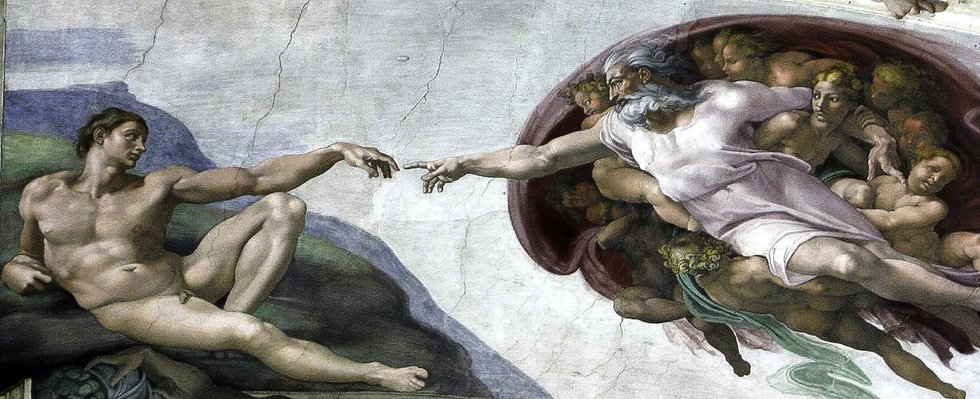 |
| Michaelangelo's "Creation of Man" |
#1 God, infinitely perfect and blessed in himself, in a plan of sheer goodness, freely created man to make him share in his own blessed life. For this reason, at every time and in every place, God draws close to man. He calls man to seek him, to know him, to love him with all his strength. He calls together all men, scattered and divided by sin, into the unity of his family, the Church. To accomplish this, when the fullness of time had come, God sent his Son as Redeemer and Saviour. In his Son and through him, he invites men to become, in the Holy Spirit, his adopted children and thus heirs of his blessed life.
#2 So that this call should resound throughout the world, Christ sent forth the apostles he had chosen, commissioning them to proclaim the gospel: "Go therefore and make disciples of all nations, baptizing them in the name of the Father and of the Son and of the Holy Spirit, teaching them to observe all that I have commanded you; and lo, I am with you always, to the close of the age."4 Strengthened by this mission, the apostles "went forth and preached everywhere, while the Lord worked with them and confirmed the message by the signs that attended it."5
 |
| Christ teaching the Apostles |
#3 Those who with God's help have welcomed Christ's call and freely responded to it are urged on by love of Christ to proclaim the Good News everywhere in the world. This treasure, received from the apostles, has been faithfully guarded by their successors. All Christ's faithful are called to hand it on from generation to generation, by professing the faith, by living it in fraternal sharing, and by celebrating it in liturgy and prayer.6
There is a lot of talk in the Church these days about "changing teaching." This kind of talk is dangerous, especially when it fails to make clear the critical distinction between what is changeable, and what is not, among the Church's many teachings.
The whole of the "deposit of faith" is not changeable. As the quote from the beginning of the CCC shows, it is precisely this core content, revealed by God in the Incarnation, life, Passion, death, and Resurrection of Jesus Christ, as well as in Scripture and Apostolic Tradition, that must be kept whole and intact, and passed on to future generations. Christ Himself commanded that the Apostles (and their successors) do exactly that: preserve and hand on, without change, the teachings ("deposit of faith") He taught them.
 |
| St Bede the Venerable, preserving and proclaiming |
A certain bishop recently said, "We're not a Church of preservation, but rather a Church of proclamation." This is misleading. We certainly are a Church of proclamation, but the only thing we have authority (given by Christ) to proclaim is precisely what has been preserved, namely the apostolic deposit of faith. We're not free to add to it or subtract from it, to alter it, to rearrange its parts into a more pleasing pattern, to hide parts of it behind other parts of it, etc. We are given the mandate by Christ Himself to preserve it, and to hand it on. So, we are also a Church of preservation - not for the sake of preserving as an end in itself, but precisely for the sake of proclaiming something real and true.
So what constitutes that deposit of faith? Here's a brief schematic (following CCC #84 ff):
- Scripture and Tradition - the unchangingness of revealed/inspired Scripture is generally unquestioned, but some modern translations implicitly change the meaning by subordinating the actual text to (transient) cultural norms; "Tradition" tends to be understood rather nebulously, rather than as the concrete set of things the Apostles actually did and taught, and therefore passed on to their immediate successors to be received as essential to faith in Christ. The problem is precisely that Tradition is not written down. But, the synthesis of the Pastristic Fathers and the witness of the medieval and early modern Church does a good job of demonstrating in practice what Tradition really means.

An ecumenical council:
pope and bishops togetherMagisterium - the teaching authority of the Church. It has two and only two explicit duties, for which Christ has given His authority, namely, the preservation of the deposit of faith, and the interpretation of it across time and cultures. There is no authority given to innovate.- defined Dogma - Some aspects of faith are so overarching that they "crystalize" in dogmatic form. Dogma must be present from the beginning, as part of the deposit of faith, but may be demonstrated either from Scripture or from Tradition. Having been defined with full magisterial authority, dogma cannot be changed, and we should not lightly change the formula in which the dogma is expressed. Here's a short list (not trying to be comprehensive):
- Trinity - God is three persons in one substance; God is both transcendent and immanent
- Incarnation - Christ is both fully God and fully man; "remaining what He was, He became what He was not;" He truly suffered and died for our sins; His sacrifice on the Cross is sufficient for our redemption; He truly rose from the dead and took again the body he had previously assumed, now perfected and glorified; He founded the Church He intended to found; etc
- Church - "One, holy, Catholic, and apostolic," with a divinely-intended mission and "constitution," including the authority of the papacy and the episcopate
- Seven Sacraments - hence also the fullness of the liturgy, sacramental grace, the reality of sin and conversion, the necessity of baptism; the baptismal call to holiness; the revealed definition of marriage; the mission of the laity in the world as witnesses and disciples; the clergy
- Four Last Things
- Etc - all of these defined dogmas have numerous further implications for doctrine (positively expressed but not defined with highest authority), which likewise can't be contradicted without calling the dogma into question, as well as for pastoral practice, which likewise can't be contradicted (although there is generally a wide range of pastoral options that don't contradict the dogma)
- "sensus fidei," the actual unity of faith experienced as the instinctive acceptance of what is consistent with Catholic faith, and the instinctive rejection of what isn't - this is a sure guide, to the extent that it matches up with "what Catholics believe, always, everywhere, and by everyone"
- It is a greatly damaging modern conceit that only Catholics today matter, because Catholics in the past weren't "mature" or were "superstitous" or the like. This idea must be rejected as a grave sin of pride, and as a contradiction of the deposit of faith.
- "faith seeking understanding," the actual fullness of truth (sufficient for salvation) of the whole of the one faith, experienced as longing to know and love God by faith, contemplation, and study (study does not have to be formal; pious practices like reading the lives of the saints are also study, in this sense)

 |
| The Lamb of God |
All this content of the deposit of faith is ultimately received from God. Willfully to reject it, modify it, or subordinate it to personal whims or cultural demands is to commit the same sin of pride that caused the fall of the lost angels. (We sometimes do that not willfully, because we are finite beings, and because we are always under pressure from the world, the flesh, and the devil to make compromises. This is what we mean we say "The Church is always in need of reform.") To be faithful to Christ means that we must make every possible effort to receive the deposit of faith entire and uncorrupt (which is given to us with supernatural power in the sacraments and in the Magisterium of all time, so we can actually know it), and also to pass it on by our teaching, our witness, and our piety, likewise entire and uncorrupt.
Wednesday, March 1, 2017
Archbishop Gomez pastoral letter on Human Person
 |
| Archbishop Gomez - photo from www.la-archdiocese.org/archbishop |
Tuesday, January 31, 2017
Prescient 1958 Article by then-Fr. Ratzinger
Fr. Kenneth Baker, SJ, editor-emeritus of Homiletic and Pastoral Review has recently translated and made available an outstanding, and prescient, article from then-Father Joseph Ratzinger (now Pope-Emeritus Benedict XVI), first published in 1958.
It is notable to what extent the problems we continue to wrestle with today were already noticeable in the Church of the "pre-Vatican II" decades. It is also more than noteworthy, with what consistency Ratzinger/Benedict has approached these sorts of issues over the past five decades. What an outstanding thinker and teacher for the Church.
In this article, he supports the now-common practice of admitting to the Sacraments (when no obstacles exist) those weakly or improperly formed Catholics whom he calls "secularized" (I often use the phrase "formed more by the world than by the Church"), when they ask for them. The request itself constitutes some evidence of faith and desire to belong to the Church, however imperfect it may be, and the grace of the Sacraments certainly can aid them in growing in faith over time.
He also notes that this secularization of believers constitutes a tangible challenge for many believers, in that, if a very basic and worldly level of moral commitment, with occasional sacramental participation, is truly sufficient for salvation, then the higher level of commitment to Biblical morality and consistent sacramental participation (including frequent Confession) can be experienced as a burden rather than a grace. The long-term solution for this, he argues, is for the Church to relinquish its "medieval" assumptions of social prestige and place in the world, and return to a "martyrial" distinctiveness - not an opposition to the world, as if all the world outside the Church is evil and bad, but a distinctiveness of "the few" as witness and fulcrum for the lifting up of "the many." He calls this a "de-secularization" of the Church, and notes three (simultaneous) levels or steps:
(1) the sacramental, in which the distinctiveness of the Church's true worship stands over against any materialistic, "magical" thinking about sacramental participation, and therefore invites to a deeper level of conversion;
(2) the proclamation of the faith, in which the distinctiveness of the Church once again supports a clear difference in mode of preaching, between the catechetical (to those in the Church), and the missionary (to those not yet deeply converted) - and this mode has not been heard in the West in many centuries; and
(3) the personal witness, in which the distinctiveness of how the believer lives in the world, especially in the midst of rejection, ridicule, and suffering, stands as clear evidence of the reality and effectiveness of grace.
This core, missionary, and witnessing Church, then, serves ultimately as "priestly people" for the whole world, bringing the salvation of Jesus Christ to the whole world, even those baptized who remain quite worldly, and even those outside the Church, who might respond in any way to the power of God:
"If men and women, indeed the greater number of persons are saved, without belonging in the full sense to the community of the faithful, so then it takes place only because the Church herself exists as the dynamic and missionary reality, because those who have been called to belong to the Church are performing their duty as the few..." (third-to-last paragraph).
If, however, the Church has no such core, no such missionary impulse in the modern world, no such capacity for witness to grace (i.e., "the spirit of Vatican II" church), how shall Christ be proclaimed? If the Church's only mode of worshipping, proclaiming, and living, is "worldly," more or less indistinguishable from everyone else, what is there to inspire to a deeper and greater love?
It is notable to what extent the problems we continue to wrestle with today were already noticeable in the Church of the "pre-Vatican II" decades. It is also more than noteworthy, with what consistency Ratzinger/Benedict has approached these sorts of issues over the past five decades. What an outstanding thinker and teacher for the Church.
In this article, he supports the now-common practice of admitting to the Sacraments (when no obstacles exist) those weakly or improperly formed Catholics whom he calls "secularized" (I often use the phrase "formed more by the world than by the Church"), when they ask for them. The request itself constitutes some evidence of faith and desire to belong to the Church, however imperfect it may be, and the grace of the Sacraments certainly can aid them in growing in faith over time.
He also notes that this secularization of believers constitutes a tangible challenge for many believers, in that, if a very basic and worldly level of moral commitment, with occasional sacramental participation, is truly sufficient for salvation, then the higher level of commitment to Biblical morality and consistent sacramental participation (including frequent Confession) can be experienced as a burden rather than a grace. The long-term solution for this, he argues, is for the Church to relinquish its "medieval" assumptions of social prestige and place in the world, and return to a "martyrial" distinctiveness - not an opposition to the world, as if all the world outside the Church is evil and bad, but a distinctiveness of "the few" as witness and fulcrum for the lifting up of "the many." He calls this a "de-secularization" of the Church, and notes three (simultaneous) levels or steps:
(1) the sacramental, in which the distinctiveness of the Church's true worship stands over against any materialistic, "magical" thinking about sacramental participation, and therefore invites to a deeper level of conversion;
(2) the proclamation of the faith, in which the distinctiveness of the Church once again supports a clear difference in mode of preaching, between the catechetical (to those in the Church), and the missionary (to those not yet deeply converted) - and this mode has not been heard in the West in many centuries; and
(3) the personal witness, in which the distinctiveness of how the believer lives in the world, especially in the midst of rejection, ridicule, and suffering, stands as clear evidence of the reality and effectiveness of grace.
This core, missionary, and witnessing Church, then, serves ultimately as "priestly people" for the whole world, bringing the salvation of Jesus Christ to the whole world, even those baptized who remain quite worldly, and even those outside the Church, who might respond in any way to the power of God:
"If men and women, indeed the greater number of persons are saved, without belonging in the full sense to the community of the faithful, so then it takes place only because the Church herself exists as the dynamic and missionary reality, because those who have been called to belong to the Church are performing their duty as the few..." (third-to-last paragraph).
If, however, the Church has no such core, no such missionary impulse in the modern world, no such capacity for witness to grace (i.e., "the spirit of Vatican II" church), how shall Christ be proclaimed? If the Church's only mode of worshipping, proclaiming, and living, is "worldly," more or less indistinguishable from everyone else, what is there to inspire to a deeper and greater love?
Wednesday, December 7, 2016
Thoughts on "rigidity" and orthodoxy
Twice in as many months (e.g., here and here), Pope Francis has inveighed against "rigid" believers. He uses very negative language against this perceived phenomenon: “They appear good because they follow the Law; but behind, there is something that does not make them good. Either they're bad, hypocrites, or they are sick. They suffer!” Such people are "enslaved," they "lead a double life." They exhibit the opposite of the beatitudes: "Rigidity is not a gift of God. Meekness is; goodness is; benevolence is; forgiveness is. But rigidity isn’t!" He attaches the same label and language to those who know, love, and respect the traditional liturgy: "Pope Francis told Father Spadaro he wonders why some young people, who were not raised with the old Latin Mass, nevertheless prefer it. 'And I ask myself: Why so much rigidity? Dig, dig, this rigidity always hides something, insecurity or even something else. Rigidity is defensive. True love is not rigid.'"
Certainly, the temptation to this sort of "pharisaical" attitude exists in the Church. It is something always to be guarded against. Because of our sacramental forms and theology, it is easy at times to get caught up in the details of the liturgy, and miss the forest (interior and spiritual realities) for the trees (exterior and physical forms, words, symbols). Likewise with the nuances of our moral theology. One can, in this sense, fall into "rigidity." And it is true that rigidity is not loving, and that rigidity resists Christ and grace.
But there is another sort of "rigidity" not often adverted to, although it appears to be far more common, currently. It consists in putting one's own will before God's, insisting that one is right while Tradition, the Church, the Bible, and God Himself must be wrong. St. James says, "Submit yourself to God... If you judge the law, you are not subject to the law." (Jms 4:7, 11). Those who are rigid in this sense judge the law of faith, and do not submit to God in their hearts.
The path of faith always involves conversion. After our initial conversion (which might be as an infant or child in Baptism), we continue to experience "ongoing conversion," as we strive over our whole life to conform our hearts and minds, our loves and desires, to those of Christ. To be united with Christ in this conformity, "putting on the mind of Christ" (Rom 2:12, etc), is precisely what it means to live as a Christian.
The heart experiencing conversion must be humble. It must recognize and accept (even when there is struggle actually to do - concupiscence is a real thing) that what the believer desires, of himself, is likely not what God desires for him, and therefore that one must learn to desire instead what God desires. This softness and pliability of the heart in respect to God's Law, Revelation, commandments and precepts, personal vocation, moral law, and Tradition is properly understood as a sign of strong faith. As the Rule of St. Benedict says in its very first words, "Listen carefully, my son, to the Master's instructions, and attend to them with the ear of your heart... The labor of obedience will bring you back to Him from whom you have drifted by the sloth of disobedience." This is the opposite of rigidity. (See e.g. the parable of the Pharisee and the publican, Lk 18:9-14.)
Rigidity, then, is not only clinging to the exterior forms of religion, which Pope Francis (rightly) decries. The willful rejection of Tradition is equally a form of rigidity (see e.g. Dei Verbum #7-8, etc). It is a hardness of heart with respect to God's calling the believer. It is spiritual pride, asserting in effect that this generation (or even this individual!) knows better what is good for souls than all prior generations, than all prior saints, doctors, mystics of the Church. I don't think it's too strong to say that there's more than a touch of idolatry, of self-worship, in this attitude. (It remains true that much of the rejection and loss of Tradition and faith in the last century is not willful, but from ignorance and weakness.)
Thus, one might correctly say: The idea that external or physical forms (e.g., the construction of a church, the placement of the Tabernacle, the beauty of vestments and statues, etc) don't matter to internal or spiritual realities (faith, union with God, repentance and conversion) is false (e.g. Sacrosanctum Concilium #8, 112-3, 122-5, etc). To cling to this idea in the face of Tradition and correction is to be rigid.
Idem: The idea that Christ did not and does not will the seven Sacraments for the Church, as the primary means of salvific grace for believers, is false (e.g. SC #5-8, Lumen Gentium #7, 11, etc). To cling stubbornly to the opposite idea, that we can meddle with the Sacraments or deny their efficacy, in the face of Tradition and correction, is to be rigid.
Idem: The ideas of moral relativism and religious indifferentism are false (e.g. Dominus Iesus, Fides et Ratio, etc). To insist, in the face of Tradition and correction, that they are true, is to be rigid.
And so forth.... In short, modernism is rigid, but Tradition properly received and loved ("the living faith of the dead," as one great Church historian noted) is life with Christ.
Certainly, the temptation to this sort of "pharisaical" attitude exists in the Church. It is something always to be guarded against. Because of our sacramental forms and theology, it is easy at times to get caught up in the details of the liturgy, and miss the forest (interior and spiritual realities) for the trees (exterior and physical forms, words, symbols). Likewise with the nuances of our moral theology. One can, in this sense, fall into "rigidity." And it is true that rigidity is not loving, and that rigidity resists Christ and grace.
But there is another sort of "rigidity" not often adverted to, although it appears to be far more common, currently. It consists in putting one's own will before God's, insisting that one is right while Tradition, the Church, the Bible, and God Himself must be wrong. St. James says, "Submit yourself to God... If you judge the law, you are not subject to the law." (Jms 4:7, 11). Those who are rigid in this sense judge the law of faith, and do not submit to God in their hearts.
The path of faith always involves conversion. After our initial conversion (which might be as an infant or child in Baptism), we continue to experience "ongoing conversion," as we strive over our whole life to conform our hearts and minds, our loves and desires, to those of Christ. To be united with Christ in this conformity, "putting on the mind of Christ" (Rom 2:12, etc), is precisely what it means to live as a Christian.
The heart experiencing conversion must be humble. It must recognize and accept (even when there is struggle actually to do - concupiscence is a real thing) that what the believer desires, of himself, is likely not what God desires for him, and therefore that one must learn to desire instead what God desires. This softness and pliability of the heart in respect to God's Law, Revelation, commandments and precepts, personal vocation, moral law, and Tradition is properly understood as a sign of strong faith. As the Rule of St. Benedict says in its very first words, "Listen carefully, my son, to the Master's instructions, and attend to them with the ear of your heart... The labor of obedience will bring you back to Him from whom you have drifted by the sloth of disobedience." This is the opposite of rigidity. (See e.g. the parable of the Pharisee and the publican, Lk 18:9-14.)
Rigidity, then, is not only clinging to the exterior forms of religion, which Pope Francis (rightly) decries. The willful rejection of Tradition is equally a form of rigidity (see e.g. Dei Verbum #7-8, etc). It is a hardness of heart with respect to God's calling the believer. It is spiritual pride, asserting in effect that this generation (or even this individual!) knows better what is good for souls than all prior generations, than all prior saints, doctors, mystics of the Church. I don't think it's too strong to say that there's more than a touch of idolatry, of self-worship, in this attitude. (It remains true that much of the rejection and loss of Tradition and faith in the last century is not willful, but from ignorance and weakness.)
Thus, one might correctly say: The idea that external or physical forms (e.g., the construction of a church, the placement of the Tabernacle, the beauty of vestments and statues, etc) don't matter to internal or spiritual realities (faith, union with God, repentance and conversion) is false (e.g. Sacrosanctum Concilium #8, 112-3, 122-5, etc). To cling to this idea in the face of Tradition and correction is to be rigid.
Idem: The idea that Christ did not and does not will the seven Sacraments for the Church, as the primary means of salvific grace for believers, is false (e.g. SC #5-8, Lumen Gentium #7, 11, etc). To cling stubbornly to the opposite idea, that we can meddle with the Sacraments or deny their efficacy, in the face of Tradition and correction, is to be rigid.
Idem: The ideas of moral relativism and religious indifferentism are false (e.g. Dominus Iesus, Fides et Ratio, etc). To insist, in the face of Tradition and correction, that they are true, is to be rigid.
And so forth.... In short, modernism is rigid, but Tradition properly received and loved ("the living faith of the dead," as one great Church historian noted) is life with Christ.
Friday, August 26, 2016
Lessons of the Early Church
I am the Catholic I am, in large part because of the martyrs of the early Church. Their faith shamed my lack of faith, and understanding why they felt it was worth sacrificing the world for the sake of Heaven gave me the impetus to return to the Church as the only way to salvation. Now, the Church needs their witness again, as the world around us seems primed to descend into a new paganism.
The Christian refusal to cooperate with pagan Roman society was rooted in three connected things: (1) The Roman Empire was inherently idolatrous. Civic participation required participation in pagan ritual worship. Oaths of office required the same, to be a soldier, a teacher, etc., not just for politicians. (2) The reality of (unjust) persecution. Romans persecuted Christians mostly because they saw Christian faith as "atheism" and "innovation," two things that threatened the stability and success of the Empire as a whole. But as Tertullian famously pointed out in his Apologeticum, forcing Christians to worship other gods by violence made that worship ineffective for the good of the Empire. (3) Idolatry and unjust persecution represented abuses of power by the Empire. All worldly authority comes ultimately from God, as Paul argued. Its uses must therefore conform at least to natural law standards of justice. That the Empire abused its power in these (and other) ways justified Christian non-participation.
This line of argument, which permeated Christian thought for two centuries, has been buried under other understandings of the Church's relationship to a world seemingly cooperative rather than repressive. The successful evangelization of the West and the creation of Christendom meant that we didn't need to think much about things that support a Christianity of non-participation. But we have this treasure somewhere in the attic, not entirely lost or forgotten. If we confront the increasingly hostile world only with the lessons of cooperative Christendom, we will probably lose. We need the lessons of conflict as well, distilled from that earlier Christian experience of martyrdom.
Here are three of those critical lessons.
1. The world can never provide an avenue of salvation. This should be obvious to Christ's disciples. Only God can forgive sins; only God can save souls; our ultimate homeland is not earth, but Heaven. But in contrast, it's a key plank of modernism, more or less obvious in all three of its branches (liberal democracy, Communism, and fascism), that the State aspires to become all-in-all, the "savior," in a sense. In fascism, it does so directly. In Communism, it does so as the mediating institution of the people's revolutionary will. In liberal democracy, it does so more subtly, as the mediating institution between conflicts of rights and powers; but over time, its mediation inevitably expands and coems to dominate everything else. In all three, "scientism" promises imminent salvation from all the suffering and evils of the world.
Any uncritical acceptance of modernism, then, implicitly accepts the (false) claim that the State exercises the highest and most decisive form of authority. This claim tends to be not merely political, but also moral (i.e., abusing God-given authority!). It rejects, more or less explicitly, a traditional, Bible-informed moral vision. Acceptance of modernism therefore also means accepting the relegation of religion to the private sphere only. The moral verities and priorities of the culture (which are, in terms of Christian Revelation, not true) come to be enforced as true, and any serious objection to them is firmly punished, at least socially (loss of status, respect, jobs, friends, etc), possibly legally (fines, jail, the police showing up in the middle of the night to investigate your family, etc), and even (sometimes) fatally.
If we accept, even implicitly, that the world offers salvation within itself, we cannot be Christians. We must stand firmly and intentionally in the core Christian claim of salvation through Christ alone. Short of martyrdom, we do this especially in our (public) worship. Worship focused on God (as in traditional modes) demonstrates our conviction, and teaches spiritual salvation. Worship focused on ourselves (as in "theater in the round" church design, or hymns all about us or making us speak in God's first person voice, etc.) opens the door to implicit acceptance of the lie of the world saves itself.
2. Forms of idolatry must be clearly rebuked. The Church of the martyrs taught clearly and consistently to all its members that cooperation with idolatry leads to loss of saving relationship with Christ. It wasn't just pagan rituals that were identified, it was a whole host of public or civic activities or positions that were inherently idolatrous - teachers and soldiers, attending theater or civic games, etc etc. This process of identifying and rebuking forms of participation in idolatry was very successful.
Pope St. John Paul II, for one example, did an excellent job throughout his pontificate (and even before) of doing the equivalent for us today. We don't tend to think in terms of "idolatry" today, but the moral equivalent corrupting the Church and society is "secularism" (and similar labels). A creeping domination of "secular" ideas in all spheres of life is intent on displacing any Biblical or natural-law-based cultural patrimony in the West. This is especially apparent at the moment in issues of sexuality and family, or education policy, for example. Pope St. John Paul II showed us how to parse the good and the bad in all such conflicts, and having identified the elements or ideas inconsistent with truth and therefore unacceptable to Christians, he rebuked ideas without condemning people.
The more we conform ourselves to the mores of the world, the more this creeping secularism insinuates itself into our faith. Pope St. John Paul II told us constantly, "Be not afraid!" Short of martyrdom, we can be clear and consistent in our rejection of modern forms of idolatry by fearlessly knowing the truth (virtue of faith), living the truth (virtue of hope), and speaking the truth (virtue of love) - always with charity and mercy. It is, in fact, the visibility of the true charity and mercy of Christ in our lives that can attract those mired in worldly idolatry.
3. Faith in Christ is the greatest treasure. If we look to the world for our salvation (even unconsciously), and fall into secular (idolatrous) modes of thinking, we will inevitably undervalue our faith. This doesn't necessarily mean we will lose our faith entirely, but we won't have much motive for living it out consistently. We will be "secular Christians," who, even when we go every Sunday to worship God, live the rest of the week as if Christ doesn't matter to us. We will be "formed by the culture" rather than "formed by the Church." We will have fallen into the trap of privatizing our faith - which is precisely what the totalizing, secular world demands of us.
Pope Benedict XVI understood this dynamic deeply. So much of his pontificate was aimed at enflaming our faith anew, at helping us realize just what an inestimable treasure faith in Christ actually is. Nobody is attracted to a faith that seems not to matter even to its regular practitioners! Only those who are on fire for God have the chance to spread the fire to others. Only those who, by how they live in every sphere of life, clearly value above other things the love of God can proclaim the value of that love.
If it's true, finally, that "the blood of the martyrs is the seed of the Church," then our evangelizing efforts can only bear fruit if we first die to self, and to the world, and live only in Christ.
 |
| Martyrdom of St. Polycarp - "Away with the atheists!" |
This line of argument, which permeated Christian thought for two centuries, has been buried under other understandings of the Church's relationship to a world seemingly cooperative rather than repressive. The successful evangelization of the West and the creation of Christendom meant that we didn't need to think much about things that support a Christianity of non-participation. But we have this treasure somewhere in the attic, not entirely lost or forgotten. If we confront the increasingly hostile world only with the lessons of cooperative Christendom, we will probably lose. We need the lessons of conflict as well, distilled from that earlier Christian experience of martyrdom.
Here are three of those critical lessons.
1. The world can never provide an avenue of salvation. This should be obvious to Christ's disciples. Only God can forgive sins; only God can save souls; our ultimate homeland is not earth, but Heaven. But in contrast, it's a key plank of modernism, more or less obvious in all three of its branches (liberal democracy, Communism, and fascism), that the State aspires to become all-in-all, the "savior," in a sense. In fascism, it does so directly. In Communism, it does so as the mediating institution of the people's revolutionary will. In liberal democracy, it does so more subtly, as the mediating institution between conflicts of rights and powers; but over time, its mediation inevitably expands and coems to dominate everything else. In all three, "scientism" promises imminent salvation from all the suffering and evils of the world.
 |
| Reductio ad absurdum of acceptance of modernism. |
 |
| A different acceptance of modernism - no less absurd. |
2. Forms of idolatry must be clearly rebuked. The Church of the martyrs taught clearly and consistently to all its members that cooperation with idolatry leads to loss of saving relationship with Christ. It wasn't just pagan rituals that were identified, it was a whole host of public or civic activities or positions that were inherently idolatrous - teachers and soldiers, attending theater or civic games, etc etc. This process of identifying and rebuking forms of participation in idolatry was very successful.
Pope St. John Paul II, for one example, did an excellent job throughout his pontificate (and even before) of doing the equivalent for us today. We don't tend to think in terms of "idolatry" today, but the moral equivalent corrupting the Church and society is "secularism" (and similar labels). A creeping domination of "secular" ideas in all spheres of life is intent on displacing any Biblical or natural-law-based cultural patrimony in the West. This is especially apparent at the moment in issues of sexuality and family, or education policy, for example. Pope St. John Paul II showed us how to parse the good and the bad in all such conflicts, and having identified the elements or ideas inconsistent with truth and therefore unacceptable to Christians, he rebuked ideas without condemning people.
March for Life 2013 - excellent example of rebuking without condemning
The more we conform ourselves to the mores of the world, the more this creeping secularism insinuates itself into our faith. Pope St. John Paul II told us constantly, "Be not afraid!" Short of martyrdom, we can be clear and consistent in our rejection of modern forms of idolatry by fearlessly knowing the truth (virtue of faith), living the truth (virtue of hope), and speaking the truth (virtue of love) - always with charity and mercy. It is, in fact, the visibility of the true charity and mercy of Christ in our lives that can attract those mired in worldly idolatry.
3. Faith in Christ is the greatest treasure. If we look to the world for our salvation (even unconsciously), and fall into secular (idolatrous) modes of thinking, we will inevitably undervalue our faith. This doesn't necessarily mean we will lose our faith entirely, but we won't have much motive for living it out consistently. We will be "secular Christians," who, even when we go every Sunday to worship God, live the rest of the week as if Christ doesn't matter to us. We will be "formed by the culture" rather than "formed by the Church." We will have fallen into the trap of privatizing our faith - which is precisely what the totalizing, secular world demands of us.
 |
| Pope Benedict XVI Adoring our Lord Jesus Christ |
If it's true, finally, that "the blood of the martyrs is the seed of the Church," then our evangelizing efforts can only bear fruit if we first die to self, and to the world, and live only in Christ.
Thursday, September 24, 2015
Pope Francis in America - Homily, Midday Prayer with the Bishops, 9/23
This is, I think, the clearest, most comprehensive articulation that I've seen, of what Pope Francis is trying to do as Pope. Some of his actions and words have, at times, been seen with confusion and ambiguity. His "style" can be abrupt and imprecise, especially in comparison with his two immediate predecessors. But here, there is nothing unclear or objectionable in what he's laying out, and there is a full embrace of Tradition, just as I also embrace, believe, and strive to act. Especially, his words here are full of charity and joy, as he invites his brother bishops (and, through them, all of us) again to work with him in the vineyard of Christ. Read the whole thing at the above link.
Some highlights:
The heart of the Pope expands to include everyone. To testify to the immensity of God’s love is the heart of the mission entrusted to the Successor of Peter, the Vicar of the One who on the cross embraced the whole of mankind. May no member of Christ’s Body and the American people feel excluded from the Pope’s embrace. Wherever the name of Jesus is spoken, may the Pope’s voice also be heard to affirm that: “He is the Savior”! From your great coastal cities to the plains of the Midwest, from the deep South to the far reaches of the West, wherever your people gather in the Eucharistic assembly, may the Pope be not simply a name but a felt presence, sustaining the fervent plea of the Bride: “Come, Lord!” Whenever a hand reaches out to do good or to show the love of Christ, to dry a tear or bring comfort to the lonely, to show the way to one who is lost or to console a broken heart, to help the fallen or to teach those thirsting for truth, to forgive or to offer a new start in God… know that the Pope is at your side, the Pope supports you. He puts his hand on your own, a hand wrinkled with age, but by God’s grace still able to support and encourage.
Some highlights:
 |
| www.gettyimages.com |
I speak to you as the Bishop of Rome, called by God in old age, and from a land which is also American, to watch over the unity of the universal Church and to encourage in charity the journey of all the particular Churches toward ever greater knowledge, faith and love of Christ. Reading over your names, looking at your faces, knowing the extent of your churchmanship and conscious of the devotion which you have always shown for the Successor of Peter, I must tell you that I do not feel a stranger in your midst. I am a native of a land which is also vast, with great open ranges, a land which, like your own, received the faith from itinerant missionaries. I too know how hard it is to sow the Gospel among people from different worlds, with hearts often hardened by the trials of a lengthy journey. Nor am I unaware of the efforts made over the years to build up the Church amid the prairies, mountains, cities and suburbs of a frequently inhospitable land, where frontiers are always provisional and easy answers do not always work. What does work is the combination of the epic struggle of the pioneers and the homely wisdom and endurance of the settlers. As one of your poets has put it, “strong and tireless wings” combined with the wisdom of one who “knows the mountains”.
 |
| www.gettyimages.com |
We are bishops of the Church, shepherds appointed by God to feed his flock. Our greatest joy is to be shepherds, and only shepherds, pastors with undivided hearts and selfless devotion. We need to preserve this joy and never let ourselves be robbed of it. The evil one roars like a lion, anxious to devour it, wearing us down in our resolve to be all that we are called to be, not for ourselves but in gift and service to the “Shepherd of our souls” (1 Pet 2:25). The heart of our identity is to be sought in constant prayer, in preaching (Acts 6:4) and in shepherding the flock entrusted to our care (Jn 21:15-17; Acts 20:28-31). Ours must not be just any kind of prayer, but familiar union with Christ, in which we daily encounter his gaze and sense that he is asking us the question: “Who is my mother? Who are my brothers?” (Mk 3:31-34). One in which we can calmly reply: “Lord, here is your mother, here are your brothers! I hand them over to you; they are the ones whom you entrusted to me”. Such trusting union with Christ is what nourishes the life of a pastor.
The great mission which the Lord gives us is one which we carry out in communion, collegially. The world is already so torn and divided, brokenness is now everywhere. Consequently, the Church, “the seamless garment of the Lord” cannot allow herself to be rent, broken or fought over. Our mission as bishops is first and foremost to solidify unity, a unity whose content is defined by the Word of God and the one Bread of Heaven. With these two realities each of the Churches entrusted to us remains Catholic, because open to, and in communion with, all the particular Churches and with the Church of Rome which “presides in charity”. It is imperative, therefore, to watch over that unity, to safeguard it, to promote it and to bear witness to it as a sign and instrument which, beyond every barrier, unites nations, races, classes and generations.
Thursday, May 15, 2014
Apostolic Succession: Thoughts on the Feast of St. Matthias, 14 May
Yesterday was the Feast of St. Matthias, the one chosen in Acts 1:15-26 to take the place of Judas among the Twelve. I preached on how this demonstrates Apostolic Succession, and what that means for our faith today. This is an extended version of what I preached about, more in the form of reflections than the homily was.
Here's the text, according to the Douay-Rheims version:
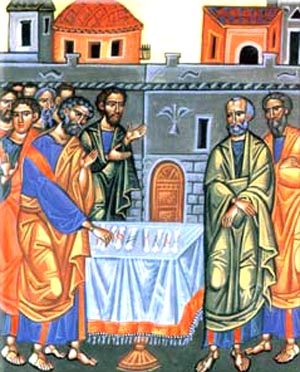 In those days Peter rising up in the midst of the brethren, said (now
the number of persons together was about an hundred and twenty): Men, brethren, the scripture must needs be fulfilled, which the Holy
Ghost spoke before by the mouth of David concerning Judas, who was the
leader of them that apprehended Jesus: Who was numbered with us, and had obtained part of this ministry... For it is written in the book of Psalms: Let their habitation become
desolate, and let there be none to dwell therein [Ps 69 (68):26]. And his bishopric [Vulg "episcopatum;" LXX "επισκοπήν, episcopen"] let
another take [Ps 109 (108):8]. Wherefore of these men who have companied with us, all the time that the Lord Jesus came in and went out among us, Beginning from the baptism of John, until the day wherein he was taken
up from us, one of these must be made a witness with us of his
resurrection. And they appointed two, Joseph, called Barsabas, who was surnamed Justus, and Matthias. And praying, they said: Thou, Lord, who knowest the heart of all men, shew whether of these two thou hast chosen, To take the place of this ministry and apostleship, from which Judas
hath by transgression fallen, that he might go to his own place. And they gave them lot, and the lot fell upon Matthias, and he was numbered with the eleven apostles.
In those days Peter rising up in the midst of the brethren, said (now
the number of persons together was about an hundred and twenty): Men, brethren, the scripture must needs be fulfilled, which the Holy
Ghost spoke before by the mouth of David concerning Judas, who was the
leader of them that apprehended Jesus: Who was numbered with us, and had obtained part of this ministry... For it is written in the book of Psalms: Let their habitation become
desolate, and let there be none to dwell therein [Ps 69 (68):26]. And his bishopric [Vulg "episcopatum;" LXX "επισκοπήν, episcopen"] let
another take [Ps 109 (108):8]. Wherefore of these men who have companied with us, all the time that the Lord Jesus came in and went out among us, Beginning from the baptism of John, until the day wherein he was taken
up from us, one of these must be made a witness with us of his
resurrection. And they appointed two, Joseph, called Barsabas, who was surnamed Justus, and Matthias. And praying, they said: Thou, Lord, who knowest the heart of all men, shew whether of these two thou hast chosen, To take the place of this ministry and apostleship, from which Judas
hath by transgression fallen, that he might go to his own place. And they gave them lot, and the lot fell upon Matthias, and he was numbered with the eleven apostles.
This passage clearly shows us the criteria in the minds of the earliest disciples, including the Apostles, even before Pentecost, of what would come to be called "apostolic succession." I've highlighted the key passages:
 What all of this shows is the critical importance of the doctrine of apostolic succession for the Catholic faith. Jesus Christ gave specific teachings, spiritual gifts and powers, and a share in His own authority to the Twelve. They in turned passed the same "inheritance" on, intact and unchanged, to Matthias and others (e.g. Timothy, etc.). They in turn used the gifts for the same purpose (i.e. "ministry," namely, proclamation of the Good News, leadership of the Church in unity under Peter and his eventual successors, and the sacraments (e.g., baptism, Acts 2:38; Confirmation, Acts 8:14-17; Eucharist, Acts 2:46, I Cor 11:20; anointing, Jas 5:14-15; ordaining by laying on of hands, Acts 6:6, I Tim 5:22; witnessing marriages "in the Lord," I Cor 7:39; forgiving sins (but private auricular confession becomes normal for the use of this power only later), Acts 3:19, 26; 4:4...).
Therefore, we must recognize the fact that the Church exists from its beginning in Christ, in its fullness! (See CCC 771ff.) Christ gives everything necessary to the Church, in the beginning, completely. Now, granted, there is the historical work of "unpacking" the fullness of this gift, doctrinally, sacramentally and liturgically, and in evangelization of the whole world, and indeed that unpacking continues even today. But it is the unfolding of what has already been given, not the creation or invention of new divine gifts and revelations.
 It's precisely this apostolic succession that ensures that we're dealing with the same divine deposit of faith, and not inventing new things for ourselves. This is the essential argument of Irenaeus against Gnosticism, for example, and it has been deployed many times. If the Eucharist does not come from the hands of Christ Himself at the Last Supper, then the Church invented it, and it is not essential or divinely intended. If Holy Orders do not come from the hands and will of Christ Himself, through the Apostles (choosing Matthias, choosing the Seven in Acts 6, Paul choosing Timothy, etc), then the Church invented these roles and rules, and they are not essential or divinely intended. And so forth. This is exactly what we mean when we say in the Creed that we believe the Church to be "apostolic" as one of its defining realities.
This doctrine is part of the faith we receive in baptism, but it is not, in the strict sense, a "mystery." It is not impenetrable, nor does it exceed reason to consider in what way, precisely, as recorded in the New Testament and as lived out in the history of the Church, the concrete and tangible gifts of ministry were given by Christ to the Apostles, and were used by them in the first three decades of the Church, and were handed on intact by them to their successors, to be used still further for the building up of the Church, and so on. It is entirely rational and historical to grasp this part of the faith, and to apply it to the realities of the seven Sacraments, the Church's worship in general, the moral life, and the life of charity. The great apologists of the second century - e.g., Irenaeus, Justin Martyr, Tertullian, Clement of Alexandria - did exactly that in defending apostolicity against both Roman (pagan) syncretism and Gnostic mythologization, and others since have imitated them.
But contrast this understanding of faith against the most common assumption or model of the modern world, namely, "evolution." Modern thought implicitly assumes that everything follows the pattern of evolution gleaned from biology - of more primitive things becoming more complex over time, following certain common patterns and driven not by clear purpose or teleology, but by "survival" or "fitness" in a specific context, or by mere self-perpetuation in some form. Nearly every example of adaptation or change over time is squeezed in this evolutionary model, regardless of whether that actually helps understanding or not.
In terms of Church history, the imposition of the evolutionary model since the 19th century has led to many "non-traditional" arguments and conclusions, some of which are extremely damaging to the faith. For a lesser example, arguments that Mark's Gospel is earlier than Matthew's essentially boil down to the claim that it must be earlier because it's shorter (= the more primitive form). (There's a bit more to the argument than that, especially that so much of Mark is in Matthew, but not as much in reverse. Still, some good arguments for Matthew's being earlier are not given as much attention, because they don't fit the model.) There are many other, more serious ways in which the imposition of the evolutionary model distorts our understanding of faith. Most insidious is the idea that opposes "the Jesus of history" (primitive form) against "the Christ of faith" (later complex form), and ends with denying the divinity of Jesus itself!
In terms of the doctrine of apostolic succession, especially, the evolutionary model is completely the wrong one to use. Still, it is all too common to assume that more primitive forms of ministry must have preceded later forms, such that, in the first decades of the Church, it's not really possible to talk of "bishops," of Peter as "Pope," of the "sacraments" (apart from baptism, and the "breaking of bread," which is not yet the "Eucharist"), of a coherent body of doctrine (apart from a few elements labelled "the primitive kerygma"), etc. The dissimilarities between the earliest Church and the "post-Apostolic" Church are just too great, it is argued, to use these later terms and institutions to describe what's going on in the "primitive form" of the earliest Church. If these fit even in the earliest Church, then they're not really primitive forms - but, it's just impossible (it is assumed) to explain how fully developed forms of things can exist without more primitive predecessors.
But the problem with this conclusion is precisely that it is not consonant with faith in Christ, as noted above. If Christ did not will and give the essential aspects of these things to the Apostles, then they are not constitutive of the Church! If they are not willed and given by Christ to the Apostles, then there is no divine power behind them. Baptism doesn't really wash away sins, it's just a symbol. Priestly ordination doesn't really give a man a sacred power to change bread and wine into Christ's own Body and Blood, it's just a symbol of leadership, possibly even a corrupt and politicized one. The faith which is proclaimed doesn't have to be the same one that was proclaimed by earlier generations of Christians; it can even contradict what was previously believed. Even Scripture itself is undermined, since divine authorship is incompatible with the evolutionary model, and the Canon of the New Testament is therefore a political side-effect of Church history, and thus also one which a new politics could redefine. In the end, imposing an evolutionary model on the Church destroys apostolic succession and many other central doctrines, and makes us all into feckless false believers in empty, meaningless symbols.
I ended my homily with an exhortation to ask the intercession of St. Matthias and the other Apostles to increase our faith and strengthen our witness. If we don't believe in a robust doctrine of the Church and her dependance on Christ and the Apostles, if we don't accept that there is a true and unchanging apostolic deposit of faith which we must believe, live, and transmit to others unchanged, then in the end, we don't really believe in Christ as "the one Mediator between God and men." God save us from such a puny and selfish thing!
Here's the text, according to the Douay-Rheims version:
This passage clearly shows us the criteria in the minds of the earliest disciples, including the Apostles, even before Pentecost, of what would come to be called "apostolic succession." I've highlighted the key passages:
- Peter rising up... - It's Peter's role as the leader of the Twelve to take this action. Right from the beginning, Peter has a distinctive leadership among the Apostles, rooted in the events of Mt 16:18-19 ("You are Peter, and on this rock...") and Jn 21:15-17 ("Do you love me? Feed my sheep." (thrice)). The first several chapters of Acts bear this out. When Peter eventually becomes Bishop of Rome, this headship will be exercised by his successors, Linus, Cletus, Clement (e.g., in his Letter to the Corinthians), etc., and become the basis of papal authority over the whole Church.
- ...the scripture must needs be fulfilled... - The action described here is explicitly understood to be divinely inspired, both in the action of the Holy Spirit among the community prompting Peter's leadership, the community's responses, and the eventual choice of Matthias - note, again, this is before Pentecost! - and in the Scriptural foundation now revealed to be a prophetic preparation for this moment. God is in charge, and therefore the whole doctrine of apostolic succession is "of God."
- And his bishopric let another take... - The divine shape of the office of bishop is, in is essence, also rooted in Scripture and in the use Christ and (here) the Holy Spirit make of it. Peter uses Ps 109 to call the position held by Judas and now to be given to another the "episcopate." In the Greek and in the Latin, the connotation is not generic, such as "manager" for us today is generic, but something with more specific, even if still flexible, outlines, function, and purpose.
- ...one of these must be made a witness... - part of the essence of the office being given is that of witness, of one who can proclaim the Good News and the Kingdom as an eyewitness and credible testifier.
- ...a witness with us... - the unity of the Twelve in this mission, among themselves and together with Peter their leader, is paramount. This is still true today; see e.g., Lumen Gentium 18: "This Sacred Council, following closely in the footsteps of the First Vatican Council, with that Council teaches and declares that Jesus Christ, the eternal Shepherd, established His holy Church, having sent forth the apostles as He Himself had been sent by the Father; and He willed that their successors, namely the bishops, should be shepherds in His Church even to the consummation of the world. And in order that the episcopate itself might be one and undivided, He placed Blessed Peter over the other apostles..." etc.
- ...a witness with us of his resurrection. - The bedrock of the Gospel is the Resurrection of Christ from the dead. It's not just that Jesus worked miracles, or taught a moral law, or challenged corrupt or lax religious authority, but most especially that He died and rose for us, that makes Christianity what it is. One cannot proclaim or follow Christ without proclaiming and following the (hope of) the Resurrection. Knowing and following the Lord Jesus must make this kind of difference in one's life.
- ...take the place of this ministry and apostleship... - Again, Peter and the Apostles are giving this task of proclaiming a specific authority and shape with this sort of terminology. Their role in the Church is different from that of other disciples, even if they are still disciples first, as Ignatius of Antioch would say (Letter to the Romans, 4). "Ministry," in particular, although it can often be a more generic word, takes on a specific, non-generic connotation in relation to the Resurrection of Christ, and the proclamation of that Good News by the Church (see e.g. Paul's usage in Rom 15:16: "That I should be the minister of Christ Jesus among the Gentiles: sanctifying the gospel of God, that the oblation of the Gentiles may be made acceptable and sanctified in the Holy Ghost.") Here, Gospel proclamation and Eucharistic sacrifice are explicitly linked in "the ministry of Christ."
- ...he was numbered with the eleven apostles. - In other words, Matthias held an equal position with the other Apostles, under the leadership of Peter, even though he was given this position by them, and not, as they originally were or as Paul would be, by Christ Himself. The fullness of Christ gifts to the Apostles are still held by Matthias - and by extension, by all those chosen by the Apostles and by their successors.
Therefore, we must recognize the fact that the Church exists from its beginning in Christ, in its fullness! (See CCC 771ff.) Christ gives everything necessary to the Church, in the beginning, completely. Now, granted, there is the historical work of "unpacking" the fullness of this gift, doctrinally, sacramentally and liturgically, and in evangelization of the whole world, and indeed that unpacking continues even today. But it is the unfolding of what has already been given, not the creation or invention of new divine gifts and revelations.
This doctrine is part of the faith we receive in baptism, but it is not, in the strict sense, a "mystery." It is not impenetrable, nor does it exceed reason to consider in what way, precisely, as recorded in the New Testament and as lived out in the history of the Church, the concrete and tangible gifts of ministry were given by Christ to the Apostles, and were used by them in the first three decades of the Church, and were handed on intact by them to their successors, to be used still further for the building up of the Church, and so on. It is entirely rational and historical to grasp this part of the faith, and to apply it to the realities of the seven Sacraments, the Church's worship in general, the moral life, and the life of charity. The great apologists of the second century - e.g., Irenaeus, Justin Martyr, Tertullian, Clement of Alexandria - did exactly that in defending apostolicity against both Roman (pagan) syncretism and Gnostic mythologization, and others since have imitated them.
But contrast this understanding of faith against the most common assumption or model of the modern world, namely, "evolution." Modern thought implicitly assumes that everything follows the pattern of evolution gleaned from biology - of more primitive things becoming more complex over time, following certain common patterns and driven not by clear purpose or teleology, but by "survival" or "fitness" in a specific context, or by mere self-perpetuation in some form. Nearly every example of adaptation or change over time is squeezed in this evolutionary model, regardless of whether that actually helps understanding or not.
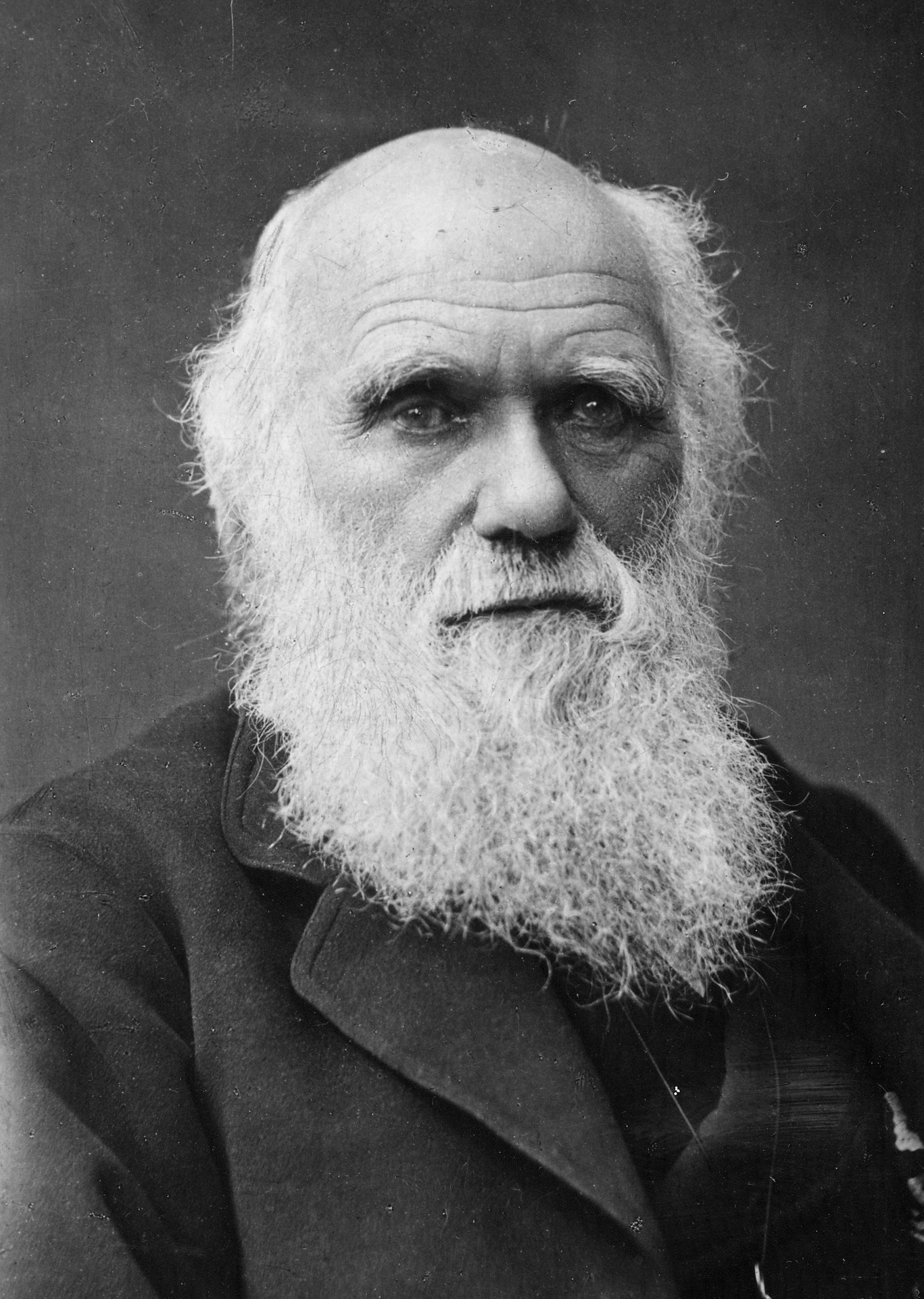 | |
| Darwin might look like a prophet, but he's a poor theologian. |
In terms of the doctrine of apostolic succession, especially, the evolutionary model is completely the wrong one to use. Still, it is all too common to assume that more primitive forms of ministry must have preceded later forms, such that, in the first decades of the Church, it's not really possible to talk of "bishops," of Peter as "Pope," of the "sacraments" (apart from baptism, and the "breaking of bread," which is not yet the "Eucharist"), of a coherent body of doctrine (apart from a few elements labelled "the primitive kerygma"), etc. The dissimilarities between the earliest Church and the "post-Apostolic" Church are just too great, it is argued, to use these later terms and institutions to describe what's going on in the "primitive form" of the earliest Church. If these fit even in the earliest Church, then they're not really primitive forms - but, it's just impossible (it is assumed) to explain how fully developed forms of things can exist without more primitive predecessors.
But the problem with this conclusion is precisely that it is not consonant with faith in Christ, as noted above. If Christ did not will and give the essential aspects of these things to the Apostles, then they are not constitutive of the Church! If they are not willed and given by Christ to the Apostles, then there is no divine power behind them. Baptism doesn't really wash away sins, it's just a symbol. Priestly ordination doesn't really give a man a sacred power to change bread and wine into Christ's own Body and Blood, it's just a symbol of leadership, possibly even a corrupt and politicized one. The faith which is proclaimed doesn't have to be the same one that was proclaimed by earlier generations of Christians; it can even contradict what was previously believed. Even Scripture itself is undermined, since divine authorship is incompatible with the evolutionary model, and the Canon of the New Testament is therefore a political side-effect of Church history, and thus also one which a new politics could redefine. In the end, imposing an evolutionary model on the Church destroys apostolic succession and many other central doctrines, and makes us all into feckless false believers in empty, meaningless symbols.
I ended my homily with an exhortation to ask the intercession of St. Matthias and the other Apostles to increase our faith and strengthen our witness. If we don't believe in a robust doctrine of the Church and her dependance on Christ and the Apostles, if we don't accept that there is a true and unchanging apostolic deposit of faith which we must believe, live, and transmit to others unchanged, then in the end, we don't really believe in Christ as "the one Mediator between God and men." God save us from such a puny and selfish thing!
 |
| "Christ taking leave of the Apostles," Duccio di Buoninsegna ca. 1311, in the Museo dell'Opera del Duomo, Siena |
Wednesday, February 12, 2014
Homily for 12 Feb 2014, Wednesday of the Fifth Week in Ordinary Time
The Old Testament reading today is the visit of the Queen of Sheba to King Solomon, 1 Kgs 10:1-10. Here's the homily I preached, as well as I can remember and reconstruct.
In our first reading today, King Solomon stands as a type of Christ. We are particularly invited in this
passage to consider first his wisdom, like that of Christ. King Solomon's wisdom of course was exceptional, although merely human, while Christ's wisdom is divine and perfect. But Solomon's wisdom is of God, and points us toward the more perfect wisdom of our Lord. Because of his wisdom, he kept his kingdom in peace for many years, and gave justice and good laws. Christ does the same, more perfectly, for His Church and for His kingdom.
We're also invited to consider Solomon as the builder of the temple in Jerusalem. Again, he foreshadows the temple Christ builds, which is His Church, His own Body. We want to participate in the worship that takes place in Christ's temple, and so here we are at this Holy Mass.
This passage also offers us the figure of the Queen of Sheba. She is a more worldly ruler than Solomon, very rich and powerful and successful in her own kingdom. But she's not a negative example of the world, because she does come to Solomon to exchange gifts and confirm peace. Rather, she stands in relation to Solomon in very much the way we stand in relation to Christ. She's heard of his extraordinary wisdom, his goodness and justice, and she's interested, but she can't quite believe that all this could be completely true. We too sometimes hesitate to believe fully in the perfect wisdom, mercy, and goodness of Jesus Christ - although we have faith, certainly; yet sometimes we're reluctant to lower our guard, to set aside our reservations, and give ourselves totally to Christ. Like her, it may seem to us that the forgiveness or the providence of Christ is just too good to be true.
So the queen comes to Solomon to test him, to see if he really is what has been reported. And she is convinced by what she finds, and so she gives him all the gifts that she has prepared for him, if it turns out to be true. We can do the same. We don't need to test Christ, but we can come to him and listen to His wisdom, to His Word, and see how it satisfies us. We can come before Him with our faith, and strive to set aside our worldly defenses and hesitations. We can do the hard work of deeper interior conversion in order to be more open to Him, to His grace and His perfect will. And we do this especially in prayer, and in the sacraments.
When we do this, we usually see that Christ really is our perfect king and savior. What is reported of Him is not exaggerated! He is the one, the only one, who can offer us pure mercy, the redemption of our sins. And therefore, like the queen, we should give Him the gifts we have prepared. It's significant that she gives to Solomon gifts of gold and spices - the same gifts which the Magi offer to the infant Christ in Bethlehem. In both cases, the gift of gold represents Christ's kingship, and therefore to give Christ our gold is to give Him our allegiance and obedience. Because He is our only savior, to grow in faith means to grow in our readiness and willingness to do only His will, to follow His laws which He enacts through His Church.
In the same way, the gift of spices represents Christ's priesthood, His saving sacrifice of the Cross and
His holy passion. To give Christ our spices is to participate in His priesthood, especially through the sacraments, which again, He offers us only through His Church. Because He is the one High Priest, to grow in faith means to grow in desire for His grace and mercy in receiving and living out all the sacraments, as well as to grow in prayer and devotions.
When we do this - when we expose ourselves to Christ in order to receive more deeply all His gifts for us, and then give back to Him a deeper faith, obedience, and devotion - then we also show the love and mercy of God to all those around us. We show why the ways of the world don't lead to salvation or real happiness, and what a difference it truly makes to be close to our Lord Jesus Christ. We show this by the quality of our lives. We preach simply and without confrontation, heart directly to heart, about our true faith and joy in Christ, our Lord and Savior.
So let us pray to the Holy Spirit for the courage to be defenseless before Jesus Christ. Let us pray that we may receive everything He wills to give us, and that we may willingly give back to Him everything we have and are. In this way, may we always offer the light of Christ to those in darkness.
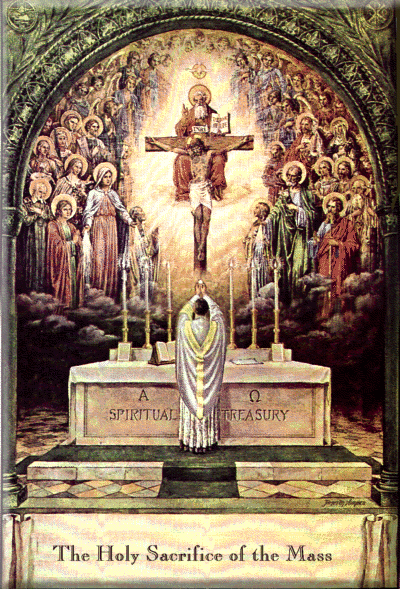
* http://bible-belt-catholic.blogspot.com/2012/01/magis-new-work.html
** http://catholicapologetics.info/library/directory/holymass.gif
 |
| Lavinia Fontana. The Visit of the Queen of Sheba to Solomon. c. 1600. Dublin, National Gallery of London. |
In our first reading today, King Solomon stands as a type of Christ. We are particularly invited in this
passage to consider first his wisdom, like that of Christ. King Solomon's wisdom of course was exceptional, although merely human, while Christ's wisdom is divine and perfect. But Solomon's wisdom is of God, and points us toward the more perfect wisdom of our Lord. Because of his wisdom, he kept his kingdom in peace for many years, and gave justice and good laws. Christ does the same, more perfectly, for His Church and for His kingdom.
We're also invited to consider Solomon as the builder of the temple in Jerusalem. Again, he foreshadows the temple Christ builds, which is His Church, His own Body. We want to participate in the worship that takes place in Christ's temple, and so here we are at this Holy Mass.
This passage also offers us the figure of the Queen of Sheba. She is a more worldly ruler than Solomon, very rich and powerful and successful in her own kingdom. But she's not a negative example of the world, because she does come to Solomon to exchange gifts and confirm peace. Rather, she stands in relation to Solomon in very much the way we stand in relation to Christ. She's heard of his extraordinary wisdom, his goodness and justice, and she's interested, but she can't quite believe that all this could be completely true. We too sometimes hesitate to believe fully in the perfect wisdom, mercy, and goodness of Jesus Christ - although we have faith, certainly; yet sometimes we're reluctant to lower our guard, to set aside our reservations, and give ourselves totally to Christ. Like her, it may seem to us that the forgiveness or the providence of Christ is just too good to be true.
So the queen comes to Solomon to test him, to see if he really is what has been reported. And she is convinced by what she finds, and so she gives him all the gifts that she has prepared for him, if it turns out to be true. We can do the same. We don't need to test Christ, but we can come to him and listen to His wisdom, to His Word, and see how it satisfies us. We can come before Him with our faith, and strive to set aside our worldly defenses and hesitations. We can do the hard work of deeper interior conversion in order to be more open to Him, to His grace and His perfect will. And we do this especially in prayer, and in the sacraments.
 |
| The Adoration of the Magi * |
 |
| source ** |
His holy passion. To give Christ our spices is to participate in His priesthood, especially through the sacraments, which again, He offers us only through His Church. Because He is the one High Priest, to grow in faith means to grow in desire for His grace and mercy in receiving and living out all the sacraments, as well as to grow in prayer and devotions.
When we do this - when we expose ourselves to Christ in order to receive more deeply all His gifts for us, and then give back to Him a deeper faith, obedience, and devotion - then we also show the love and mercy of God to all those around us. We show why the ways of the world don't lead to salvation or real happiness, and what a difference it truly makes to be close to our Lord Jesus Christ. We show this by the quality of our lives. We preach simply and without confrontation, heart directly to heart, about our true faith and joy in Christ, our Lord and Savior.
So let us pray to the Holy Spirit for the courage to be defenseless before Jesus Christ. Let us pray that we may receive everything He wills to give us, and that we may willingly give back to Him everything we have and are. In this way, may we always offer the light of Christ to those in darkness.
* http://bible-belt-catholic.blogspot.com/2012/01/magis-new-work.html
** http://catholicapologetics.info/library/directory/holymass.gif
Thursday, May 2, 2013
May 2, 2013 - St. Athanasius, Evangelization, the Unicity of the Church, and truth and goodness
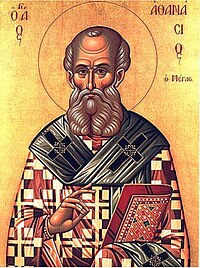 Today is the feast day of St. Athanasius, whose chops as an opponent of heresy are second to none; and for that reason, and because of some of the reading I've been doing for the conclusion of our Christology class, as well as some recent news stories in which the Church is unnecessarily type-cast as the antagonist, I have been pondering a bit this phenomenon of increasing open, vocal, assertive, brazen anti-Christian rhetoric and posturing. It certainly verges on discrimination, although it's not yet formally entrenched anywhere in the US, merely materially ascendant in certain places.
Dominus Iesus (2000) hit the nail squarely on the head in listing, in a very general sort of way, the nature of the erroneous thinking involved here:
4. The Church's constant
missionary proclamation is endangered today by relativistic theories which seek
to justify religious pluralism, not only de
facto but also de iure (or in
principle). As a consequence, it is held that certain truths have been
superseded; for example, the definitive and complete character of the revelation
of Jesus Christ, the nature of Christian faith as compared with that of belief
in other religions, the inspired nature of the books of Sacred Scripture, the
personal unity between the Eternal Word and Jesus of Nazareth, the unity of the
economy of the Incarnate Word and the Holy Spirit, the unicity and salvific
universality of the mystery of Jesus Christ, the universal salvific mediation of
the Church, the inseparability "while recognizing the distinction" of the
kingdom of God, the kingdom of Christ, and the Church, and the subsistence of
the one Church of Christ in the Catholic Church.
The roots of these problems are to be found in certain presuppositions of
both a philosophical and theological nature, which hinder the understanding and
acceptance of the revealed truth. Some of these can be mentioned: the conviction
of the elusiveness and inexpressibility of divine truth, even by Christian
revelation; relativistic attitudes toward truth itself, according to which what
is true for some would not be true for others; the radical opposition posited
between the logical mentality of the West and the symbolic mentality of the
East; the subjectivism which, by regarding reason as the only source of
knowledge, becomes incapable of raising its "gaze to the heights, not daring
to rise to the truth of being"; the difficulty in understanding
and accepting the presence of definitive and eschatological events in history;
the metaphysical emptying of the historical incarnation of the Eternal Logos,
reduced to a mere appearing of God in history; the eclecticism of those who, in
theological research, uncritically absorb ideas from a variety of philosophical
and theological contexts without regard for consistency, systematic connection,
or compatibility with Christian truth; finally, the tendency to read and to
interpret Sacred Scripture outside the Tradition and Magisterium of the Church.
But I think we shouldn't underestimate the consequences of muddled thought in and of itself. Moral relativism is taught daily in our public schools, sometimes overtly, often by default; subjectivism is everywhere, with its stupid but powerful idea that truth is best recognized by an observable emotional response; the problem of "metaphysical emptying" is everywhere, quite apart from its Christological and ecclesiological implications, teaching people to accept lower order goods and to accept division in place of unity; eclecticism makes rational argumentation much harder than it needs to be; and so forth. The net effect of all of these incomplete or inadequate ways of thinking is that most people are more or less convinced that what's good for them (often in a reductive and/or immediate sense) is the same as the common good; and therefore if others disagree with them, these others must be opposed to them, in the manner of trying to deny them some good.
St. Athanasius, for all his trials and struggles for the apostolic faith of the Church, didn't have this problem to deal with. His opponents were, by and large, at least rational. Arius thought he was solving the difficult problem of divine impassibility in the Incarnation. Constantius thought he was doing what was good and necessary for the unity of the Empire. That they were mistaken about these things didn't mean they couldn't be reasoned with, and indeed, eventually, the process of rational argument did secure the apostolic teaching and the rejection of Arianism fairly definitively.
In our evangelization today, at the individual level, I think we still need to do this. How we talk about the faith, about our worldly and spiritual experiences, our consistency of word and action, and so on, constitute a kind of argument about most basic principles which is readily apparent to those around us. And since people are not usually attracted by philosophy (a systematic presentation of the truth as ideas) but by holiness (a very different but no less systematic presentation of the truth in action), this is the right way to proceed.
For those who think we are opposed to them personally merely because we disagree with them about ideas, it is the witness of consistent and joyful imitation of Christ by those who are known to them which has a chance to convince of our goodwill, even if conversion never follows.
But at the wider level, this kind of personal approach doesn't work. Here the clash of ideas and perceptions happens in a separate way from our personal witness. Consistency and joy still matter here, but somehow it needs to be translated to that more impersonal level. Here, martyrial witness is a powerful kind of argument. Those who are willing to suffer for Christ (in whatever sense; in other words, to carry the Cross in daily life, without complaint, even when it is unjust) are appealing in this sense. But the appeal rests on the coherence of the tradition or identity - in this case, the apostolic Tradition and the identity of bearing Christ's name as Christians. If that tradition and identity is not generally perceived as internally coherent - in other words, if Christians are generally perceived to be disloyal to their own tradition, for whatever reason - at one level, it doesn't even matter if it's true or not - then the quality of the witness is badly undermined.
So as St. Athanasius knew so well, a well-formed Church is really necessary for the project of evangelization. The weakness of our evangelization in the West in the past three-four generations is a symptom of insufficient internal coherence, consistency, joy, and zeal in bearing the Name and the Cross of our Redeemer. John Paul II wrote the same:

The Catechism of the Catholic Church is a major step in the right direction. So is a coherent anthropology at the root of our formation programs (four pillars of human, spiritual, intellectual, and pastoral formation). So is the plethora of solid and orthodox Bible studies which use well all the tools available to us, without abusing the historical critical method in the manner which leads to supplanting Christian identity with some mere political ideology. So is the new Missal's use of a consciously sacral language for worship. So is Friday abstinence and the daily Rosary, as universally shared elements of a clear, Catholic identity. And so on... these are the things, when used well and often, that build up our conviction, our faith, our zeal, and therefore our ability to evangelize the increasingly unfamiliar world around us.
Thursday, February 21, 2013
The "Myth" of Early Christian Persecution?
The Cardinal Newman Society news feed has this item today, about Notre Dame theology professor, Dr. Candida Moss, promoting her new book, "The Myth of Persecution: How Early Christians Invented a Story of Martyrdom." Here is her promotional:
Perhaps it would be an overreaction to this promotional material to express my surprise at what appears to be such a boldly revisionist project coming out of Notre Dame's theology department. I've not read this book, and have only read about her previous book on the early martyrs; so I make no judgments about Dr. Moss's scholarship. Certainly, I believe she would agree that there's nothing "mythic" or "invented" about the mere fact of persecution of Christians in the Roman Empire in the second and third centuries. Consider, for example, Trajan's law criminalizing Christianity "for the name;" the numerous judicial records of exactly such trials and the death, imprisonment, or exiling of actual Christians that resulted; the mid-third-century imperial laws (Decius, Valerian) against Christian clergy, possession of the Christian scriptures, and so forth; the persecution of Diocletian and his successors in the East; none of these things have ever been in doubt as what actually happened. (The question of why Roman authorities treated Christian in such ways is a separate one. I'd agree with her that it wasn't "merely because they refused to deny Christ." But why does she think these facts happened?)
This historical layer of the "Church of the martyrs" certainly does, as Dr. Moss claims, underlie in a persistent way the attitudes of Christians of other times and places to all sorts of circumstances. In this sense, one could say there is a "myth" being formed. But that's hardly unusual; all coherent groups of every kind, not only religious, recount shared experiences to reinforce identity and commitment. There's no implication here, generally, that "myth" in this sense means "not true," or "distorting the historical record," or "politicized," or the like. So it's difficult to see, based only on this promotional material and the rather provocative title, why it might follow that those implications are pertinent in this case.
But the promotion of the book as such, distinct from its scholarly content, does indeed seem to me obviously ideological ("... and they're not similarly persecuted today.") Here is an advertisement for an upcoming lecture on the same, to be given in Washington DC in March. Note the way in which word choice is used here to create an effect, and to qualify the meaningfulness of historical facts, in the direction of the very modern agenda already revealed in the video [my comments]:
What I find most arresting in this is how blatantly partisan such an avenue of promotion is, while still holding out the promised scholarship as properly scientific history. Because we know, of course, that rational, right-thinking progressives never make use of a religious heritage to suggest false or unhistorical connections between the past and the present:
Just in the promotional material, then, one seems meant to conclude that, since the Roman Empire is not really a persecutor of Christians, but made to seem so by (some) Christians intent on preserving their "hegemony," so too the modern states of the West can and should similarly exclude Christian persons and Christian ideas (the "dangerous" "religious and political right") from the public square. One cannot suggest that such exclusion might seem to violate otherwise compelling norms of law and fundamental rights, in a manner reminiscent of the history of persecution of Christians at other times and places, because of the implication that this is not really "persecution," for the same reasons it wasn't in late antique Rome. And it's left dangling as a further implication that such exclusion is necessary, lest Christians rebuild that same hegemony that (the now well-worn ideology continues) has been dismantled, at such heroic cost, by the forces of egalitarian Reason in the last three or four centuries.
This maneuver (again, just in the promotional material, since I haven't read the book itself), strikes me as highly damaging to the faith of believers. It calls into serious doubt the accepted meaning of an important period of the Church's history, and therefore also the authority of the tradition (or even Tradition) which has accepted and "mythologized" (if you like) that meaning. It challenges the use of that authority by the current leaders of the Church (in the Catholic Church, at least, the apostolic authority of the bishops) who have been increasingly outspoken against precisely that impetus of exclusion, common in the West for two generations. And it undermines the solidarity of Christians with the victims of much worse injustices (many of them, of course, Christians themselves) by falsely dividing different forms of abuse of power according to ideological preferences.
I hope the book itself will offer much better than this; this is certainly not exemplary of the love of truth and pietas to one's students which Notre Dame and Yale taught me.
* Herbert Musurillo, The Acts of the Christian Martyrs (Oxford, 1972), is an excellent example of exactly such an effort to sift true historical accounts of early Christian martyrs from later pious fictions, and is generally accepted by historians as basically accurate.
Perhaps it would be an overreaction to this promotional material to express my surprise at what appears to be such a boldly revisionist project coming out of Notre Dame's theology department. I've not read this book, and have only read about her previous book on the early martyrs; so I make no judgments about Dr. Moss's scholarship. Certainly, I believe she would agree that there's nothing "mythic" or "invented" about the mere fact of persecution of Christians in the Roman Empire in the second and third centuries. Consider, for example, Trajan's law criminalizing Christianity "for the name;" the numerous judicial records of exactly such trials and the death, imprisonment, or exiling of actual Christians that resulted; the mid-third-century imperial laws (Decius, Valerian) against Christian clergy, possession of the Christian scriptures, and so forth; the persecution of Diocletian and his successors in the East; none of these things have ever been in doubt as what actually happened. (The question of why Roman authorities treated Christian in such ways is a separate one. I'd agree with her that it wasn't "merely because they refused to deny Christ." But why does she think these facts happened?)
This historical layer of the "Church of the martyrs" certainly does, as Dr. Moss claims, underlie in a persistent way the attitudes of Christians of other times and places to all sorts of circumstances. In this sense, one could say there is a "myth" being formed. But that's hardly unusual; all coherent groups of every kind, not only religious, recount shared experiences to reinforce identity and commitment. There's no implication here, generally, that "myth" in this sense means "not true," or "distorting the historical record," or "politicized," or the like. So it's difficult to see, based only on this promotional material and the rather provocative title, why it might follow that those implications are pertinent in this case.
But the promotion of the book as such, distinct from its scholarly content, does indeed seem to me obviously ideological ("... and they're not similarly persecuted today.") Here is an advertisement for an upcoming lecture on the same, to be given in Washington DC in March. Note the way in which word choice is used here to create an effect, and to qualify the meaningfulness of historical facts, in the direction of the very modern agenda already revealed in the video [my comments]:
According to cherished [w/c] church tradition, early
Christians were uniquely [neither historians nor the Church have held the general position that only Christians were persecuted in the Roman Empire in Late Antiquity; one has only to look at e.g. Domitian] and systematically [the imperial laws against Christians in 251, 257, and 303-10 were as systematic as things got for the time] persecuted by a brutal [w/c] Roman
Empire. Vast [w/c] numbers of believers were thrown to the lions or routinely
[w/c] tortured or burned alive. In spite of these horrors, so the story goes [are we now to believe that no Christians were martyred by the Roman state?],
these heroes of the early church chose to die rather than renounce
their faith in God [indeed so; some Christians, then as now, possessed such courage and fidelity]. Such stories form part of the teaching of the church
to the present day, inspiring some to acts of like courage in the face
of modern hardships [this was and is an explicit goal in remembering the acts of the martyrs, just as the imitation of holiness is an explicit goal of remembering the lives of the saints]. Yet there is also the troubling [w/c] use of this
heritage to silence the voices of those who act outside the perceived
orthodoxies of the day [note the implication that all orthodox teachings are merely "perceived" and "of the day"].
In this lecture, Professor Candida Moss will
address the true history [never before told! hidden for hundreds of year!] of persecution in the early church, and show
how this history includes exaggerations and forgeries [this too is well known; yet we are able to evaluate the historical evidence and reliably hold that some subset of the evidence* is not exaggerated, forged, or added in later centuries] that eventually
became part of the rhetoric [w/c] of the church. Moss will also address the
question of the legacy [what she refers to in the trailer above as "dangerous," "especially in the language of the religious and political right"] of this history; a legacy that has animated the
acts of some within the religious world to exclude [w/c; the great sin of post-modernity] those who would
challenge [w/c] their hegemony [w/c].
What I find most arresting in this is how blatantly partisan such an avenue of promotion is, while still holding out the promised scholarship as properly scientific history. Because we know, of course, that rational, right-thinking progressives never make use of a religious heritage to suggest false or unhistorical connections between the past and the present:
 | |
| (Any allusion to other historical persons, living, dead, or resurrected from the dead, is purely a figment of the viewer's bigoted imagination.) |
This maneuver (again, just in the promotional material, since I haven't read the book itself), strikes me as highly damaging to the faith of believers. It calls into serious doubt the accepted meaning of an important period of the Church's history, and therefore also the authority of the tradition (or even Tradition) which has accepted and "mythologized" (if you like) that meaning. It challenges the use of that authority by the current leaders of the Church (in the Catholic Church, at least, the apostolic authority of the bishops) who have been increasingly outspoken against precisely that impetus of exclusion, common in the West for two generations. And it undermines the solidarity of Christians with the victims of much worse injustices (many of them, of course, Christians themselves) by falsely dividing different forms of abuse of power according to ideological preferences.
I hope the book itself will offer much better than this; this is certainly not exemplary of the love of truth and pietas to one's students which Notre Dame and Yale taught me.
* Herbert Musurillo, The Acts of the Christian Martyrs (Oxford, 1972), is an excellent example of exactly such an effort to sift true historical accounts of early Christian martyrs from later pious fictions, and is generally accepted by historians as basically accurate.
Subscribe to:
Posts (Atom)