Showing posts with label zeal. Show all posts

Monday, March 5, 2018

Archdiocese of Washington DC offers "Amoris Laetitia: Pastoral Plan"

This weekend, the Archdiocese of Washington DC released a longish document on their implementation of Amoris Laetitia.  Like the exhortation itself, this "Amoris Laetitia: Pastoral Plan" offers (mostly) a straightforward recapitulation of the Church's teaching about marriage, some good advice about strengthening marriage prep (both remote and proximate), and a call for conversion and stability.  We all know that our culture is increasingly anti-marriage, both in terms of more and more radical individualism and relativism, and in terms of failing to support marriage in ways both practical (tax laws, welfare state policies, etc) and theoretical (no fault divorce, education policy, court-driven custody rulings, etc).  Having a solid biblical, Catholic, Christ-centered vision of what marriage is, and of what the common problems in marriage stem from, and of how to recognize and respond to those issues in healthy and faithful ways, is critical, and I applaud anything that helps build up the culture of marriage and helps actual couples live their marriages well in Christ.

There are, however, two things about this pastoral plan that strike me as failing to aim at that goal from the outset.  This doesn't necessarily take away from the practical wisdom contained in the document, but it does invite us to think more deeply about our vision and how we communicate it.

The first is the problem of failing to articulate clearly the relationship of eros to agape.  The document states:

The desire to love and to be loved is a deep,

enduring part of our human experience. God

has written onto each human heart the desire for

self-giving love, reflected in the divine plan for

marriage and family. That plan offers a profound

“yes” to true joy in love. It gives us an invitation to

experience Christian hope in the love of God that

never ends.
 
This "desire to love and be loved" is eros-love.  Eros is often where we start, not only in marriage but in many things we pursue.  Eros is not inherently wrong or evil; it is about choices we make at the level of the "appetitive soul."  If, however, our desire and ends remain only at this level, they tend to stagnate into selfishness and idolatry, addiction and neurosis.

As Pope Benedict taught so clearly in Deus Caritas Est, natural eros must always be purified by divine agape in order to pursue the good rather than the self.  Agape is that "self-giving love, reflected in the divine plan."  It is love that imitates Christ's perfect love from the Cross.  It therefore transcends the appetitive soul, through the action of a well-formed (not an eros-formed) conscience and divine grace, allowing the rational soul to perceive and choose the authentic good for others.

What is unclear in the above paragraph is precisely that agapic love is not "natural" to us as humans.  We must learn how to love this way.  While it's true in a sense that God has written the desire for agape into our hearts (as St. Augustine wrote, "Our heart is restless until it rests in you, O Lord"), we do not have natural means to engage this.  We require grace to transcend eros-love and be converted to love with Christ's agapic love.  To fail to distinguish this grace-for-conversion here leaves the entire pastoral plan resting on an insecure foundation.  Anyone who imagines that more eros (natural desire) can solve the problems created by unrefined eros (selfish desire) is bound to fail, but this is the conclusion being (inadvertently) invited here.

Sacramental marriage gives grace precisely to transform eros into agape.  No matter how kind and loving I am to my spouse and children, if I continue to treat them as objects of desire (i.e., they must fulfill me, they are in my life for my happiness), I am not responding to this sacramental grace.  Eros transformed into agape means I live my vocation to married life as Christ crucified - that everything I am and do is for them, rather than the reverse.  From eros fulfilled comes mere happiness; from agape fulfilling others comes joy and union with Christ.

Therefore, while it is certainly true that "That (divine) plan offers a profound 'yes' to true joy in love," it must also be stated that deviations from the divine plan offer an (at least implicit) 'no' to the same conversion, joy, and agape-love.  We must not conclude what the document leaves open to us (and what Amoris Laetitia, too, often seems to suggest), that deviations from the divine plan for marriage and family contain a partial 'yes' to God and grace.  This might be true, only if the deviations result entirely from ignorance and weakness.  When they result from a deliberate choice to pursue eros-love instead of agape-love (even when that choice is less than fully informed), they do not represent authentic modes of encountering Christ's grace, and they are therefore contrary to the divine plan.  Eliding this distinction does not serve anyone well.

The second problem risks being even more corrosive.  It suggests that the Church's doctrine is not itself useful or practical, and that lived experience is needed to understand, or interpret, or even correct that doctine.

Reflecting on the implementation of Amoris

Laetitia in the Archdiocese of Washington, we

begin first with the richness of the Church’s
perennial teaching on love, marriage, family,

faith and mercy.... Secondly, we need to remember that our task is

not complete if we only limit ourselves to faith

statements. The goal is the salvation of souls

and it is a far more complex effort than simply

restating Church doctrine. For this reason, it is

essential to recognize that our teaching is received

by individuals according to their own situation,

experience and life....

At one level, this distinction is not problematic.  I am not trying to suggest that lived experience is irrelevant to doctrine, or that the reception of doctrine is not fraught with difficulties stemming from our human weakness and falibility, or stemming from cultural presumptions at odds with the Gospel, etc.  Even given this, however, it is tendentious in the extreme to suggest that the Church's pastoral care has ever attempted to engage with actual situations merely by "restating doctrine," or that, say, St. John Paul II failed to appreciate the complexities presented to the Church by contemporary culture (see e.g. Familiaris Consortio or Veritatis Splendor, or for a different vocational context, Pastores Dabo Vobis).  Should we now discard the entire Code of Canon Law, beacuse it "limits us to faith statements?"  At this level, the dichotomy becomes a blatant lie, pitting "mercy" (which now means making excuses for deviations from the divine plan for marriage and family) against "doctrine" (which now means cruelly expecting people to be unrealistically perfect). 

If this is our vision of marriage, "our faith is vain," as St. Paul says, because this vision of marriage is indistinguishable from the world's - eros without agape (love with sacrifice, happiness without personal cost), inherently self-centered, and "mercifully" lacking any possible leverage to modify behavior which is actually inimical to marriage, to the dignity of persons, or to salvation. 

I don't actually believe that the Archdiocese of Washington is promoting this cultural vision of marriage.  But, by including these two ambiguities, it weakens the vision which it is trying to offer and sustain, of Christ's sacramental marriage.  And our culture has already weakened that vision enough; we don't need to weaken our presentation of it still futher.
Friday, November 3, 2017

What is the "Deposit of Faith?"

 
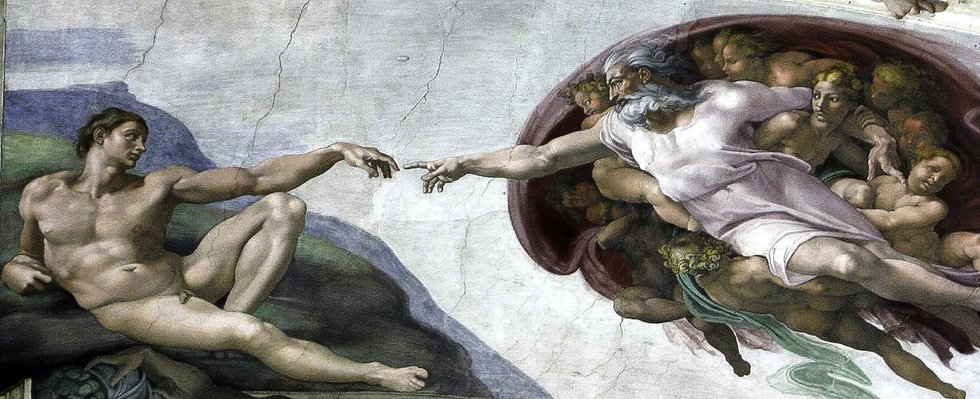
Michaelangelo's "Creation of Man"
#1 God, infinitely perfect and blessed in himself, in a plan of sheer goodness, freely created man to make him share in his own blessed life. For this reason, at every time and in every place, God draws close to man. He calls man to seek him, to know him, to love him with all his strength. He calls together all men, scattered and divided by sin, into the unity of his family, the Church. To accomplish this, when the fullness of time had come, God sent his Son as Redeemer and Saviour. In his Son and through him, he invites men to become, in the Holy Spirit, his adopted children and thus heirs of his blessed life.
 
#2 So that this call should resound throughout the world, Christ sent forth the apostles he had chosen, commissioning them to proclaim the gospel: "Go therefore and make disciples of all nations, baptizing them in the name of the Father and of the Son and of the Holy Spirit, teaching them to observe all that I have commanded you; and lo, I am with you always, to the close of the age."4 Strengthened by this mission, the apostles "went forth and preached everywhere, while the Lord worked with them and confirmed the message by the signs that attended it."5
 
Christ teaching the Apostles
#3 Those who with God's help have welcomed Christ's call and freely responded to it are urged on by love of Christ to proclaim the Good News everywhere in the world. This treasure, received from the apostles, has been faithfully guarded by their successors. All Christ's faithful are called to hand it on from generation to generation, by professing the faith, by living it in fraternal sharing, and by celebrating it in liturgy and prayer.6


There is a lot of talk in the Church these days about "changing teaching."  This kind of talk is dangerous, especially when it fails to make clear the critical distinction between what is changeable, and what is not, among the Church's many teachings.
 
The whole of the "deposit of faith" is not changeable.  As the quote from the beginning of the CCC shows, it is precisely this core content, revealed by God in the Incarnation, life, Passion, death, and Resurrection of Jesus Christ, as well as in Scripture and Apostolic Tradition, that must be kept whole and intact, and passed on to future generations.  Christ Himself commanded that the Apostles (and their successors) do exactly that: preserve and hand on, without change, the teachings ("deposit of faith") He taught them.
 
St Bede the Venerable,
preserving and proclaiming
A certain bishop recently said, "We're not a Church of preservation, but rather a Church of proclamation."  This is misleading.  We certainly are a Church of proclamation, but the only thing we have authority (given by Christ) to proclaim is precisely what has been preserved, namely the apostolic deposit of faith.  We're not free to add to it or subtract from it, to alter it, to rearrange its parts into a more pleasing pattern, to hide parts of it behind other parts of it, etc.  We are given the mandate by Christ Himself to preserve it, and to hand it on.  So, we are also a Church of preservation - not for the sake of preserving as an end in itself, but precisely for the sake of proclaiming something real and true.
 
So what constitutes that deposit of faith?  Here's a brief schematic (following CCC #84 ff):
  • Scripture and Tradition - the unchangingness of revealed/inspired Scripture is generally unquestioned, but some modern translations implicitly change the meaning by subordinating the actual text to (transient) cultural norms; "Tradition" tends to be understood rather nebulously, rather than as the concrete set of things the Apostles actually did and taught, and therefore passed on to their immediate successors to be received as essential to faith in Christ.  The problem is precisely that Tradition is not written down.  But, the synthesis of the Pastristic Fathers and the witness of the medieval and early modern Church does a good job of demonstrating in practice what Tradition really means.
  • An ecumenical council:
    pope and bishops together
    Magisterium - the teaching authority of the Church.  It has two and only two explicit duties, for which Christ has given His authority, namely, the preservation of the deposit of faith, and the interpretation of it across time and cultures.  There is no authority given to innovate.
  • defined Dogma - Some aspects of faith are so overarching that they "crystalize" in dogmatic form.  Dogma must be present from the beginning, as part of the deposit of faith, but may be demonstrated either from Scripture or from Tradition.  Having been defined with full magisterial authority, dogma cannot be changed, and we should not lightly change the formula in which the dogma is expressed.  Here's a short list (not trying to be comprehensive):
    • Trinity - God is three persons in one substance; God is both transcendent and immanent
    • Incarnation - Christ is both fully God and fully man; "remaining what He was, He became what He was not;" He truly suffered and died for our sins; His sacrifice on the Cross is sufficient for our redemption; He truly rose from the dead and took again the body he had previously assumed, now perfected and glorified; He founded the Church He intended to found; etc
    • Church - "One, holy, Catholic, and apostolic," with a divinely-intended mission and "constitution," including the authority of the papacy and the episcopate
    • Seven Sacraments - hence also the fullness of the liturgy, sacramental grace, the reality of sin and conversion, the necessity of baptism; the baptismal call to holiness; the revealed definition of marriage; the mission of the laity in the world as witnesses and disciples; the clergy
    • Four Last Things
    • Etc - all of these defined dogmas have numerous further implications for doctrine (positively expressed but not defined with highest authority), which likewise can't be contradicted without calling the dogma into question, as well as for pastoral practice, which likewise can't be contradicted (although there is generally a wide range of pastoral options that don't contradict the dogma)
  • "sensus fidei," the actual unity of faith experienced as the instinctive acceptance of what is consistent with Catholic faith, and the instinctive rejection of what isn't - this is a sure guide, to the extent that it matches up with "what Catholics believe, always, everywhere, and by everyone"
    • It is a greatly damaging modern conceit that only Catholics today matter, because Catholics in the past weren't "mature" or were "superstitous" or the like.  This idea must be rejected as a grave sin of pride, and as a contradiction of the deposit of faith.
  • "faith seeking understanding," the actual fullness of truth (sufficient for salvation) of the whole of the one faith, experienced as longing to know and love God by faith, contemplation, and study (study does not have to be formal; pious practices like reading the lives of the saints are also study, in this sense)
The Lamb of God
All this content of the deposit of faith is ultimately received from God.  Willfully to reject it, modify it, or subordinate it to personal whims or cultural demands is to commit the same sin of pride that caused the fall of the lost angels.  (We sometimes do that not willfully, because we are finite beings, and because we are always under pressure from the world, the flesh, and the devil to make compromises.  This is what we mean we say "The Church is always in need of reform.")  To be faithful to Christ means that we must make every possible effort to receive the deposit of faith entire and uncorrupt (which is given to us with supernatural power in the sacraments and in the Magisterium of all time, so we can actually know it), and also to pass it on by our teaching, our witness, and our piety, likewise entire and uncorrupt. 


Friday, August 26, 2016

Lessons of the Early Church

I am the Catholic I am, in large part because of the martyrs of the early Church.  Their faith shamed my lack of faith, and understanding why they felt it was worth sacrificing the world for the sake of Heaven gave me the impetus to return to the Church as the only way to salvation.  Now, the Church needs their witness again, as the world around us seems primed to descend into a new paganism.

Martyrdom of St. Polycarp - "Away with the atheists!"
The Christian refusal to cooperate with pagan Roman society was rooted in three connected things: (1) The Roman Empire was inherently idolatrous.  Civic participation required participation in pagan ritual worship.  Oaths of office required the same, to be a soldier, a teacher, etc., not just for politicians.  (2) The reality of (unjust) persecution.  Romans persecuted Christians mostly because they saw Christian faith as "atheism" and "innovation," two things that threatened the stability and success of the Empire as a whole.  But as Tertullian famously pointed out in his Apologeticum, forcing Christians to worship other gods by violence made that worship ineffective for the good of the Empire.  (3) Idolatry and unjust persecution represented abuses of power by the Empire.  All worldly authority comes ultimately from God, as Paul argued.  Its uses must therefore conform at least to natural law standards of justice.  That the Empire abused its power in these (and other) ways justified Christian non-participation.

This line of argument, which permeated Christian thought for two centuries, has been buried under other understandings of the Church's relationship to a world seemingly cooperative rather than repressive.  The successful evangelization of the West and the creation of Christendom meant that we didn't need to think much about things that support a Christianity of non-participation.  But we have this treasure somewhere in the attic, not entirely lost or forgotten.  If we confront the increasingly hostile world only with the lessons of cooperative Christendom, we will probably lose.  We need the lessons of conflict as well, distilled from that earlier Christian experience of martyrdom.

Here are three of those critical lessons.

1. The world can never provide an avenue of salvation.  This should be obvious to Christ's disciples.  Only God can forgive sins; only God can save souls; our ultimate homeland is not earth, but Heaven.  But in contrast, it's a key plank of modernism, more or less obvious in all three of its branches (liberal democracy, Communism, and fascism), that the State aspires to become all-in-all, the "savior," in a sense.  In fascism, it does so directly.  In Communism, it does so as the mediating institution of the people's revolutionary will.  In liberal democracy, it does so more subtly, as the mediating institution between conflicts of rights and powers; but over time, its mediation inevitably expands and coems to dominate everything else. In all three, "scientism" promises imminent salvation from all the suffering and evils of the world.

Reductio ad absurdum of acceptance of modernism.
Any uncritical acceptance of modernism, then, implicitly accepts the (false) claim that the State exercises the highest and most decisive form of authority.  This claim tends to be not merely political, but also moral (i.e., abusing God-given authority!).  It rejects, more or less explicitly, a traditional, Bible-informed moral vision.  Acceptance of modernism therefore also means accepting the relegation of religion to the private sphere only.  The moral verities and priorities of the culture (which are, in terms of Christian Revelation, not true) come to be enforced as true, and any serious objection to them is firmly punished, at least socially (loss of status, respect, jobs, friends, etc), possibly legally (fines, jail, the police showing up in the middle of the night to investigate your family, etc), and even (sometimes) fatally. 

A different acceptance of modernism - no less absurd.
If we accept, even implicitly, that the world offers salvation within itself, we cannot be Christians.  We must stand firmly and intentionally in the core Christian claim of salvation through Christ alone.  Short of martyrdom, we do this especially in our (public) worship. Worship focused on God (as in traditional modes) demonstrates our conviction, and teaches spiritual salvation.  Worship focused on ourselves (as in "theater in the round" church design, or hymns all about us or making us speak in God's first person voice, etc.) opens the door to implicit acceptance of the lie of the world saves itself. 

2. Forms of idolatry must be clearly rebuked.  The Church of the martyrs taught clearly and consistently to all its members that cooperation with idolatry leads to loss of saving relationship with Christ.  It wasn't just pagan rituals that were identified, it was a whole host of public or civic activities or positions that were inherently idolatrous - teachers and soldiers, attending theater or civic games, etc etc.  This process of identifying and rebuking forms of participation in idolatry was very successful.

Pope St. John Paul II, for one example, did an excellent job throughout his pontificate (and even before) of doing the equivalent for us today.  We don't tend to think in terms of "idolatry" today, but the moral equivalent corrupting the Church and society is "secularism" (and similar labels).  A creeping domination of "secular" ideas in all spheres of life is intent on displacing any Biblical or natural-law-based cultural patrimony in the West.  This is especially apparent at the moment in issues of sexuality and family, or education policy, for example.  Pope St. John Paul II showed us how to parse the good and the bad in all such conflicts, and having identified the elements or ideas inconsistent with truth and therefore unacceptable to Christians, he rebuked ideas without condemning people. 


March for Life 2013 - excellent example of rebuking without condemning

The more we conform ourselves to the mores of the world, the more this creeping secularism insinuates itself into our faith.  Pope St. John Paul II told us constantly, "Be not afraid!"  Short of martyrdom, we can be clear and consistent in our rejection of modern forms of idolatry by fearlessly knowing the truth (virtue of faith), living the truth (virtue of hope), and speaking the truth (virtue of love) - always with charity and mercy.  It is, in fact, the visibility of the true charity and mercy of Christ in our lives that can attract those mired in worldly idolatry.

3. Faith in Christ is the greatest treasure.  If we look to the world for our salvation (even unconsciously), and fall into secular (idolatrous) modes of thinking, we will inevitably undervalue our faith.  This doesn't necessarily mean we will lose our faith entirely, but we won't have much motive for living it out consistently.  We will be "secular Christians," who, even when we go every Sunday to worship God, live the rest of the week as if Christ doesn't matter to us.  We will be "formed by the culture" rather than "formed by the Church."  We will have fallen into the trap of privatizing our faith - which is precisely what the totalizing, secular world demands of us.

Pope Benedict XVI Adoring our Lord Jesus Christ
Pope Benedict XVI understood this dynamic deeply.  So much of his pontificate was aimed at enflaming our faith anew, at helping us realize just what an inestimable treasure faith in Christ actually is.  Nobody is attracted to a faith that seems not to matter even to its regular practitioners!  Only those who are on fire for God have the chance to spread the fire to others.  Only those who, by how they live in every sphere of life, clearly value above other things the love of God can proclaim the value of that love. 


If it's true, finally, that "the blood of the martyrs is the seed of the Church," then our evangelizing efforts can only bear fruit if we first die to self, and to the world, and live only in Christ. 


Wednesday, September 30, 2015

Bishop Olmstead (Phoenix) - "Into the Breach"

Yesterday, Bishop Olmstead published an apostolic exhortation to men to step "into the breach" of faith and spiritual life.  His exhortation is excellent!  Please read it.  It's entirely relevant to deacons and those of you in deacon formation, too.  The main point is about a revival of Catholic manliness by:
  • a rejection of postmodern culture's confusion about anthropology and gender, and an embrace of traditional and Biblical norms for masculinity (i.e., strength with gentleness, justice with mercy, wisdom and humility, basic courtesy, boldness to face down evil and to lead to the good, protection of others, especially those who can't protect themselves, the Biblical "widows and orphans" - in a word, chivalry),
  • chastity,
  • fidelity for fathers and husbands (and a deliberate promotion of the necessary norms for being good fathers and husbands, over against the self-indulgent decadence of the culture and the scourge of divorce),
  • return to the Mass and the sacrament of Confession,
  • prayer and personal devotion.
I'm hoping that the website will continue to be a good source for informationa and resources.  Click through to see a short video associated with the exhortation.

Friday, May 16, 2014

Video of May 3 Ordination

Courtesy of M.V., good friend and erstwhile instructor of this cohort, here is a video of our ordination Mass for our ten new deacons, on May 3.  The camera was hand-held and she was unable to leave the pew for better angles, but the quality is still very good overall. 

Part 1 is the procession up to the beginning of the homily:


Part 2 has the homily and part of the ordination rite:


Part 3 starts with the vesting of the new deacons:


Part 4 has some of the Communion Rite:


Part 5 starts with the Postcommunion Prayer:


Thanks to MV for sharing these with us and to the HS for causing the day to happen!  Ad multos annos!

Monday, June 24, 2013

Archbishop Chaput on the New Evangelization

From a conference last week on evangelization and preaching, Archbishop Chaput gave this stirring and sobering reflection (courtesy of CatholicPhilly.com):

(Picking up with the second third of his talk:) And that requires us to understand the pastoral terrain we face as Christians right now, today.  We should probably start by realizing that some of the same civil authorities that once happily honored Father Serra with statues in Golden Gate Park and the U.S. Capitol building now work even harder to restrict the freedom of American religious communities, force the Church out of public debate, and impose same-sex “marriage” as the law.  Father Serra gave his life to the task of bringing the Gospel to the New World.  But the “new world” we actually have in A.D. 2013 is alien to almost anything Serra could have imagined.

Blessed Pope John Paul II saw the outline of our new “new world” more than 30 years ago.  And following his lead, the Church has been calling Catholics to the work of a “new evangelization” ever since.  But there’s a natural human tendency to attach magic powers to slogans, which then replace serious thought and effort — as if saying the slogan, or talking about it, actually makes mission work happen.  In practice, the words “new evangelization” are overused and underthought.  Unless we reconfigure our lives to understanding and acting on it, the “new evangelization” is just another pious intention – well meaning, but ultimately infertile.

From here he goes to interior conversion, and the possibility of inviting others to conversion when mostly people listen to the world telling them there's no reason to change even our most sinful and destructive behaviors.  He touches on the kind of shallow Christianity which has been called "moralistic therapeutic deism," and how it's so very different from real faith in Jesus Christ; on the narcissistic trap of love of novelty rather than substance; and on the resulting lack of the fundamental virtues that allow self-mastery which afflicts our culture.  He continues:

Here’s what that means for all of us as believers.  A “new” evangelization must start with the sober knowledge that much of the once-Christian developed world, and even many self-described Christians, are in fact pagan.  Christian faith is not a habit.  It’s not a useful moral code.  It’s not an exercise in nostalgia.  It’s a restlessness, a consuming fire in the heart to experience the love of Jesus Christ and then share it with others — or it’s nothing at all.  Mastering the new social and demographic data that describe today’s world, and the new communications tools to reach it, are vitally important for the Church.  But nothing can be accomplished if we lack faith and zeal ourselves.  We – and that means you and I — are the means God uses to change the world.  The material tools are secondary.  People, not things, are decisive.

This is always the basic dynamic of Church reform and flourishing: interior first, exterior second, leading to well-grounding mission.  Nothing surprising here, but his clarity and forthrightness are admirable.  So he goes on to talk about zeal:

The heart of every fresh work of evangelization is this kind of ardor; a passionate faith that can only come from seeking out and giving ourselves entirely to Jesus Christ, no matter what the cost.  Just as Francis was raised up in his time to preach the Gospel with new passion in new kinds of ways, so Junipero Serra followed the same path, with the same unshakeable faith, to preach Jesus Christ to new souls, on a new continent, in a new world.

And thus he concludes:

I began my talk today with a passage from St. Paul because the theme of this conference — “Woe to me if I do not preach the Gospel” (9:16) — comes from the same First Letter of Paul to the Corinthians.  The irony, the glory and the joy of faith in Jesus Christ is that the more we give it away to others, the stronger it grows, and the more we have for ourselves to feed our own hearts.  George Bernard Shaw once said that “When I was young, I observed that nine out of every ten things I did were failures, so I did ten times more work.”  Shaw was never a friend of Christianity, but that just makes me happier in borrowing his words.  Young or old, we need to live our faith as Junipero Serra did — all in, 100 percent, holding nothing back, with charity, endurance, passion and hope.  That kind of faith changes lives and remakes the world.

Read the full text of the talk.