Showing posts with label interior conversion. Show all posts

Monday, March 5, 2018

Archdiocese of Washington DC offers "Amoris Laetitia: Pastoral Plan"

This weekend, the Archdiocese of Washington DC released a longish document on their implementation of Amoris Laetitia.  Like the exhortation itself, this "Amoris Laetitia: Pastoral Plan" offers (mostly) a straightforward recapitulation of the Church's teaching about marriage, some good advice about strengthening marriage prep (both remote and proximate), and a call for conversion and stability.  We all know that our culture is increasingly anti-marriage, both in terms of more and more radical individualism and relativism, and in terms of failing to support marriage in ways both practical (tax laws, welfare state policies, etc) and theoretical (no fault divorce, education policy, court-driven custody rulings, etc).  Having a solid biblical, Catholic, Christ-centered vision of what marriage is, and of what the common problems in marriage stem from, and of how to recognize and respond to those issues in healthy and faithful ways, is critical, and I applaud anything that helps build up the culture of marriage and helps actual couples live their marriages well in Christ.

There are, however, two things about this pastoral plan that strike me as failing to aim at that goal from the outset.  This doesn't necessarily take away from the practical wisdom contained in the document, but it does invite us to think more deeply about our vision and how we communicate it.

The first is the problem of failing to articulate clearly the relationship of eros to agape.  The document states:

The desire to love and to be loved is a deep,

enduring part of our human experience. God

has written onto each human heart the desire for

self-giving love, reflected in the divine plan for

marriage and family. That plan offers a profound

“yes” to true joy in love. It gives us an invitation to

experience Christian hope in the love of God that

never ends.
 
This "desire to love and be loved" is eros-love.  Eros is often where we start, not only in marriage but in many things we pursue.  Eros is not inherently wrong or evil; it is about choices we make at the level of the "appetitive soul."  If, however, our desire and ends remain only at this level, they tend to stagnate into selfishness and idolatry, addiction and neurosis.

As Pope Benedict taught so clearly in Deus Caritas Est, natural eros must always be purified by divine agape in order to pursue the good rather than the self.  Agape is that "self-giving love, reflected in the divine plan."  It is love that imitates Christ's perfect love from the Cross.  It therefore transcends the appetitive soul, through the action of a well-formed (not an eros-formed) conscience and divine grace, allowing the rational soul to perceive and choose the authentic good for others.

What is unclear in the above paragraph is precisely that agapic love is not "natural" to us as humans.  We must learn how to love this way.  While it's true in a sense that God has written the desire for agape into our hearts (as St. Augustine wrote, "Our heart is restless until it rests in you, O Lord"), we do not have natural means to engage this.  We require grace to transcend eros-love and be converted to love with Christ's agapic love.  To fail to distinguish this grace-for-conversion here leaves the entire pastoral plan resting on an insecure foundation.  Anyone who imagines that more eros (natural desire) can solve the problems created by unrefined eros (selfish desire) is bound to fail, but this is the conclusion being (inadvertently) invited here.

Sacramental marriage gives grace precisely to transform eros into agape.  No matter how kind and loving I am to my spouse and children, if I continue to treat them as objects of desire (i.e., they must fulfill me, they are in my life for my happiness), I am not responding to this sacramental grace.  Eros transformed into agape means I live my vocation to married life as Christ crucified - that everything I am and do is for them, rather than the reverse.  From eros fulfilled comes mere happiness; from agape fulfilling others comes joy and union with Christ.

Therefore, while it is certainly true that "That (divine) plan offers a profound 'yes' to true joy in love," it must also be stated that deviations from the divine plan offer an (at least implicit) 'no' to the same conversion, joy, and agape-love.  We must not conclude what the document leaves open to us (and what Amoris Laetitia, too, often seems to suggest), that deviations from the divine plan for marriage and family contain a partial 'yes' to God and grace.  This might be true, only if the deviations result entirely from ignorance and weakness.  When they result from a deliberate choice to pursue eros-love instead of agape-love (even when that choice is less than fully informed), they do not represent authentic modes of encountering Christ's grace, and they are therefore contrary to the divine plan.  Eliding this distinction does not serve anyone well.

The second problem risks being even more corrosive.  It suggests that the Church's doctrine is not itself useful or practical, and that lived experience is needed to understand, or interpret, or even correct that doctine.

Reflecting on the implementation of Amoris

Laetitia in the Archdiocese of Washington, we

begin first with the richness of the Church’s
perennial teaching on love, marriage, family,

faith and mercy.... Secondly, we need to remember that our task is

not complete if we only limit ourselves to faith

statements. The goal is the salvation of souls

and it is a far more complex effort than simply

restating Church doctrine. For this reason, it is

essential to recognize that our teaching is received

by individuals according to their own situation,

experience and life....

At one level, this distinction is not problematic.  I am not trying to suggest that lived experience is irrelevant to doctrine, or that the reception of doctrine is not fraught with difficulties stemming from our human weakness and falibility, or stemming from cultural presumptions at odds with the Gospel, etc.  Even given this, however, it is tendentious in the extreme to suggest that the Church's pastoral care has ever attempted to engage with actual situations merely by "restating doctrine," or that, say, St. John Paul II failed to appreciate the complexities presented to the Church by contemporary culture (see e.g. Familiaris Consortio or Veritatis Splendor, or for a different vocational context, Pastores Dabo Vobis).  Should we now discard the entire Code of Canon Law, beacuse it "limits us to faith statements?"  At this level, the dichotomy becomes a blatant lie, pitting "mercy" (which now means making excuses for deviations from the divine plan for marriage and family) against "doctrine" (which now means cruelly expecting people to be unrealistically perfect). 

If this is our vision of marriage, "our faith is vain," as St. Paul says, because this vision of marriage is indistinguishable from the world's - eros without agape (love with sacrifice, happiness without personal cost), inherently self-centered, and "mercifully" lacking any possible leverage to modify behavior which is actually inimical to marriage, to the dignity of persons, or to salvation. 

I don't actually believe that the Archdiocese of Washington is promoting this cultural vision of marriage.  But, by including these two ambiguities, it weakens the vision which it is trying to offer and sustain, of Christ's sacramental marriage.  And our culture has already weakened that vision enough; we don't need to weaken our presentation of it still futher.

Wednesday, December 7, 2016

Thoughts on "rigidity" and orthodoxy

Twice in as many months (e.g., here and here), Pope Francis has inveighed against "rigid" believers.  He uses very negative language against this perceived phenomenon: “They appear good because they follow the Law; but behind, there is something that does not make them good. Either they're bad, hypocrites, or they are sick. They suffer!” Such people are "enslaved," they "lead a double life." They exhibit the opposite of the beatitudes: "Rigidity is not a gift of God. Meekness is; goodness is; benevolence is; forgiveness is. But rigidity isn’t!"  He attaches the same label and language to those who know, love, and respect the traditional liturgy: "Pope Francis told Father Spadaro he wonders why some young people, who were not raised with the old Latin Mass, nevertheless prefer it. 'And I ask myself: Why so much rigidity? Dig, dig, this rigidity always hides something, insecurity or even something else. Rigidity is defensive. True love is not rigid.'"

Certainly, the temptation to this sort of "pharisaical" attitude exists in the Church.  It is something always to be guarded against.  Because of our sacramental forms and theology, it is easy at times to get caught up in the details of the liturgy, and miss the forest (interior and spiritual realities) for the trees (exterior and physical forms, words, symbols).  Likewise with the nuances of our moral theology.  One can, in this sense, fall into "rigidity."  And it is true that rigidity is not loving, and that rigidity resists Christ and grace.

But there is another sort of "rigidity" not often adverted to, although it appears to be far more common, currently.  It consists in putting one's own will before God's, insisting that one is right while Tradition, the Church, the Bible, and God Himself must be wrong.  St. James says, "Submit yourself to God... If you judge the law, you are not subject to the law." (Jms 4:7, 11).  Those who are rigid in this sense judge the law of faith, and do not submit to God in their hearts.

The path of faith always involves conversion.  After our initial conversion (which might be as an infant or child in Baptism), we continue to experience "ongoing conversion," as we strive over our whole life to conform our hearts and minds, our loves and desires, to those of Christ.  To be united with Christ in this conformity, "putting on the mind of Christ" (Rom 2:12, etc), is precisely what it means to live as a Christian.

The heart experiencing conversion must be humble.  It must recognize and accept (even when there is struggle actually to do - concupiscence is a real thing) that what the believer desires, of himself, is likely not what God desires for him, and therefore that one must learn to desire instead what God desires.  This softness and pliability of the heart in respect to God's Law, Revelation, commandments and precepts, personal vocation, moral law, and Tradition is properly understood as a sign of strong faith.  As the Rule of St. Benedict says in its very first words, "Listen carefully, my son, to the Master's instructions, and attend to them with the ear of your heart...  The labor of obedience will bring you back to Him from whom you have drifted by the sloth of disobedience."  This is the opposite of rigidity.  (See e.g. the parable of the Pharisee and the publican, Lk 18:9-14.)

Rigidity, then, is not only clinging to the exterior forms of religion, which Pope Francis (rightly) decries.  The willful rejection of Tradition is equally a form of rigidity (see e.g. Dei Verbum #7-8, etc).  It is a hardness of heart with respect to God's calling the believer.  It is spiritual pride, asserting in effect that this generation (or even this individual!) knows better what is good for souls than all prior generations, than all prior saints, doctors, mystics of the Church.  I don't think it's too strong to say that there's more than a touch of idolatry, of self-worship, in this attitude.  (It remains true that much of the rejection and loss of Tradition and faith in the last century is not willful, but from ignorance and weakness.) 

Thus, one might correctly say: The idea that external or physical forms (e.g., the construction of a church, the placement of the Tabernacle, the beauty of vestments and statues, etc) don't matter to internal or spiritual realities (faith, union with God, repentance and conversion) is false (e.g. Sacrosanctum Concilium #8, 112-3, 122-5, etc).  To cling to this idea in the face of Tradition and correction is to be rigid. 

Idem: The idea that Christ did not and does not will the seven Sacraments for the Church, as the primary means of salvific grace for believers, is false (e.g. SC #5-8, Lumen Gentium #7, 11, etc).  To cling stubbornly to the opposite idea, that we can meddle with the Sacraments or deny their efficacy, in the face of Tradition and correction, is to be rigid.

Idem: The ideas of moral relativism and religious indifferentism are false (e.g. Dominus Iesus, Fides et Ratio, etc). To insist, in the face of Tradition and correction, that they are true, is to be rigid.

And so forth....  In short, modernism is rigid, but Tradition properly received and loved ("the living faith of the dead," as one great Church historian noted) is life with Christ.

Wednesday, September 30, 2015

Bishop Olmstead (Phoenix) - "Into the Breach"

Yesterday, Bishop Olmstead published an apostolic exhortation to men to step "into the breach" of faith and spiritual life.  His exhortation is excellent!  Please read it.  It's entirely relevant to deacons and those of you in deacon formation, too.  The main point is about a revival of Catholic manliness by:
  • a rejection of postmodern culture's confusion about anthropology and gender, and an embrace of traditional and Biblical norms for masculinity (i.e., strength with gentleness, justice with mercy, wisdom and humility, basic courtesy, boldness to face down evil and to lead to the good, protection of others, especially those who can't protect themselves, the Biblical "widows and orphans" - in a word, chivalry),
  • chastity,
  • fidelity for fathers and husbands (and a deliberate promotion of the necessary norms for being good fathers and husbands, over against the self-indulgent decadence of the culture and the scourge of divorce),
  • return to the Mass and the sacrament of Confession,
  • prayer and personal devotion.
I'm hoping that the website will continue to be a good source for informationa and resources.  Click through to see a short video associated with the exhortation.

Monday, March 10, 2014

Homily for 3/9, First Sunday of Lent

via stpeterslist.com 
The great Catholic author and master of wit of a hundred years ago, G. K. Chesterton, was once famously asked, "What's wrong with the world?"  Without hestitation, he pointed to himself and responded, "I am."  This answer is universally true on more than one level, but it's especially true in showing a great humility and in embracing the doctrine of original sin.

In our first reading, we have the occasion of that original sin, the Fall of Adam and Eve.  They disobeyed God's command not to eat from the Tree of the Knowledge of Good and Evil.  They failed to trust God's promises, and they believed the devil's lies, and so they disobeyed, and fell.  And as St. Paul says in the second reading, this sin had great consequences for all of us: "By the disobedience of one man, sin entered the world, and with sin, death."

This doctrine of original sin is central to so many of the teachings of our Catholic faith.  Original sin
Matteo de Nassaro, slate bas-relief ca. 1501, via commons.wikimedia.com
is why we baptize people into the Church as soon as we reasonably can.  Baptism washes away original sin, and we don't want people to wait for that healing.  Original sin is why we receive the Holy Eucharist as often as we can, and not just once in our life, to be united with our Lord Jesus Christ in His real Body and Blood, soul and divinity.  And the consequences of original sin include all of our own sins, our capacity to sin every day.  And therefore we have the Sacrament of Penance always available to us, to receive again and again God's great mercy and forgiveness.  And likewise we have the Church's moral teachings and the examples of the saints to strengthen and encourage us in the daily struggle against sin.  Without the doctrine of original sin, so much of our faith would really make no sense.

Yet we live in a time and a culture which tries so hard to deny the reality of original sin.  The devil is still lying to us!  He wants to make us fall, as he made Adam and Eve fall, and the best weapon he has to do so is to deaden our sense of sin.  And so our world denies original sin and its consequences.  It does so in very many ways, but I'd like us to consider just one of those ways right now.

The world tries to claim that what makes something right and true is if it comes out from the depths of one's heart.  The world rejects God as illuminating what is right and wrong, rejects the Bible, rejects Tradition, rejects the wisdom of the past.  None of these, and no other person, the world wants us to think, can tell us what is right and wrong, but only what is in our heart.  Therefore, if you want something strongly enough, it must be right to want it.  Now obviously, there is a grain of truth in this idea.  There are many deep desires in our hearts that are good, love and forgiveness in the imitation of Jesus Christ foremost among them.  But also obviously, there are many desires in our hearts that are equally deep, that are not at all good.  We are all capable of many kinds of anger and violence and damaging the dignity of other people.  Clearly, having a desire to harm someone else doesn't make harming them right.

As an example of this dynamic of the mystery of sin, consider the pornography which fills our culture.  The world wants to say that there's nothing wrong with pornography, that it's simply normal.  The people who make pornography are doing so freely, and don't seem to be harmed by it.  The people who consume the pornography are expressing a personal desire by doing so.  So where's the harm, or the sin? 

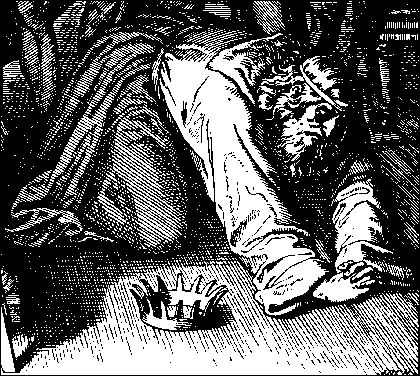
King David praying - maybe Psalm 51?
But with our Catholic understanding of original sin and the mystery of sin, we can see that all this is another lie by the devil.  Pornography is not victimless, not harmless, and not normal.  Those who make it suffer in a number of different ways.  And those who consume it also suffer in various other ways.  [I didn't enumerate in the homily, but we know what these effects are.]  It degrades the human dignity of both of them, and it becomes a constant temptation to see other people as mere objects of desire.  Pornography is the Fall in a nutshell.  And we can see this even in our first reading.  Adam and Eve do gain a true knowledge of good and evil by eating from that tree - it's not the way God promised to give this gift to them, but it's still true knowledge.  And as soon as they do, the very first thing they realize is that they are naked.

This season of Lent, just beginning, is a precious gift to each of us, an opportunity to examine our hearts and our lives in the light of Christ.  Has the world's denial of sin encroached on our faith?  Do we make worldly excuses for our sins?  Is there some part of our life where we are still dead because of sin?  Do we perhaps resist the holy desire for Christlike purity in mind and heart?  Now is the time to let the light of Christ, the mercy that flowed from His side on the Cross, begin to heal that darkness.  Jesus Christ conquers sin and death, refusing every temptation of the devil.  His Gospel is good news!  It's good news for us because it means that we too don't have to be mastered by sin, or defined by our sins.  In Him we can say no to sin - not by our own strength, because we are weak, but in Him, in His perfect power and mercy and forgiveness.  Now is the time to examine our lives and echo Chesterton's humble admission, to beg our Savior Jesus Christ for His mercy.  Each of us can say that we are truly a sinner, in great need of His mercy, but longing to be healed and freed from our sins.  In this Lent, God invites us to accept totally the words we heard just the other day, on Ash Wednesday: Repent, and believe in the Gospel.

Wednesday, February 12, 2014

Homily for 12 Feb 2014, Wednesday of the Fifth Week in Ordinary Time

The Old Testament reading today is the visit of the Queen of Sheba to King Solomon, 1 Kgs 10:1-10.  Here's the homily I preached, as well as I can remember and reconstruct.
Lavinia Fontana. The Visit of the Queen of Sheba to Solomon. c. 1600. Dublin, National Gallery of London.

In our first reading today, King Solomon stands as a type of Christ.  We are particularly invited in this
passage to consider first his wisdom, like that of Christ.  King Solomon's wisdom of course was exceptional, although merely human, while Christ's wisdom is divine and perfect.  But Solomon's wisdom is of God, and points us toward the more perfect wisdom of our Lord.  Because of his wisdom, he kept his kingdom in peace for many years, and gave justice and good laws.  Christ does the same, more perfectly, for His Church and for His kingdom.

We're also invited to consider Solomon as the builder of the temple in Jerusalem.  Again, he foreshadows the temple Christ builds, which is His Church, His own Body.  We want to participate in the worship that takes place in Christ's temple, and so here we are at this Holy Mass.

This passage also offers us the figure of the Queen of Sheba.  She is a more worldly ruler than Solomon, very rich and powerful and successful in her own kingdom.  But she's not a negative example of the world, because she does come to Solomon to exchange gifts and confirm peace.  Rather, she stands in relation to Solomon in very much the way we stand in relation to Christ.  She's heard of his extraordinary wisdom, his goodness and justice, and she's interested, but she can't quite believe that all this could be completely true.  We too sometimes hesitate to believe fully in the perfect wisdom, mercy, and goodness of Jesus Christ - although we have faith, certainly; yet sometimes we're reluctant to lower our guard, to set aside our reservations, and give ourselves totally to Christ.  Like her, it may seem to us that the forgiveness or the providence of Christ is just too good to be true.

So the queen comes to Solomon to test him, to see if he really is what has been reported.  And she is convinced by what she finds, and so she gives him all the gifts that she has prepared for him, if it turns out to be true.  We can do the same.  We don't need to test Christ, but we can come to him and listen to His wisdom, to His Word, and see how it satisfies us.  We can come before Him with our faith, and strive to set aside our worldly defenses and hesitations.  We can do the hard work of deeper interior conversion in order to be more open to Him, to His grace and His perfect will.  And we do this especially in prayer, and in the sacraments.

The Adoration of the Magi *
When we do this, we usually see that Christ really is our perfect king and savior.  What is reported of Him is not exaggerated!  He is the one, the only one, who can offer us pure mercy, the redemption of our sins.  And therefore, like the queen, we should give Him the gifts we have prepared.  It's significant that she gives to Solomon gifts of gold and spices - the same gifts which the Magi offer to the infant Christ in Bethlehem.  In both cases, the gift of gold represents Christ's kingship, and therefore to give Christ our gold is to give Him our allegiance and obedience.  Because He is our only savior, to grow in faith means to grow in our readiness and willingness to do only His will, to follow His laws which He enacts through His Church.

source **
In the same way, the gift of spices represents Christ's priesthood, His saving sacrifice of the Cross and
His holy passion.  To give Christ our spices is to participate in His priesthood, especially through the sacraments, which again, He offers us only through His Church.  Because He is the one High Priest, to grow in faith means to grow in desire for His grace and mercy in receiving and living out all the sacraments, as well as to grow in prayer and devotions.

When we do this - when we expose ourselves to Christ in order to receive more deeply all His gifts for us, and then give back to Him a deeper faith, obedience, and devotion - then we also show the love and mercy of God to all those around us.  We show why the ways of the world don't lead to salvation or real happiness, and what a difference it truly makes to be close to our Lord Jesus Christ.  We show this by the quality of our lives.  We preach simply and without confrontation, heart directly to heart, about our true faith and joy in Christ, our Lord and Savior.

So let us pray to the Holy Spirit for the courage to be defenseless before Jesus Christ.  Let us pray that we may receive everything He wills to give us, and that we may willingly give back to Him everything we have and are.  In this way, may we always offer the light of Christ to those in darkness.


* http://bible-belt-catholic.blogspot.com/2012/01/magis-new-work.html 
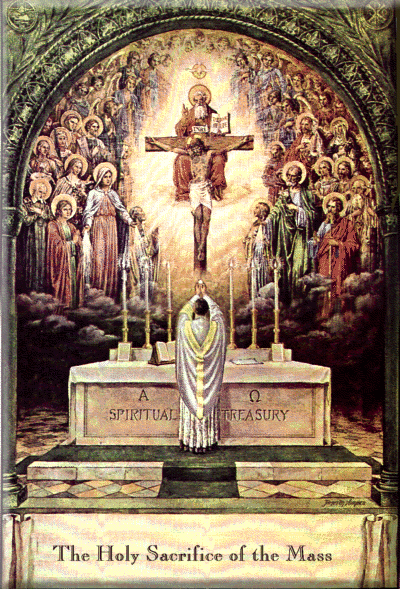
** http://catholicapologetics.info/library/directory/holymass.gif

Monday, July 22, 2013

Homily - 16th Sunday in Ordinary Time, July 21, 2013

As best I recall, this is what I preached at the 5 pm Mass on Sunday.  I may be condensing a bit from what I actually preached.  Although I didn't mention it in the homily, I chose to preach on this topic because of NFP Awareness Week this week, 7/21-28.

The obvious theme in today's readings is hospitality.  And these readings give us nice and clear examples of what the fruits of hospitality are meant to be. 

In his eagerness to serve the three strangers, Abraham first shows us gratitude.  As St. Paul says, "Name something you have that you have not received."  Everything we have comes to us a gift from God - our very life, our vocations, certainly all of our material possessions.  Abraham understands this.  And he understands that what we have received is meant not only for our own good, but also for the good of others.  And so he is quick to express gratitude to God for his prosperity, by offering food and water and shade to the strangers who come to his tent.

The second fruit of hospitality is fruitfulness.  In receiving the word of the coming birth of his son, NOW, after years of wanting and hoping for the fulfillment of this promise, Abraham receives a fruitful increase to his hospitality.  This is true for us as well, either materially or spiritually.  When we give, we are rewarded even more, in some way.

And Mary sitting at the feet of Jesus shows the third fruit of hospitality, which is contemplation.  Hospitality brings us, like Mary, to His feet, so that we can hear His voice and see His holy face in serving others.

All of us are called by our baptism to practice this kind of hospitality.   God wants us to be grateful for all the gifts He has given us, and to use all them, both for our own good and salvation, and for that of others. God wants us to be materially and spiritually fruitful, in our work and in our prayer, and in every part of our life.  And God really wants us to know Him and to love Him with our whole being. 

Now, contrast this, what the Bible says about hospitality, with what the world says about hospitality.  Everywhere in the world we look, every time we turn on the TV or the internet or the radio or open a magazine, the world tries to tell us how we must be.  And in particular, the world tells us that in place of hospitality, we must have contraception.

Contraception is the opposite of hospitality.  We can see that here, in these readings.  Point by point, contraception contradicts all of the fruits of hospitality.  In place of gratitude, contraception makes us selfish.  Practicing contraception leads us to demand what is meant to be given as the free gift of love.  Of course contraception is the opposite of fruitfulness; and this is just as true of spiritual fruitfulness as of bodily fruitfulness.  And contraception, being a serious sin, never leads us to contemplate the face or the voice of our Lord Jesus Christ in the one we love.

But we know that God is most merciful and forgiving.  He "desires not the death of the sinner."  And He calls us every day to turn away from sin in our life, and seek His forgiveness, and really change and become the holy people He wants us to be.  We know the means of this constant journey of conversion - daily prayer, and the grace of the sacraments, especially of the Sacrament of Reconciliation.  Every day, every moment, is an opportunity for each of us to hear and respond to His call, to love in a better way, as we follow the example of Jesus Christ and the saints. [I think I had a few more sentences rounding out this exhortation, but I can't remember exactly how I closed.]

Monday, June 24, 2013

Archbishop Chaput on the New Evangelization

From a conference last week on evangelization and preaching, Archbishop Chaput gave this stirring and sobering reflection (courtesy of CatholicPhilly.com):

(Picking up with the second third of his talk:) And that requires us to understand the pastoral terrain we face as Christians right now, today.  We should probably start by realizing that some of the same civil authorities that once happily honored Father Serra with statues in Golden Gate Park and the U.S. Capitol building now work even harder to restrict the freedom of American religious communities, force the Church out of public debate, and impose same-sex “marriage” as the law.  Father Serra gave his life to the task of bringing the Gospel to the New World.  But the “new world” we actually have in A.D. 2013 is alien to almost anything Serra could have imagined.

Blessed Pope John Paul II saw the outline of our new “new world” more than 30 years ago.  And following his lead, the Church has been calling Catholics to the work of a “new evangelization” ever since.  But there’s a natural human tendency to attach magic powers to slogans, which then replace serious thought and effort — as if saying the slogan, or talking about it, actually makes mission work happen.  In practice, the words “new evangelization” are overused and underthought.  Unless we reconfigure our lives to understanding and acting on it, the “new evangelization” is just another pious intention – well meaning, but ultimately infertile.

From here he goes to interior conversion, and the possibility of inviting others to conversion when mostly people listen to the world telling them there's no reason to change even our most sinful and destructive behaviors.  He touches on the kind of shallow Christianity which has been called "moralistic therapeutic deism," and how it's so very different from real faith in Jesus Christ; on the narcissistic trap of love of novelty rather than substance; and on the resulting lack of the fundamental virtues that allow self-mastery which afflicts our culture.  He continues:

Here’s what that means for all of us as believers.  A “new” evangelization must start with the sober knowledge that much of the once-Christian developed world, and even many self-described Christians, are in fact pagan.  Christian faith is not a habit.  It’s not a useful moral code.  It’s not an exercise in nostalgia.  It’s a restlessness, a consuming fire in the heart to experience the love of Jesus Christ and then share it with others — or it’s nothing at all.  Mastering the new social and demographic data that describe today’s world, and the new communications tools to reach it, are vitally important for the Church.  But nothing can be accomplished if we lack faith and zeal ourselves.  We – and that means you and I — are the means God uses to change the world.  The material tools are secondary.  People, not things, are decisive.

This is always the basic dynamic of Church reform and flourishing: interior first, exterior second, leading to well-grounding mission.  Nothing surprising here, but his clarity and forthrightness are admirable.  So he goes on to talk about zeal:

The heart of every fresh work of evangelization is this kind of ardor; a passionate faith that can only come from seeking out and giving ourselves entirely to Jesus Christ, no matter what the cost.  Just as Francis was raised up in his time to preach the Gospel with new passion in new kinds of ways, so Junipero Serra followed the same path, with the same unshakeable faith, to preach Jesus Christ to new souls, on a new continent, in a new world.

And thus he concludes:

I began my talk today with a passage from St. Paul because the theme of this conference — “Woe to me if I do not preach the Gospel” (9:16) — comes from the same First Letter of Paul to the Corinthians.  The irony, the glory and the joy of faith in Jesus Christ is that the more we give it away to others, the stronger it grows, and the more we have for ourselves to feed our own hearts.  George Bernard Shaw once said that “When I was young, I observed that nine out of every ten things I did were failures, so I did ten times more work.”  Shaw was never a friend of Christianity, but that just makes me happier in borrowing his words.  Young or old, we need to live our faith as Junipero Serra did — all in, 100 percent, holding nothing back, with charity, endurance, passion and hope.  That kind of faith changes lives and remakes the world.

Read the full text of the talk.

Wednesday, December 14, 2011

Homily - Dec 14, 2011, Feast of St. John of the Cross (falling on Wednesday of the Third Week of Advent)

Today in my homily at the Cathedral, I started out like this:

"Turn to me and be safe, all you ends of the earth, for I am God; there is no other!" (Is 45:21) Today, as we celebrate the memorial of St. John of the Cross, the great Carmelite reformer, we note that we are two-thirds of the way through Advent. Have we done as we are called to do in this season of preparation for Christ's coming - His coming to us in our hearts, and His coming in Bethlehem in the Incarnation, and His final coming to judge the living and the dead? Have we in fact turned back to God?

I'll answer for myself, and I think most of you would agree with this answer: "Yes, but..." Yes, we love God; that's why we're here for this Mass. But, I am weak; I am easily distracted; I am subject to temptation. I know well my own failings.

But this is the great joy of the Incarnation, which has changed everything, always and everywhere: Turning to God is not something we do only once. Just as He comes to us again and again in His Church, so we can turn back to Him again and again. He always remains faithful. He longs for our conversion with a patience as great as His infinite love.


I said just a little more about using well what remains of Advent, which to be honest I can't remember very clearly. I ended with the same quote from the first reading I started on. I had intended to add another line to that quote ("Only in the LORD are just deeds and power"), and then say finish on something like "Jesus, we trust in you," but when I looked down at the lectionary, I couldn't find it. It wasn't in my head, it wasn't on the page; so I simply stopped right there.

One of the parishioners told me after Mass he thought I was going to say something else when I ended my homily. We shared a chuckle when I explained how I lost my place on the page.

St. John of the Cross, prayer for us!

Wednesday, August 24, 2011

Saint Bartholomew, Apostle and Martyr

Jesus said to him, "Before Philip called you, when you were under the fig tree, I saw you." Nathanael [=Bartholomew] answered him, "Rabbi, you are the Son of God! You are the King of Israel!" (Jn 1:48-9)

Many of the Old Testament prophets use the fig tree as a symbol of the Covenant. If it's barren, the fig tree can mean that the People of God are not living up to the Covenant, as for example in Jeremiah 8: "How will you say, 'We are wise, and the law of the Lord is with us?' In vain have the scribes used a false pen. The wise men are ashamed, and alarmed, and taken, because they have rejected the word of the Lord. What wisdom is there in them? ...There are no grapes on the vines, and no figs on the fig trees, and the leaves have fallen off."

But if the fig tree is flourishing, it can mean that the fullness of God's grace abounds, as for example in Micah 4: "And at the last days, the mountain of the Lord shall be manifest, and established above the mountains and exalted above the hills... for out of Zion shall go forth a law, and the word of the Lord from Jerusalem. And he shall judge among many peoples, and shall rebuke strong nations afar off; and they shall beat their swords into ploughshares and their spears into sickles... And everyone shall rest under his vine, and everyone under his fig tree, and there shall be none to alarm them, for the mouth of the Lord Almighty has spoken these words."

Philip and Bartholomew are looking and longing for the Messiah, "him of whom Moses in the law, and also the prophets, wrote" (Jn 1:"45). His heart is "without guile" (1:47), and therefore is open to God satisfying his desire. Philip, who has witnessed John the Baptist baptize Jesus, tells Bartholomew to "Come and see" (1:46) the one who fulfills these prophecies. So when Jesus tells Bartholomew, "I saw you under the fig tree," the prophets' use of the fig tree leaps to mind. Bartholomew recognizes that this man, who knows his mind and heart so intimately and immediately, is from God, and is God - the Son of God and King of Israel, the "word of the Lord from Jerusalem" of whom Micah spoke.

Bartholomew believes because Jesus identifies Himself to him in this very intimate and personal way. Because he believes, he sacrifices all to follow Him. He becomes one of the Twelve, and eventually a great preacher and martyr who established the Church in India.

Jesus identifies Himself to us with the same immediate, intimate, and personal love. In baptism, and confession, and Eucharist, He calls us to follow Him. How do we let Jesus see us? Are our hearts "without guile" for Him? Do we rest under the fig tree - seeking union with Him in Scripture, and in the sacraments, and in prayer? Do we hold firmly to our hope and faith in His victory over sin and death? Do we recognize Him? Are we ready to hear and respond?

Friday, July 8, 2011

"Deacon Reader" Summer Reading 6

Chapter 3 - The Deacon and Gaudium et Spes (Fr. McPartlan)

This essay argues that "We must try... to relate the diaconate... to some of the major principles of Vatican II's teaching," and especially to the main themes of the Constitution on the Church in the Modern World, Gaudium et Spes.

The first major principle he notes, in the second paragraph and following, is Church unity (my p. 57). Charity, he notes, serves unity, as does the authentic kerygma of the Good News, along with reaching out to the marginalized (probably envisioning both ecumenism and social justice) and defending the rights of the weak. Then he has a long section on the relationship between Church and the world, and the relevance of this to the diaconate (which we'll come back to in a moment), before listing other major principles at the end (by way of demonstrating what he's been trying to say). The other major principles he notes (my p. 73) are (2) the Church as servant, (3) the central role of the College of Bishops (and the implications of this for the meaning of the Sacrament of Holy Orders), (4) that "good liturgy animates the apostolate [of the laity]," and (5) solidarity.

Now, as principles for the Church, these five are quite solid. The challenge of the essay is in the part about the relationship of Church and world.

He wants to argue that the Church and the world should be united in the manner of "seamlessness" (p. 65, beginning of the section, "Deacons and the New Ecclesial Embrace of the World"). He says, "Everything she [the Church] does is for the salvation of the world, of which she is thoroughly a part" (p. 60, just after the long quote from JP2 at the Assisi ecumenical meeting in 2002).

Now, there's an obviously sense in which this is true: the Church has never not understood herself to be both "in the world" and "for the world." Even the most isolated hermit serves the world by praying and sacrificing. And every attempt to deny that Christ established the Church for the whole world (e.g., Manicheaism in the 4th-5th c., Waldensians et al in the 12th c., Jansenism in the 18th-19th c.) has been roundly condemned.

But at the same time, the Church has also always understood that she is supposed to be "not of the world." The world is fallen. Original sin exists. Personal sin exists. This is the universal and unchanging basis for admitting that we need a Savior. By baptism, we die in a very real sense, in the order of fallen nature, so that we can live the new life of Christ. The life of struggling to carry the Cross is, at the most basic, completely different from the life of not struggling to carry the Cross.

It's not clear in this essay that this "seamlessness" argument includes both of these terms. The "in and for the world" part predominates; the conversion part is hard to see. At best, it's implicitly present in what is preached, and how that preaching might be received by the modern world.

In the section on the "Deacon and the New Ecclesial Embrace..." (my p. 65ff), he states that deacons should be signs of this seamless solidarity; present in the world, somewhat like what the worker-priest movement tried in the 1950's; a kind of link between altar and world (he doesn't mention that both priests and laity do this also, each in different ways from deacons); a reader of the signs of the times and an applier of the Gospel to them.

If he means all this as "in and for the world" only, without the expectation of conversion to Christ, then all this is pretty obviously flawed. Without the demand of conversion, solidarity degenerates into mere niceness; presence gives way to autonomy and moral relativism; the Eucharistic altar stands well apart from the world; and the signs of the times can never say anything truly human, but only fads and whims as culture drifts.

I have a hard time thinking this is what Fr. McPartlan really meant. So, we must read in explicitly the need for conversion. Then I think his argument is pretty good, although still imprecise. With the demand for conversion to Christ (even if that demand is not made explicit in every act), then these things make more sense. Solidarity with my neighbor is a way of being in Christ, together; presence brings the grace of Christ into a situation; the Eucharistic altar calls everyone to truth and beauty; and the signs of the times can speak essential human needs, where Mercy is most hungered for.

But, I still note that this is only descriptive, not definitive. I argue that the set of {solidarity, presence, linking to the altar, and responding to true need} is what deacons do, not because of ordination, but because of baptism. These four aspects are general modes of discipleship. We have to dig deeper if we want to see in what particular, unique manner they are modes of diaconal ministry.

For example, in his opening list of principles, he notes the special role of the College of Bishops, and therefore of ordained ministry, and therefore (one infers) of the particular share in the apostolic ministry each of the lower grades (priests and deacons) receives. So how does the sacred power to proclaim the Gospel by word and action, in liturgy and in ministry, give a unique shape or character to the deacon's particular discipleship? He says it should be "symbolic of their [deacons'] relationships and activities in the world at large" (my p. 76, third-to-last paragraph). But none of our sacraments are mere symbols; so, symbolic in what sacramental sense?

Likewise, the principle that good liturgy animates the apostolate clearly means something different for deacons than for priests, since our liturgical roles are distinct. So, what exactly does it mean for deacons? How can we, in our liturgical ministry, be in solidarity with the laity, or with the whole world; or be present to them; or link them to the Eucharist; or (help) respond to their actual needs for grace and mercy?

Tuesday, July 5, 2011

Homily - Sunday, July 3, 2011

This weekend, as we’re celebrating the Lord’s Day, we also celebrate Independence Day, our country’s birthday. I want to share with all of you my prayers and good wishes for a safe and joyful holiday weekend. We can and should love our country, and especially the very high ideals of life, liberty, equality, and happiness that we stand for at our best. Those ideals are very good, and we’re very grateful to God for blessing us with them.

And yet, even given those ideals that bind us together, it’s still pretty hard to be a Christian these days. Our witness isn’t valued very much, is it? Often, it seems like most of our friends and neighbors just laugh at all the things that we as Catholics know are most important – things like our respect for tradition; respect for the dignity of each human person; marriage; justice; the Bible; the Cross; Our Lord in the Blessed Sacrament; even life itself. Every day, if we want to live up to our high calling as followers of Christ, we have to fight for it. Picking up our Cross to follow Him means carrying a double weight – the weight of the Cross, and the burden of scorn and rejection.

So why does Jesus tell us, “My yoke is easy, and my burden light?” Doesn’t He know how hard it us for us to die to ourselves, and to die to the world, in order to love Him?

Of course He knows. He knows exactly what kind of a place the world is, because He lived here, as one of us. He knows exactly how much it costs to be faithful to God the Father, because He suffered here, just like we do. Being faithful to the Father cost Him everything! And if we follow Him, we will find that it costs us everything, too. There’s no such thing as giving yourself to God a little bit.

For those who are learned and wise and powerful in the world, this kind of total commitment, the commitment of the Cross, is crazy. That’s why they laugh at us – they think we are fools. To them, we’re like little children – because we’re afraid of the wrong things, and we love the wrong things.

Because the world puts its hope and its trust in things, not God, worldly people are most afraid of loss. They fear losing their possessions and their “lifestyle” so much that they’ll destroy lives and marriages to keep them. They fear being taken advantage of, especially by the poor, and so they give very little to worthy charities. They fear the loss of their reputation so much that they can’t trust their co-workers, even their own families. Beyond all hope, they fear dying. This kind of fear is totally irrational. It is why so many rich people are so unhappy. They can’t take pleasure in the good things they have, and they can’t even be happy for the good things others have, because they’re so afraid of losing these goods.

On the other side of the same coin, what the world most loves is self. The great and the wise of the world preach constantly that the only way to be happy is to indulge yourself. We can’t turn on the TV, or the radio, or the Internet, or open a newspaper or a magazine, without being bombarded with this message: Eat more! Buy more! Have more! Flaunt more! Make people envy you – then you’ll be happy. Never deny yourself even a small pleasure – then you’ll be happy.

But we know this is all false. It’s the wrong fear, and the wrong love, and it’s a very heavy burden for those who can’t put it down.

Jesus tell us, “My yoke is easy, and my burden light.” We who carry the Cross, we know that we should fear only God. “The fear of the Lord is the beginning of wisdom” – not the false wisdom of the world, but the wisdom of faith. It’s fear of God that teaches us how to let go of our stuff, how to give it away, how to share it generously with those who need it even more than we do. Fear of God teaches us that everything we have is His gift to us. In our own charity to others, we recognize some little part of God’s infinite and perfect love for each of us. We see that He is so good to us, so generous, so just. Therefore we gain faith and hope also – for how could He not give more to those who give freely from His gift?

Therefore the other side of this coin is love of neighbor. The Cross is a light and easy burden to carry, because we carry it together. Love is always a sharing, a communion between people, and between us and God, in Jesus Christ. That’s why love of self makes people bitter and mean; it doesn’t go anywhere; it only festers. We learn this first in our family, and then also in our Church. Our unity here, at the foot of this altar, is a great gift of God, and so we desire something of that unity to exist also in our city and our country.

That’s why the Cross is a much lighter burden than the world. Where the fear of loss prevails, there can be no true hope. But where the fear of God shines from our hearts, hope follows easily, and the invitation to put down the heavy burden of selfishness, and follow Christ. Where the love of self prevails, there can be no true charity. But where the love of neighbor shines from our hearts, true charity follows easily, and the invitation to put down the heavy burden of selfishness, and follow Christ.

So when the world laughs at us for our commitment to the Cross, don’t be afraid. Don’t get discouraged. Don’t give up. The world needs our witness to the liberty and the happiness of a holy life. Our country needs our faith most of all, more than anything else we can give. That’s why Jesus says, “Take my yoke upon you and learn from me, for I am meek and humble of heart; and you will find rest for yourselves. For my yoke is easy, and my burden light.”

Tuesday, April 12, 2011

Continuing Conversion - Psalm 10

From Matins (aka Office of Readings) for today, from Psalm 10:

"For the wicked man boasts of his heart's desires;
the covetous blasphemes and spurns the Lord.
In his pride the wicked says, 'He will not punish.
There is no God.' Such are his thoughts."

All of us have heart's desires. For most of us, most of the time, what we desire isn't any sort of great evil; and most of the time, again, when we do desire something evil, we recognize it and resist that temptation. All that is good, and it means we're growing in faith and holiness, more or less.

There's another layer here that's caught my attention recently, and I was arrested by it again this morning as I read this Psalm. Sometimes, the good things we desire can be desired wrongly. We covet, as the Psalm says, rather than submit. In little pockets of our life, we let our own will, rather than God's will, dominate. I may let God choose what I desire, but I'm going to choose how I desire it, and how I pursue it. We think, as the Psalm says, God won't punish us for wanting something good, because of the goodness of the thing desired, even if we want or pursue it in a selfish or self-serving way. Or in other words, we want the fruit of the Cross, without having to walk the path to Calvary with that great heavy Cross on our shoulders.

Here's a practical example, that always challenges me: most of us don't take criticism well. Another verse says, "If a good man strikes or reproves me, it is kindness," but mostly we don't live up to that ideal. We don't look at the goodness of the person trying to tell us we're wrong, we only see the striking and reproving, and we don't like it. Frankly, it hurts, even when it's true and needed. We close our hearts, then, to the truth (as it so often is) of what we're being criticized for.

If this Psalm convicts us of having this interior struggle between my will and God's will, what to do? This is part of my journey, too, and I don't have answers here. What do you think? Prayer is obviously needed, but what kind of prayer works for this further step in our journey of conversion? Spiritual direction can also be very useful, but how to be open to it? How do we accept the fruits of our spiritual discipline in this way, so as to bring these little corners of our rampant will under God's kingship?

Wednesday, March 16, 2011

St. Leo the Great on our participation in Christ's own life and salvation

Pope St. Leo the Great is generally recognized as a great Church leader, a great theologian, and a vigorous defender of Rome and the Church. He is counted as one of the doctors of the Church, certainly. But he's also a great teacher of prayer. Here's a short reflection on part of one of his homilies on the Nativity, concerning Leo's view of how we participate in the life and salvation of Christ. It follows his profound understand of Incarnation (atonement, rebirth, freedom = the same pattern as his Tome to Flavian, "pre-existence, kenosis, exaltation") in how we receive the life of grace from Him (interior life) and how we live it out in the Church's mission (vocation, exterior life).


May the graces of this season of Lent enkindle the desire for deep prayer in all our lives.

Friday, December 3, 2010

Verbum Domini 3

In the first nine paragraphs, Pope Benedict has established the Word, Jesus Christ the Son of God, as the root and the meaning ("Logos") of all physical creation, spiritual reality, and salvation history. "Human salvation is the reason underlying everything." (9) This divine foundation puts the dynamic of perfect love at the center of everything; nothing can possibly exist, even sin, apart from a defining relationship with "God who Speaks."

In paragraph 10, he begins working down to the level of the individual:

Those who know God’s word also know fully the significance of each creature... those who build their lives on his word build in a truly sound and lasting way. (10)

This is of course not a novel idea for followers of Christ. The parable of the house built on rock (on The Rock) versus one built on sand will come to mind, for example. In the same way, no created thing is solid and "real" enough to be that foundation stone:

Possessions, pleasure and power show themselves sooner or later to be incapable of fulfilling the deepest yearnings of the human heart. (10)

This brings into this discussion the interior dynamic of continuing conversion and the action of grace; that is, the encounter with and desire for perfect love. As we grow in faith and holiness, we see more and more clearly how things of this world, even when they are good and even as we inevitably use them daily, cannot be the end, the "root and meaning" of our lives. We dig deeper to find and make more central the Rock which is Christ, because only perfect love fulfills perfectly the longing of our hearts. (Cue St. Augustine's famous quote from the Confessions, "Our hearts are restless until they rest in you, O Lord.") This longing brings us face to face with Jesus Christ:

Here the word finds expression not primarily in discourse, concepts or rules. Here we are set before the very person of Jesus. His unique and singular history is the definitive word which God speaks to humanity. We can see, then, why “being Christian is not the result of an ethical choice or a lofty idea, but the encounter with an event, a person, which gives life a new horizon and a definitive direction” (11, citing his own Deus Caritas Est, 1).

The bits and pieces of preparatory revelation, embedded everywhere in creation (as how could they not be?), all point to the definitive revelation of God the Son, Jesus Christ. Only the darkness of sin prevents us from seeing this clearly from the beginning. The fundamental encounter is precisely "illumination:" Christ who is "lumen gentium" literally "in-lumen-ates" us, dispelling the darkness of sin from our spiritual senses. And given a taste of transcendent and perfect love, we long for more:

The constant renewal of this encounter and this awareness fills the hearts of believers with amazement at God’s initiative, which human beings, with our own reason and imagination, could never have dreamt of. (11)

Friday, September 3, 2010

3 September - Pope Saint Gregory the Great

On loving God in the active life – wisdom from Pope Saint Gregory the Great

Before he was chosen as Pope, Saint Gregory was a monk (under the Rule of Saint Benedict), and a deacon (yea, go deacons!!). He had a monastic contemplative life, based around his monastic schedule – Liturgy of the Hours, lectio divina, meditative prayer, and silence of tongue, mind, and opinion. When he became Pope, he complained bitterly about the loss of this schedule and this spiritual routine. He feared greatly the damage this lack of contemplation could do to him, and through him to the souls in his care.

But in the course of his pontificate, Saint Gregory came to understand another path of contemplative prayer, suitable for those in the active life. Here in very schematic form are the six steps he sketches out on this path.

1. The pursuit of natural virtue in one’s duties in the world. The four cardinal virtues – prudence, fortitude, justice, and temperance – are part of the natural law, and we know about them, and what makes them good, from our ordinary experience in this world. No one in the active life can deny that to pursue these virtues is a good thing in itself. Those who strive for these virtues are “better” people, and they are more admired and respected, in general. The more systematic and self-disciplined the pursuit of these virtues, the more admirable the person.

2. Humility. Saint Benedict says that humility is the root of all virtue, and the self-disciplined pursuit of even natural virtues tends to humility. But humility creates in us the capacity to love the other more than one loves oneself. Humility perfects natural virtue, and, if we’re looking in that direction, leads us to Christ.

3. Obedience. Obedience is another fruit of growing in natural virtue. “Obedience” here doesn’t mean taking orders from someone else; it means choosing to put the good of someone else reasonably high in our priorities. For example, husbands and wives practice this obedience to each other daily, when they choose to do household chores out of love. Employees practice this obedience when they choose honesty rather than lying or stealing from their employer. And so forth. In a larger sense, what we’re doing when we obey in this way is choosing the good more effectively. We’re submitting ourselves more wholeheartedly to the demands of that vision of the good, through the practice of natural virtue perfected in humility. Already at this level there is a degree of joy which draws us further along this active path. As the saying goes, "Virtue is its own reward."

4. Unity and peace, then, are the practical fruit of natural virtue, humility, and obedience in one’s state in life. It is the lack or the imperfection of virtue that separates us from each other, and that breaks our peace with each other, for example in anger. But, looked at from the other direction, unity and peace are also the means of encountering the true unity and true peace of the Mystical Body of Christ. That is, natural unity and peace are the historical expression of supernatural unity and peace in Christ. So again, natural virtue leads us to Christ. The more our growth in virtue orients us to the good of others, the harder it is to maintain a vision of the good separate from the good which is Christ.

5. In the Church, the submission of one’s judgment to the reign of Christ is purified. The fruit of unity and peace in the Church, the mystical Body, is an encounter with Christ the Head. We therefore begin to apply the humility and obedience to the Church, also. We come to love God’s providential will in the Church. We submit ourselves more and more to her wisdom in doctrine; we look more and more to her moral guidance in daily matters; we find increasing happiness in fulfilling her precepts. The joy of loving Christ, and of loving like Christ, begins to make our attraction to merely created goods less compelling.

6. Loving the Church, we can finally envision love for God Himself as perfect Love. We find, in the depths of our most basic motive for meeting our duties in the active life, the eye of our heart gazing upon God’s divinity. To put it simply, we live the divine praises.


The attractive object of contemplation for those in the active life -- what draws our attention and our attraction out of the created order and toward God -- is, then, the providential will of God. By learning to love the will of God, starting at the most general level of natural virtue and working “up” to the most personal level of my vocation and what God wills me to do, right now, today, in order to serve in that vocation, we come to love God Himself – which is, of course, what we are created and baptized for.

I stress that following this path doesn’t happen automatically. We still sin. Even without sinning, we choose contradictory and retrograde goods every day. God doesn’t deprive us of the good of our will. We must choose to love him, at every moment. But what this path showed to Saint Gregory was that he need not regret leaving the monastery. It is possible to be a perfect imitator of the perfect love of Christ, even in the midst of active life in the world – in the world, that is, but not of the world. This path, finally, is one of interior conversion -- a different path of interior conversion than the monastic vocation, but that’s precisely why we who aren’t monks need it.