 |
| Lavinia Fontana. The Visit of the Queen of Sheba to Solomon. c. 1600. Dublin, National Gallery of London. |
In our first reading today, King Solomon stands as a type of Christ. We are particularly invited in this
passage to consider first his wisdom, like that of Christ. King Solomon's wisdom of course was exceptional, although merely human, while Christ's wisdom is divine and perfect. But Solomon's wisdom is of God, and points us toward the more perfect wisdom of our Lord. Because of his wisdom, he kept his kingdom in peace for many years, and gave justice and good laws. Christ does the same, more perfectly, for His Church and for His kingdom.
We're also invited to consider Solomon as the builder of the temple in Jerusalem. Again, he foreshadows the temple Christ builds, which is His Church, His own Body. We want to participate in the worship that takes place in Christ's temple, and so here we are at this Holy Mass.
This passage also offers us the figure of the Queen of Sheba. She is a more worldly ruler than Solomon, very rich and powerful and successful in her own kingdom. But she's not a negative example of the world, because she does come to Solomon to exchange gifts and confirm peace. Rather, she stands in relation to Solomon in very much the way we stand in relation to Christ. She's heard of his extraordinary wisdom, his goodness and justice, and she's interested, but she can't quite believe that all this could be completely true. We too sometimes hesitate to believe fully in the perfect wisdom, mercy, and goodness of Jesus Christ - although we have faith, certainly; yet sometimes we're reluctant to lower our guard, to set aside our reservations, and give ourselves totally to Christ. Like her, it may seem to us that the forgiveness or the providence of Christ is just too good to be true.
So the queen comes to Solomon to test him, to see if he really is what has been reported. And she is convinced by what she finds, and so she gives him all the gifts that she has prepared for him, if it turns out to be true. We can do the same. We don't need to test Christ, but we can come to him and listen to His wisdom, to His Word, and see how it satisfies us. We can come before Him with our faith, and strive to set aside our worldly defenses and hesitations. We can do the hard work of deeper interior conversion in order to be more open to Him, to His grace and His perfect will. And we do this especially in prayer, and in the sacraments.
 |
| The Adoration of the Magi * |
 |
| source ** |
His holy passion. To give Christ our spices is to participate in His priesthood, especially through the sacraments, which again, He offers us only through His Church. Because He is the one High Priest, to grow in faith means to grow in desire for His grace and mercy in receiving and living out all the sacraments, as well as to grow in prayer and devotions.
When we do this - when we expose ourselves to Christ in order to receive more deeply all His gifts for us, and then give back to Him a deeper faith, obedience, and devotion - then we also show the love and mercy of God to all those around us. We show why the ways of the world don't lead to salvation or real happiness, and what a difference it truly makes to be close to our Lord Jesus Christ. We show this by the quality of our lives. We preach simply and without confrontation, heart directly to heart, about our true faith and joy in Christ, our Lord and Savior.
So let us pray to the Holy Spirit for the courage to be defenseless before Jesus Christ. Let us pray that we may receive everything He wills to give us, and that we may willingly give back to Him everything we have and are. In this way, may we always offer the light of Christ to those in darkness.
* http://bible-belt-catholic.blogspot.com/2012/01/magis-new-work.html
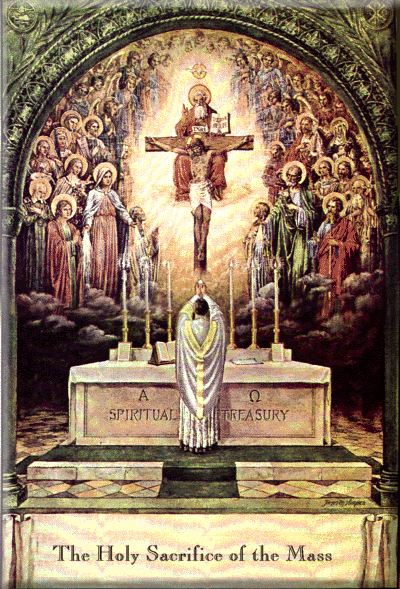
** http://catholicapologetics.info/library/directory/holymass.gif