From the Catechism of the Catholic Church:
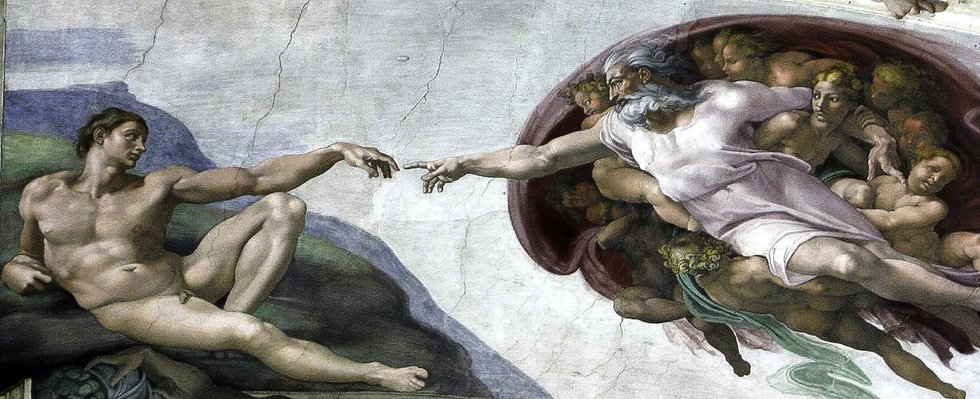 |
| Michaelangelo's "Creation of Man" |
#1 God, infinitely perfect and blessed in himself, in a plan of sheer goodness, freely created man to make him share in his own blessed life. For this reason, at every time and in every place, God draws close to man. He calls man to seek him, to know him, to love him with all his strength. He calls together all men, scattered and divided by sin, into the unity of his family, the Church. To accomplish this, when the fullness of time had come, God sent his Son as Redeemer and Saviour. In his Son and through him, he invites men to become, in the Holy Spirit, his adopted children and thus heirs of his blessed life.
#2 So that this call should resound throughout the world, Christ sent forth the apostles he had chosen, commissioning them to proclaim the gospel: "Go therefore and make disciples of all nations, baptizing them in the name of the Father and of the Son and of the Holy Spirit, teaching them to observe all that I have commanded you; and lo, I am with you always, to the close of the age."4 Strengthened by this mission, the apostles "went forth and preached everywhere, while the Lord worked with them and confirmed the message by the signs that attended it."5
 |
| Christ teaching the Apostles |
#3 Those who with God's help have welcomed Christ's call and freely responded to it are urged on by love of Christ to proclaim the Good News everywhere in the world. This treasure, received from the apostles, has been faithfully guarded by their successors. All Christ's faithful are called to hand it on from generation to generation, by professing the faith, by living it in fraternal sharing, and by celebrating it in liturgy and prayer.6
There is a lot of talk in the Church these days about "changing teaching." This kind of talk is dangerous, especially when it fails to make clear the critical distinction between what is changeable, and what is not, among the Church's many teachings.
The whole of the "deposit of faith" is not changeable. As the quote from the beginning of the CCC shows, it is precisely this core content, revealed by God in the Incarnation, life, Passion, death, and Resurrection of Jesus Christ, as well as in Scripture and Apostolic Tradition, that must be kept whole and intact, and passed on to future generations. Christ Himself commanded that the Apostles (and their successors) do exactly that: preserve and hand on, without change, the teachings ("deposit of faith") He taught them.
 |
| St Bede the Venerable, preserving and proclaiming |
A certain bishop recently said, "We're not a Church of preservation, but rather a Church of proclamation." This is misleading. We certainly are a Church of proclamation, but the only thing we have authority (given by Christ) to proclaim is precisely what has been preserved, namely the apostolic deposit of faith. We're not free to add to it or subtract from it, to alter it, to rearrange its parts into a more pleasing pattern, to hide parts of it behind other parts of it, etc. We are given the mandate by Christ Himself to preserve it, and to hand it on. So, we are also a Church of preservation - not for the sake of preserving as an end in itself, but precisely for the sake of proclaiming something real and true.
So what constitutes that deposit of faith? Here's a brief schematic (following CCC #84 ff):
- Scripture and Tradition - the unchangingness of revealed/inspired Scripture is generally unquestioned, but some modern translations implicitly change the meaning by subordinating the actual text to (transient) cultural norms; "Tradition" tends to be understood rather nebulously, rather than as the concrete set of things the Apostles actually did and taught, and therefore passed on to their immediate successors to be received as essential to faith in Christ. The problem is precisely that Tradition is not written down. But, the synthesis of the Pastristic Fathers and the witness of the medieval and early modern Church does a good job of demonstrating in practice what Tradition really means.

An ecumenical council:
pope and bishops togetherMagisterium - the teaching authority of the Church. It has two and only two explicit duties, for which Christ has given His authority, namely, the preservation of the deposit of faith, and the interpretation of it across time and cultures. There is no authority given to innovate.- defined Dogma - Some aspects of faith are so overarching that they "crystalize" in dogmatic form. Dogma must be present from the beginning, as part of the deposit of faith, but may be demonstrated either from Scripture or from Tradition. Having been defined with full magisterial authority, dogma cannot be changed, and we should not lightly change the formula in which the dogma is expressed. Here's a short list (not trying to be comprehensive):
- Trinity - God is three persons in one substance; God is both transcendent and immanent
- Incarnation - Christ is both fully God and fully man; "remaining what He was, He became what He was not;" He truly suffered and died for our sins; His sacrifice on the Cross is sufficient for our redemption; He truly rose from the dead and took again the body he had previously assumed, now perfected and glorified; He founded the Church He intended to found; etc
- Church - "One, holy, Catholic, and apostolic," with a divinely-intended mission and "constitution," including the authority of the papacy and the episcopate
- Seven Sacraments - hence also the fullness of the liturgy, sacramental grace, the reality of sin and conversion, the necessity of baptism; the baptismal call to holiness; the revealed definition of marriage; the mission of the laity in the world as witnesses and disciples; the clergy
- Four Last Things
- Etc - all of these defined dogmas have numerous further implications for doctrine (positively expressed but not defined with highest authority), which likewise can't be contradicted without calling the dogma into question, as well as for pastoral practice, which likewise can't be contradicted (although there is generally a wide range of pastoral options that don't contradict the dogma)
- "sensus fidei," the actual unity of faith experienced as the instinctive acceptance of what is consistent with Catholic faith, and the instinctive rejection of what isn't - this is a sure guide, to the extent that it matches up with "what Catholics believe, always, everywhere, and by everyone"
- It is a greatly damaging modern conceit that only Catholics today matter, because Catholics in the past weren't "mature" or were "superstitous" or the like. This idea must be rejected as a grave sin of pride, and as a contradiction of the deposit of faith.
- "faith seeking understanding," the actual fullness of truth (sufficient for salvation) of the whole of the one faith, experienced as longing to know and love God by faith, contemplation, and study (study does not have to be formal; pious practices like reading the lives of the saints are also study, in this sense)

 |
| The Lamb of God |
All this content of the deposit of faith is ultimately received from God. Willfully to reject it, modify it, or subordinate it to personal whims or cultural demands is to commit the same sin of pride that caused the fall of the lost angels. (We sometimes do that not willfully, because we are finite beings, and because we are always under pressure from the world, the flesh, and the devil to make compromises. This is what we mean we say "The Church is always in need of reform.") To be faithful to Christ means that we must make every possible effort to receive the deposit of faith entire and uncorrupt (which is given to us with supernatural power in the sacraments and in the Magisterium of all time, so we can actually know it), and also to pass it on by our teaching, our witness, and our piety, likewise entire and uncorrupt.