Showing posts with label theological method. Show all posts

Friday, January 30, 2015

Cardinal Rodriguez Maradiaga, "Church of Mercy of Pope Francis," response in several parts - Part Four (and last)

This continues my explication and response to Cardinal Rodriguez Maradiaga's essay and talk, "The Church of Mercy of Pope Francis."  Previous parts are here and here and here.

“The Church of Mercy with Pope Francis” (cont'd)


3. To Bear Witness to God’s Mercy is to Commit to Man


The best testimony of charity and mercy is found especially in the saints, in their high level of Christian life and in the maturity of the live idea of God [True; but, their witness is also witness to “traditional” spirituality, and the apostolic and sacramental order inherent in the Church.  To invoke them is to defend that “traditional” spirituality which he seems want to change, and thus undermines his putative argument.]. The God loved and worshiped by saints reveals Himself gradually along with the fidelity and contemplative growth of the believer [“no one knows who the Son is except the Father, or who the Father is except the Son and anyone to whom the Son chooses to reveal him.” (Luke 10: 22)].


The biblical God is not the God of Theodicy or of pure rationality [Not sure what he means by this.  Does he mean this in a “traditional” way, namely, that, while our reason applied to the created world can find evidence that reveals God’s nature as Creator, reason alone cannot know God without the gift of faith?  Or does he mean something else, such as that “traditional” theology (often disparagingly called “onto-theology” should be rejected as “triumphalist” and “domesticating” of God?]: it is a God that has to be found, that has to be received as a gift and as a revelation. It is a different God… The Christian God is not exactly the God of the philosophers, of the logic and of the Theists. [Augustine and Aquinas, e.g., would certainly agree with this.]  Just believing in God does not make you a Christian. [“Faith without works is dead.”]  A Christian is someone who has discovered the biblical God; the God of Abraham, of Moses, of the Prophets, that revealed Himself in plenitude in the God of Jesus. [I assume he does not mean to imply, by the parallelism (God of Abraham = God of Moses = God of Jesus), that Jesus is not God.]  Through the history of Salvation, there is a gradual revelation of the face of the true and only God [i.e., Jesus Christ, true God and true man, who gave us the Church and the Sacraments as the primary means of salvation, and sends thereby the Holy Spirit to unite us to Himself and the Father]. The way of the Church’s pastoral conversion today is to guide individuals and cultures through that gradual revelation, though in different contexts and experiences. [This is a false dichotomy, if meant in contradistinction to some “traditional” method of pastoral conversion, imagined not to introduce to others that same face of God in Jesus Christ through appropriate contexts and experiences.]  Nothing reveals God more than love. Therefore, Pope Francis says (speech of November 14, 2013) that, “The Church’s primary task is to bear witness to the mercy of God and to encourage generous reactions of solidarity in order to open a future of hope. For where hope increases, energy and commitment to building a more human and just social order also grows, and new possibilities for sustainable and healthy development emerge.”


3.1 Full-Time Christians


In the Family Synod (October 2014) something notable happened for the first time: [What he describes here is exactly what Pope Benedict described having happened at Vatican II (e.g., again, the 2005 Christmas address, and elsewhere).  So this dichotomy of “two synods” is hardly the “first time.”  Is he ignorant or forgetful of Pope Benedict’s remarks, or is he implicitly contradicting and rejecting them?]  There were like two Synods because outside the precinct where the Synod Fathers were gathered, there was a media Synod that denoted a perverse intention to confuse opinions, invent answers, imagine solutions and exaggerate positions of those of us gathered there; instead, inside the working room a charismatic, serene, cordial, filled-with-unction-and-faith synod was taking place, seeking to agree and to answer the essential issues of family and marriage.


Many [in the false, media synod] identified as the unique and fundamental topic, issues that were merely secondary. For example, we did not talk only about giving “communion” to re-married Christians —that was a collateral argument, it was never essential. What was really said, and I repeat and emphasize, is that the realities of dissolved and rebuilt families are not an impediment to live and participate in the abundant life of the Church; that the “sacramental communion” is not the only way to vitally participate in the pastoral dynamic of the parish community and that every Christian couple that seeks God will find Him because he allows Himself to be found and that every re-married Christian can be a full-time Christian, has a right to be happy, and his house can become also a place where the love of God is born witness. [Well, yes, but... this should not be taken in a sense which downplays the uniqueness of the Eucharist.  There are many reasons why one might refrain from approaching Holy Communion at any given time, and such experiences indeed do not prevent the love of God from indwelling in us; but at the same time, it remains true that participation in the Holy Eucharist is the “source and summit,” and therefore the ideal, of the Christian life, toward which we are meant to strive.  If it lies within our power to remove an obstacle to our reception of Holy Communion, and we refuse to do so, are we not rejecting thereby the fullness of God’s love for us?  We must not take a complacent or minimalist attitude about our total union with Christ.]


For me, there is no “place in the basement” of the Church for Catholics that have wanted to rebuild their lives having remarried, though they cannot receive the Sacrament of Communion; there is no corner in attic for migrants that do not have documents in order and want to prepare their children in the sacraments of Christian Initiation; there is no special window in Heaven to assist those who have left the Catholic Church and have gone to other places seeking the warmth, refuge and respect that their mother has not been able to provide. [I think this is basically correct (Mt 23:4, Col 3:13, Eph 4:2).]


All these are challenges to our conscience and a strong and tough demand to our parish practices that are so rigid and narrow-minded. [Indeed, it is possible that we fail to live up to these high standards of radical love, and that we fail to evangelize and to foster faith in others.  And some of the ways in which we can so fail might well be called “rigid” or “narrow-minded.”  However, if he means here to identify “rigid and narrow-minded” with “traditionalist,” as above, then he’s going too far.] That is why the Pope said to be careful not to turn the parish and episcopal offices into “customs.” And he is completely right. (Santa Marta, May 25, 2013). To remember the whole message, I quote: “We are many times ‘controllers of faith,’ instead of becoming ‘facilitators’ of the faith of the people,” lamented the Pope during his daily mass at Santa Marta’s Guest House in the Vatican. In his homily that was broadcasted by Vatican Radio, the Argentine Pope mentioned a priest who refused to baptize the son of a single mother, “this girl who had the courage to carry her pregnancy (…) and what does she find? A closed door,” affirmed the Pope. [We need to know more about this anecdote before we can conclude that this priest acted “rigidly” or “narrow-mindedly.”  Just by itself, the quote does not demonstrate what he claims.]


Nobody is excluded from the Church of Christ. [True, but many people exclude themselves by rejecting God’s mercy, love, and grace.]  There is a place for everybody, for the migrants, for those who one day abandoned the Church but come back convinced that they can stay forever, for those married-divorced-remarried, for the poor, for everybody. Within these categories fall those that Francis calls “the least”, when he encourages: “The Church must step outside herself. To go where? To the outskirts of existence, whatever they may be. If we step outside ourselves we find poverty. We cannot put up with this! We cannot become starched Christians, those over-educated Christians who speak of theological matters as they calmly sip their tea. [Another false dichotomy.  Although his exhortation to embrace the mission is sound, the contrasting of “education” with “courage” is belied by, say, St. Dominic, etc.]  No! We must become courageous Christians and go in search of the people who are the very flesh of Christ, those who are the flesh of Christ! (Vigil of Pentecost, May 18, 2013).


3.2 The Culture of Good


The Pope’s words sounded strong when he said, “Be men and women with others and for others: true champions at the service of others” (December 2, 2013). [Another “traditional” exhortation.]  Following this, the Holy Father tells us something fundamental, three points that I want to share with you today to finish my talk here: [First point: importance of public Christian witness to mercy, love, hope] “In your society, which is deeply marked by secularization, I encourage you also to be present in the public debate, in all the areas where man is at issue, to make God’s mercy and his tenderness for every creature visible.” Yes, dear Friends, let it be a task and commitment for you to work courageously and heroically “where man is at issue.” Only in that manner will we bear witness of God’s mercy, the mercy that is love —and love that begins at home. [His three points here returns to the tenor of Part I, above, which seems quite orthodox, but now there is a deep, ambiguous tension in his words.  Does he mean this conclusion in a “traditional” way, with the apostolic and sacramental commitments thus implied, or is he evoking some “new” ecclesial vision and order?]


[Second point: importance of strong spiritual foundations] The incarnate aspect of spirituality, turning life into a transcendental humanism according to the Spirit, is what lays the foundation for the Christian mystic. [Are we to take this in continuity or in rupture with the great spiritual masters?]  It is focused on the search for God through Jesus, but also focused on man and the search for fraternal love. It lives in the hope that the Kingdom will have no end but it centers completely on the tasks of a Kingdom in history and in society. It receives faith as a gift from God, irrepressible to any human experience, but it knows that faith takes diverse shapes [“unity in diversity” has always been acceptable; but there are limits, since some diversities do indeed break the unity] and demands according to the cultures, the challenges of society and the individual commitment, and that all human or Christian commitment must also be a place of the experience of God.


[Third point: priority of the “preferential option for the poor”] Since certainly, the privileged “place” in which Christ’s Mercy becomes incarnate and becomes practice is in the love for the brothers and sisters, and in the preferential love for the poor and the suffering. The temporal reality that summarizes all the incarnations of the mystic, all the realism of the Christian spirit, and that gathers all the demands of the practice of the faith and love, is the brother, is the poor. [Are we meant to take this in continuity with the “traditional” understanding of the Great Commandment, or as a “new” understanding?  How does this understanding of love of neighbor relate to the traditional understanding of the love of God?]  The God hiding in the faces of our brothers is the supreme experience of incarnation and to practice mercy is its definitive stamp because “mercy is the true force that can save man and the world” (September 15, 2013). [Again, continuity or rupture?]


[Overall, this essay is pretty forceful and coherent, but it has a significant issue in the middle.  Part I and the first two sections of Part 2 are clear and reasonable.  He does not directly contradict anything in the Church’s traditional understanding of Scripture, Tradition, mission, vocation, or evangelization.  However, one must supply the full understanding of these topics.  The absence of any mention of the place of the Sacraments becomes striking in the middle of the essay.  In this sense, in the last two sections of Part 2 (2.3 and 2.4), when dealing explicitly with the “traditional” Church and the changes following Vatican II, he seems strongly to take the position of the “hermeneutic of rupture,” rejected by Pope Benedict XVI (and Pope St. John Paul II).  His language is vague and his meanings remain rather uncertain.  It is difficult to understand what he could mean if his vision is not essentially that of the hermeneutic of rupture, but it is also difficult to know clearly what he means even within that point of view.  His arguments in this section remain unconvincing, especially the flawed argument from authority.  In the final section of the essay (Part 3), his failure to mention the sacramental economy as the primary avenue of mercy for the Church and the world in the beginning of the essay, along with the appearance of taking the hermeneutic-of-rupture position in the middle of the essay, introduces a devastating ambiguity into his conclusions.  The reader no longer knows how to understand what is being put forth.  The language and content seem to hew close to the Church’s proper understanding of the topics at issue, but we cannot be certain that he means the same things by these same words. 


The best reading of the essay, then, I would suggest, is to set aside the unconvincing middle section, and to embrace the hermeneutic of continuity at least implicitly taken in the beginning.  By this reading, the conclusion becomes a straightforward, fairly strong and urgent, exhortation to deepen our missionary zeal, and to work more to overcome the various obstacles to the spread of the Gospel that our own weakness, sins, and particular historical/cultural blind spots might impose.]

Thursday, January 29, 2015

Cardinal Rodriguez Maradiaga, "Church of Mercy of Pope Francis," response in several parts - Part Three

This continues my explication and response to Cardinal Rodriguez Maradiaga's essay and talk, "The Church of Mercy of Pope Francis."  Previous parts are here and here.

“The Church of Mercy with Pope Francis” (cont'd)


2.3. The Finish Point: The Church of Mercy


We walk as Church towards a deep and global renovation. [I think “renewal” is what he means.]  For this renovation to be sincerely Catholic, it must encompass all of the historical dimensions of the Church.


Specifically, there is no true ecclesial renovation without a transformation of the institutions [Here he begins to say things that seem to contradict what he has already established.  Especially, it’s not at all clear what it might mean to “transform” the essential institutions of the Church – namely, the hierarchical-apostolic order, the organization into dioceses/parishes/religious houses, and all that serves the sacramental and pastoral care of souls – in any sense that would remain “Catholic.”]; of the quality and focus of the activities; of the mystic and the spiritual. Usually, renovation begins with pastoral activities. For it is there where the inconsistencies of a certain “model” of the Church and reality are primarily experienced. The missionaries, the evangelists on the “margins” of the Church, are the first ones to notice the insufficiency of the “traditional” ways of action; the pastoral criticism begins with the experience of the mission in the “peripheries.” Changes and adjustments begin there. [This, too, is curious, because the “margins” of the Church (Asia, Africa, the pro-life movement, the pro-traditional-liturgy movement, etc.) seem quite consistently to want something much different than this next paragraph calls for:]


After Vatican Council II, the methods and content of evangelization and Christian education change [not always for the better]. The liturgy changes: local languages are adopted, some rituals and symbols change, measurements are taken for a greater participation, etc. The missionary perspective changes: the missionary must know the culture, the human situation; the missionary must establish an evangelizing dialogue with those realities. “Social action” changes, it is no longer just charity and development services but also struggle for justice, human rights and liberation… [Some notable false dichotomies in here. One thinks, e.g., of the first generation of Jesuit missionaries in Asia in the 16th century, of whom it certainly could not be said that they did not learn and value the culture, the language, the people, etc.; nor is “the struggle for justice, human rights, and liberation” a new thing in the Church in the later 20th century.  But since these efforts have always been there, too, this paragraph implies either a repudiation of the Church before Vatican II, or a confusion about what the Church did for its mission in previous generations.  In either case, it is quite superficial and misleading to present it in this manner.]


For Christian coherency, certain institutional and organizational changes are contemplated simultaneously: new functions require new suitable institutions. [Again, it’s not at all clear what “new functions” he means.]


The Council propelled institutional renovations, following the logic of the Spirit. [Note the dangerous implication that the Church before the Council was not following the same logic.]  These reforms encompass all levels of the ecclesial organization: the religious congregations or missionary societies —whose “Chapters of Renovation” multiply— the diocesan and Vatican Curia, Episcopal Conferences, the Synods, the parishes, the pastoral areas, the presbyteries, the lay apostolic institutions, the teaching of theology, the seminaries, the catholic schools… New institutions for missionary dialogue emerge: ecumenism, Jews, other religions… Everything in the Church changes consistent with a renewed pastoral model. [Exaggeration for effect? Clearly, not everything in the Church changes.  But it’s important to note, I think, what he’s eliding here by implication, namely, the apostolic and sacramental order labelled “Tradition.” This therefore could be taken to contradict what he sketched out in Part I, above.]


Maybe some thought that the Church renovation was only that. But the institutional and functional changes —alone in themselves— proved insufficient, superficial. [This language becomes quite dangerous.  Note how he now implicitly pits “the Church before the Council” and “the Church after the Council” against each other, in just the manner Pope Benedict taught must not be done (e.g., in the 2005 Christmas address to the Curia).] Sometimes they created new problems and crises both unnecessary and deep. Any change in the Church eventually requires considering a renovation of the motivations that the new options inspire. Without deep-rooted, living and explicit motivations, no human group, no institution and no society can survive for a long time, much less renovate itself. Motivations answer to the fundamental “why” of the options, the enterprises, the demands, and the same reason for being of the institution.


The Pope wants to take this Church renovation to the point where it becomes irreversible. The wind that propels the sails of the Church towards the open sea of its deep and total renovation is Mercy.


For the Church, the motivations are more than essential; they are its identity stamp. The “why” of its organization and its action cannot be decisively explained by the human sciences or the pure historical rationality: they refer to Jesus and his Gospel as the global, indispensable and predominant motivation. It is the motivation of the Spirit. Therefore, to speak of motivations in Christianity is to speak of the mystical, of spirituality. [Right.  In Part I, he seemed to agree that it is of the essence of the Church founded by Christ that this “why” goes to the reception of grace/mercy and the journey of conversion, via Scripture and Tradition, the Sacraments, and the works of mercy. Now, he’s hinting at some new “why,” some new relationship in the Church between “mercy” and “concrete love,” that would change the essential shape of Tradition.]


The institutional and functional renovation of the Church requires a renovation of its mystical dimension. And at the roots of the mystical is mercy.


2.4 The Maternal Heart of Mercy


Catholic spirituality in history, due to its same incarnate nature, never takes place as an “activity” isolated from the pastoral, the theological, the social and the cultural conditions. [That’s certainly true of the Sacraments, too.]  Since one of its dimensions —it is not the only one— is to motivate believers to follow of Jesus. This following acquires renovated nuances, demands and topics consistent with the mission and with the human experience of the believers. While the life of Christ and the Gospels are always the same, the experiences and the options that inspire are always historical. [What does this mean for Tradition?]


Spirituality is not a science nor one more praxis in the Church. It is the “nourishment” of the pastoral, the theology and the community, whatever their “model” is. [But in this broad sense, “spirituality” must be unchanging, part of what comes to the Church immediately from God.  He seemed to accept this in Part I, but now he seems to contradict himself.]


When this was forgotten by the process of ecclesial renovation, [I’m guessing he missed the implication here that it was not forgotten by the Church before the Council...]  this caused “schizophrenia” in some Christians, which is one of the causes of many failures. In a short time, they progressed in all of the levels of the renovation. They changed many pastoral, theological, and disciplinary categories. The image and the mission of the Church changed. Likewise, its concept that related faith with history and society changed; therefore the social and political options became more important.


In this context, there was no mystical renovation and it remained “traditional,” consistent with another vision of the faith and of the mission, and inconsistent with the new ecclesial experiences. [And there it is: “traditional” = “bad.”  Notice how he now elides Tradition by labeling it merely “another vision of the faith the mission” – as if the fundamental orientation of the Church were so malleable!  Again, in his argument in Part I, he seemed to accept Tradition; now, he is claiming that “traditional” spirituality, rooted in the “traditional” understanding of Scriptures, apostolicity, sacramentality, devotions, etc., is no longer fit for the Church.  So, either this section of the essay is confused and unhelpful, or else his real argument is this: If our fundamental spiritual “experience” and “vision” remains that of the Apostles, the Fathers, and the Councils, then we are “schizophrenic” and “inconsistent!”]


In this context, a spirituality does not motivate, it becomes irrelevant. It ends up being perceived as a useless appendix and ends up being abandoned, since a mystic that does not nourish the human experience stops having meaning; a spirituality that is foreign to the ecclesial model that is being lived leads to the crisis of the Christian “schizophrenia.” Many abandonments of the ecclesial life, and even of the faith, are rooted there. [Even granting this “being foreign to the ecclesial model” to be true (which I don’t), this does not follow:] The only answer is not in abandoning all mystic or reversing the renovation of the institutions or options (due to fear of a collapse of the Christian values), but in deeply renovating the faith and spirituality starting from love to reach mercy. [Assuming he really means what he says here, this is an extraordinarily sweeping claim. He’s saying that the “traditional” model of the Church, and the spirituality that underpins it, do not “start from love to reach mercy.” So the whole of Church history, all the works of all the great saints and mystics of the past, the whole sacramental order and experience of the Church for 19 centuries, that was not really what God intended for the Church.  But now, somehow, almost ex nihilo, suddenly this tiny handful of people understand everything better and clearer than all the doctors of the Church and the whole of the faithful...] That is what the Pope wants. [And just in case you’re not convinced, he pulls out the argument from authority.  The (current) Pope is claimed to want it, so it must be right.]


In that regard, on July 28, 2013, Pope Francis said (speech): “She gives birth, suckles, gives growth, corrects, nourishes and leads by the hand… So we need a church capable of rediscovering the maternal womb of mercy. Without mercy we have little chance nowadays of becoming part of a world of ‘wounded’ persons in need of understanding, forgiveness and love.” [This quote doesn’t support what he claims.  Since “the Church is always in need of renewal,” the Pope is quite correct (in that sense) to say this; but such “rediscovery” means a return to what the Church has always done, in evangelical and apostolic integrity, not a substitution of some new ecclesial vision for the “traditional” one.]


On December 9, 2014, at the Chapel of the Santa Marta Guest House I heard the Pope say loud and clear what I will share now: “I ask myself, what is the consolation of the Church? [2 Cor 1:3-5 - he paraphrases thus:]  Just as an individual is consoled when he feels the mercy and forgiveness of the Lord, the Church rejoices and is happy when she goes out of herself [offering the same mercy and forgiveness to those who long, even inchoately, for reconciliation with God; as said above, this ultimately leads to full sacramental participation.]. In the Gospel, the pastor who goes out goes to seek the lost sheep – he could keep accounts like a good businessman. [He could say]: ‘Ninety-nine sheep, if I lose one, it’s no problem; the balance sheet – gains and losses. But it’s fine, we can get by.’ No, he has the heart of a shepherd, he goes out and searches for [the lost sheep] until he finds it, and then he rejoices, he is joyful.”


“When the Church does not do this [Has there ever been a time or place when the Church, qua Church, has not done this?  Or does he mean, when the members of the Church don’t?], then the Church stops herself, is closed in on herself, even if she is well organized, has a perfect organizational chart, everything’s fine, everything’s tidy – but she lacks joy, she lacks peace, and so she becomes a disheartened Church, anxious, sad, a Church that seems more like a spinster than a mother, and this Church doesn’t work, it is a Church in a museum. The joy of the Church is to give birth [i.e., to new disciples]; the joy of the Church is to go out of herself to give life [i.e., by those new disciples’ sacramental participation and sharing in the mission]; the joy of the Church is to go out to seek the sheep that are lost; the joy of the Church is precisely the tenderness of the shepherd, the tenderness of the mother.”


“May the Lord give us the grace of working, of being joyful Christians in the fruitfulness of Mother Church, and keep us from falling into the attitude of these sad Christians, impatient, disheartened, anxious, that have all the perfection in the Church, but do not have ‘children.’ [This is good.  As disciples, any of us might experience discouragement and loss of zeal, and we need this prayer continually.]  May the Lord console us with the consolation of a Mother Church that goes out of herself and consoles us with the consolation of the tenderness of Jesus and His mercy in the forgiveness of our sins.” [Again, these words of Pope Francis do not support the supposed argument about Tradition the Cardinal is possibly trying to make. The Pope is saying that we’re not good enough disciples, that we’re distracted by all kinds of weakness and sin from carrying out the mission of the Church consistently.  That’s true and always has been, and yet God works through us in spite of it.  This is quite a “traditional” thing to say.  But it doesn’t follow from this that “traditional” spirituality is faulty or inadequate.]


These are words accompanied by gestures of the Pope that speak of coherence. His actions and his harmony with those who need consolation are small pieces of encyclicals, they are itinerant “Pope Magisterium,” [Argument from authority again.  Moreover, if Pope Francis’s “gestures” and “small pieces of encyclicals” constitute this “itinerant papal Magisterium,” then so, logically, did those of Pope Benedict XVI, Pope St. John Paul II, and all the popes... which obviously leads to conflicting claims and irreconcilable differences within the Magisterium.  So this becomes a reductio ad absurdum, and is clearly not tenable. See LG #22, 25; Heb 13:9; Mt 7:15; etc.] they are prophetic gestures that arouse admiration and cause the holy emulation of what he does, because he does it as Christ did and Peter summarizes it at Cornelius’ house: “He went about doing good” (Acts 10: 38).


Cardinal Rodriguez Maradiaga, "Church of Mercy of Pope Francis," response in several parts - Part Two

This continues my explication and response to Cardinal Rodriguez Maradiaga's essay and talk, "The Church of Mercy of Pope Francis."  Part One of my response is here.

“The Church of Mercy with Pope Francis” (cont'd)


2. Mercy is the Highest Expression of Love


The Church presided in charity—as it is called liturgically—wants to be known in times of Pope Francis [and, indeed, in all times] as the house of mercy. The following text summarizes this symbol of identity: “I believe that this is the season of mercy. This new era we have entered, and the many problems in the Church – like the poor witness given by some priests, problems of corruption in the Church, the problem of clericalism for example – have left so many people hurt, left so much hurt. The Church is a mother: she has to go out to heal those who are hurting, with mercy.” (Pope Francis Press Conference on July 28, 2013)


The Pope’s words in this speech feel harsh for the corrupted, the abuser, the liar, the one who seeks power mundanely, but feel tender and benevolent, like balm and sweet to “those who are hurting.” [By itself, this risks being a false dichotomy. What about those already being healed, who seek to serve? Or those outside the Church still rejecting every approach of grace?]  A Samaritan Church will heal the wounds of those who are beaten, hurting and prostrated, those who have weakly fallen under the power of those who use violence. That is why the Pope’s words have such a deep evangelical meaning. Thinking about the Church as “a mother who has to go out to heal those who are hurting, with mercy,” puts her in a completely original role —the one from the beginning of Christianity— a Church that is close to people, incarnated and submerged in the existential history of man, turning their miseries into wealth and their weaknesses into their biggest strength. [Quite true, that Christ founded the Church to be a merciful mother to all, and that, inasmuch as the Church is indefectible (Mt 16:18), she has always been such.  But, he seems to contradict this, below...]  This makes us think of the Church in metaphoric similarities to a “home” and a “hospital”. The Church of Christ is the Church of Francis: beset with compassion.


2.1 The starting point: God’s Mercy


In the Angelus from September 15, 2013, the Pope said: “Remember this well, ‘There is no limit to the Divine Mercy which is offered to everyone,” since “Mercy is the true force that can save man and the world from the “cancer” that is sin, moral evil, spiritual evil. Only love fills the void, the negative chasms that evil opens in hearts and in history. Only love can do this, and this is God’s joy!”


Starting from God’s Mercy, the Church that allows itself to be led by that mercy [What’s his implied contradiction here? Is it possible to imagine “the Church,” qua Church, not allowing itself to be led by divine mercy?] becomes infinitely generous and can take the commandment of Love to the ultimate consequences, knowing that it is Love what saves man and the world, or what saves man from the world. If sin is considered a “cancer” and can disguise itself as moral evil, spiritual evil and psychological evil, then the universal remedy against any form of evil will be the love that becomes forgiveness [In its fullness, this means participation in the holy Eucharist: LG #13, etc.]; it will be the love that becomes hope able to give meaning to so many empty lives and so many human lives beset with pain and frustration. If something is able to redeem from sin it is the Cross of Christ. Therefore, everything that fits under the Cross’ shade is redeemed. [In this image, one sees Mary and John at the foot of the Cross, with the whole apostolic, sacramental, and devotional “spirituality” thus evoked.]


It is not just Christ’s pain and his passion that redeem, it is not just the cross that saves us: his pain, his passion and his cross have redeeming power because of Love. [Because the Love is God Himself; see CCC 602, 603, etc.]  It is then Christ’s crucified Love that gives back meaning to human existence and elevates it to the dignity from which sin deprived it and that Jesus’ decision, dying for love in the cross, recovered.


If the world experienced how big God’s love and salvation initiative are, all temples would be filled with people asking for the holy sacraments of Confession, Baptism, Anointing of the Sick and Eucharist. Priests would not be able to handle such a need for absolution, blessing or communion since entire multitudes —convinced of that infinite love of God, origin of salvation—, would understand that truth and life have a name: Jesus. And his name is Love.


That is why the Pope says, “Only love fills the void,” Which void? Superficiality, noise, alienation of the heart that hardens when it lets itself be taken over by consumerism, love for money, the culture of death, the maelstrom of pleasure in all its forms, the drugs and the life without God. [In a word, sin.]  If man’s void was filled with God’s mercy and mercy could be experienced in the Church, nobody would abandon their parish, temples would be packed with faithful, seminaries would be filled with young men that would leave the field of daily worries to devote themselves to serve God and console their brothers. This is not idyllic nor poetic, it is as realistic as the pain that only love can heal. Void cannot be filled with another void. It has to be filled with content and realities that can sublimate and explain them. [I.e, the real encounter with divine love and mercy, of which the highest form is in the Sacraments.]  That is why the answer that man—wounded—seeks as the ultimate meaning of his existence only exists in God. If people were to found a Church close to the people, compassionate, a companion, identified with the bleeding pain of so many “sick” and terminally ill lives, the Church of Christ, the Church that Pope Francis presides today, would be more credible and necessary. [I certainly don’t think he means that people founded the Church instead of Christ, but he does begin here to drive in the wedge of “Church of Christ = Church of Francis, but not = Church of, say, Trent...”]


2.2. The Point of Encounter: Man’s misery


It is starting from God’s mercy how we reach man. That is why every honest meeting with the existential reality of man takes place under the sign of mercy. It is either mercy or judgment. [A perfectly correct dichotomy (e.g., CCC 1021)]  And the Church is not here to judge, condemn, reproach or reject anybody but to embrace as in a home where love reigns for everybody who needs it. [No, but, let’s not gloss over the rather critical step of one’s acceptance of mercy and entering into the path of conversion.]


Pope Francis explains that Jesus’ mercy towards man is not so much a feeling as a force. He says it in this manner, “it is a force that gives life, that raises man up! (…) “This compassion is the love of God for man, it is mercy, the attitude of God in contact with human misery, with our poverty, our suffering, our anguish,” (Angelus, June 9, 2013).


[This paragraph is good:] It is not a simple emotional harmony of the agreement of altruist feelings but a real assumption and possession of the misery of man by God. When Christ was Incarnate by the Holy Spirit of the Virgin Mary and was made Man (cf. Nicene’s Creed), he took as his all human beings reality, all their miseries to redeem them and save what was lost. He did it in a way that where there was man in his circumstances, where there was a person conditioned by his or her own existential environment, where life weighs and existence hurts, where depression and absurdity stand out, God’s love arrives, repeating what the Pope said, “the attitude of God in contact with human misery, with our poverty, our suffering, our anguish,” (idem). God does not become absent from man. Instead, moved by mercy, He has an eternal appointment with him to heal his misery and proclaim about each life and about each history a new hope made up of forgiveness, comprehension and deep tenderness. This type of God wants this type of Church. [Yes; and in fact God has this type of Church, since it’s precisely this Church which He founded.]


Therefore, following Jesus does not mean to participate in a triumphant entourage. [Again, yes, but... We certainly embrace humility and reject “triumphalism” in any of its worldly senses (see Mt 20:25-6; 1 Pet 3:5; etc.), but the victory of Christ over sin and death is a triumph worth celebrating; and the host of saints entering Heaven in “martial array” (e.g., 1 Kgs 8, Rev 19, etc.) is “triumphant” in a good sense, which it would damage the Church to lose – to wit:] It means to share his merciful love, to enter his great work of mercy for each man and for all men.

Wednesday, January 28, 2015

Cardinal Rodriguez Maradiaga, "Church of Mercy of Pope Francis," response in several parts - Part One

Oscar Andres Cardinal Rodriguez Maradiaga speaking at SCU
(photo from the Markkula Center's website)
Last week, at Santa Clara University, at teh Markkula Center for Applied Ethics, Cardinal Rodriguez Maradiaga gave a talk on "The Church of Mercy of Pope Francis."  He is an important figure these days, being not only the cardinal archbishop of Tegulchigalpa (capital of Honduras) and president of the Church's charity arm Caritas Internationalis, but also member and chairman of Pope Francis's special council of cardinal-advisors.  His talk in the USA was therefore a notable Church happening.

Santa Clara was good enough to publish the text of his essay.  In the spirit of fraternal dialogue, I offer a thoughtful and, I hope, constructive response.  The published text is in black, [with my comments in red, inserted].  The essay is somewhat long, so I'm breaking it into several parts, following the sections in the original.  Here is Part One of my response.

“The Church of Mercy with Pope Francis”


1. The Gospel is summarized in love


Fraternal love has its origins in God, who is Love and that loved us first. [Yes, quite so.] He spreads his love unto us, through the Holy Spirit [By what means?  See below...], so that, in each of us, that love can grow, mature and resemble true love —the love with which Christ loved us.


If we are able to love, it is because God communicates his love to us. If we can love, it is due to Christ’s death for love and His resurrection, which have made love possible [not only by imitation, but especially by participation; the Sacraments make us capable of loving like Christ – see LG #11; CCC 150, 221-227, 654, etc.  This critical understanding of “divine love” is consistently elided in this essay.]. This love of Jesus is the measure [and “source and summit”] of love. The Christian ideal surpasses [precisely in sacramental participation, without which it remains merely “humanistic”] the pure humanism of interpersonal equality ("don’t do unto others what you don’t want others to do unto you; do unto others what you want others to do unto you"), and pushes us to love as Christ loved us. Therefore love’s growth has no limits in our life. That is why learning to love is the great task of Christian spirituality, always unfinished. [So there is a necessary supernatural element in human love which participates in Christ’s perfect love.]


Sometimes there is the risk of focusing spirituality on other goals, other values, and not giving supremacy to the Beatitude of Mercy [“Blessed are the merciful, for they will be shown mercy.”]. This Beatitude teaches us that according to the Gospel, it is both solidarity and commitment of efficient love towards the brother in need and suffering misery, and the forgiveness of offenses and the reconciliation.


Mercy is the practice of fraternal love, and it shows us the concrete ways of the incarnation of love: the reconciliation and the liberation from miseries. [But also in a supernatural sense; therefore liberation from spiritual miseries (i.e. sins and the effects of sin) is also always central to the presence of divine mercy in the world, i.e., the mission of the Church.]  Jesus’ teachings reveal to us that practicing mercy is the only universal way that builds fraternity (that makes us brothers and sisters to one another). [True and full fraternity is unity in the Church; see LG #2, #13 – “All men are called to belong to the new people of God...”]  That is the message of The Parable of the Good Samaritan, which is the parable of the true practice of mercy and fraternal love (Luke 10: 25-37). At the end of the parable, Jesus asks the experts in the law, “Which of these three do you think was a neighbor (brother) to the man who fell into the hands of robbers?” (Luke 10: 30). It means that the three were not brothers of the wounded. They could have been, but in fact “the one who showed him mercy” (Luke 10: 37) was. The priest was not a brother of the Jew and neither was the Levite, the Samaritan was. For Jesus being a brother to others is not something “automatic,” like an acquired right [because of the reality of sin]. We are not brothers without practicing love. Saint Paul reminds us that we gain nothing if we serve the poor or surrender to martyrdom if we do not have love (I Cor. 13: 1 et seq.)


[This paragraph is very good:] Regarding the commandment of growing in love, we must acknowledge that we do not know how to love. [Again, he’s invoking the reality of sin.]  Our love is usually a caricature (Rom. 12: 9: “let love be genuine”). Our selfishness, our worries and our sensitivity take us over. Nevertheless we know that fraternal charity is the most difficult Christian and human realization: to be able to love as Christ loves us. [This is what we’re striving for in the whole of the spiritual life, and why we need constant recourse to the grace of the sacraments, and to deeper prayer.]  We know that on Earth we will never reach the perfection of love; we know that we will continually fail, that we do not know how to overcome division and rancor, that every day we are timid in serving, in welcoming, in forgiving and in giving something of our lives for others. All this does not mean that we do not want to love or that in fact we do not love. Love is the way of love, to love is to want to love. What God asks of us, essentially, is not the success of charity but the permanent effort to grow in love and the struggle to learn to love, which begins every day. In the struggle to mature in love, the “human” and “evangelical” aspect of love walk together hand in hand, without ruptures or contradictions.


There is no separation between human love and Christian charity. [True; but there is the distinction, already noted above, between natural and supernatural realities.]  There should not be in practice a quandary between evangelization and social action born out of charity. The commandment of love that Christ gave us coincides with the vocation of man to grow affectionately, to give and give oneself above receiving and possessing.


Indeed, the mission, the mercy and the service to the poor and to all brothers as a human and missionary experience must be a place of discovery of God, of greater knowledge of the face of God. God’s Spirit reveals Himself in the values of self-giving and service, the aspirations to justice and solidarity, in each conversion, in the “little ones”, the suffering and the indigent… Human reality, cultures, are filled with the presence of the Holy Spirit and the action of God that builds the Kingdom; they lead us to experience God Himself. [This is all quite true, but again, must not be taken in a sense which denies that the Sacraments are also encounters with God, or that drives any kind of wedge between prayer/liturgy/sacrament and charity/social action; see below...]


The social dimension of the mission implies becoming “contemplative in the action.” Both dimensions of the evangelist’s spirituality are inseparable: The God that is experienced and loved in Himself and through himself, and the God experienced and loved in the brothers. The first dimension underlines that Christianity is transcendental to any temporal reality; the second dimension highlights that Christianity is incarnated and inseparable from the love to the brother. The first one reminds us of the first commandment to love God above everything else, and the absolute of the person of Jesus. The second one reminds us of the commandment similar to the first one, to love your neighbor as yourself and the presence of Christ in that love. [I like his stress on the inseparability of these two dimensions.  This is all quite true.]


The Christ found and contemplated in the prayer of the faithful “prolongs itself” in the encounter with the brother, and if we are able to experience Christ in the service to the “little ones,” it is because we have already found Him in the contemplative prayer [and the Sacraments; or rather, because He has found us (Jn 15:16)]. Social charity is not only to discover Jesus’ presence in the brother (“you do it to me”), but also a call to action in his favor, a call to commitment. That is why if we evangelize with Christ in our hearts, we will do the works he did. [“Having Christ in our heart” is not a feeling or a choice we make, but only ever a response to His love and mercy we have received – the response of faith, which, he’s just been stressing, comprises inseparably the love of God (Church and Sacraments, etc) and the love of neighbor (vocation and mission).]


Jesus certainly has widened the horizon and the demands of love and has given it new motives and meaning. But his demands for evangelical charity take place and develop in the interior of human love, the emotional nature and the heart, though they are surpassed by the faith and action of the Holy Spirit. (For which fraternal love it is not always sensitive and gratifying). We learn to love following Jesus through love. Once more, he shows us the true practice of love, and communicates to us the light and life to be able to love like he loved us and to be able to evangelize as he did.


Wednesday, October 8, 2014

Society for Catholic Liturgy conference, Oct 2-4, 2014, in Colorado Springs

This past weekend I presented a paper at the annual conference of the Society for Catholic Liturgy, in Colorado Springs.  St. Mary's Cathedral was a great venue for the conference, and it was great to meet some new people and hear some quite excellent papers and presentations.

Here are some brief write-ups about the conference.  The main keynote was from Bp. Conley of Lincoln.
Bp. Conley giving keynote at St. Mary's Cathedral. Picture by Jennifer Donelson.
 
My paper was called "Order of Levitical Blessing: Fruitfully Reclaiming a Patristic, Liturgical Typology of the Diaconate."  I argued that the Latin Church very early developed a theology of the diaconate based on the type of the Levite, the second priesthood (after that of Aaron) of the Old Testament.  We can see this type used in a wide variety of sources, liturgical and non-liturgical.  I sketched out the main lines of development of the type, noting its moral arguments and its theological implications for relationships among the grades of Holy Orders, and I examined the use of the type in the ordination rites of deacons in the Latin Church (citing texts from the Leonine Sacramentary, Gelasian Sacramentary, Gregorian Sacramentary, Missale Francorum, Liber Ordinum (Mozarabic Rite), and Tridentine (1595) Pontificale Romanum), and comparing the much more limited use of the type in the current (2012 English edition) Pontificale.  I showed how the Tradition had developed an understanding of specific blessings or graces for the Church in the separate ministry of deacons, complementing that of other orders, and how that idea disappeared from the current recension of the rite, because it used only New Testament passages to develop a (slightly different) theology of the diaconate.  I therefore suggested that re-introducing the previous Old Testament typology to our understanding of the rite and of the diaconate would greatly add to the Church's reflection on the renewal of the diaconate, and help us answer key questions about certain aspects of its sacramentality, and about its distinctive place within the layers of the Church's ministry.

Thursday, May 15, 2014

Apostolic Succession: Thoughts on the Feast of St. Matthias, 14 May

Yesterday was the Feast of St. Matthias, the one chosen in Acts 1:15-26 to take the place of Judas among the Twelve.  I preached on how this demonstrates Apostolic Succession, and what that means for our faith today.  This is an extended version of what I preached about, more in the form of reflections than the homily was.

Here's the text, according to the Douay-Rheims version:

In those days Peter rising up in the midst of the brethren, said (now the number of persons together was about an hundred and twenty): Men, brethren, the scripture must needs be fulfilled, which the Holy Ghost spoke before by the mouth of David concerning Judas, who was the leader of them that apprehended Jesus: Who was numbered with us, and had obtained part of this ministry...  For it is written in the book of Psalms: Let their habitation become desolate, and let there be none to dwell therein [Ps 69 (68):26]. And his bishopric [Vulg "episcopatum;" LXX "επισκοπήν, episcopen"] let another take [Ps 109 (108):8]. Wherefore of these men who have companied with us, all the time that the Lord Jesus came in and went out among us, Beginning from the baptism of John, until the day wherein he was taken up from us, one of these must be made a witness with us of his resurrection. And they appointed two, Joseph, called Barsabas, who was surnamed Justus, and Matthias. And praying, they said: Thou, Lord, who knowest the heart of all men, shew whether of these two thou hast chosen, To take the place of this ministry and apostleship, from which Judas hath by transgression fallen, that he might go to his own place. And they gave them lot, and the lot fell upon Matthias, and he was numbered with the eleven apostles.

This passage clearly shows us the criteria in the minds of the earliest disciples, including the Apostles, even before Pentecost, of what would come to be called "apostolic succession."  I've highlighted the key passages:
  • Peter rising up... - It's Peter's role as the leader of the Twelve to take this action.  Right from the beginning, Peter has a distinctive leadership among the Apostles, rooted in the events of Mt 16:18-19 ("You are Peter, and on this rock...") and Jn 21:15-17 ("Do you love me? Feed my sheep." (thrice)).  The first several chapters of Acts bear this out.  When Peter eventually becomes Bishop of Rome, this headship will be exercised by his successors, Linus, Cletus, Clement (e.g., in his Letter to the Corinthians), etc., and become the basis of papal authority over the whole Church.
  • ...the scripture must needs be fulfilled... - The action described here is explicitly understood to be divinely inspired, both in the action of the Holy Spirit among the community prompting Peter's leadership, the community's responses, and the eventual choice of Matthias - note, again, this is before Pentecost! - and in the Scriptural foundation now revealed to be a prophetic preparation for this moment.  God is in charge, and therefore the whole doctrine of apostolic succession is "of God."
  • And his bishopric let another take... - The divine shape of the office of bishop is, in is essence, also rooted in Scripture and in the use Christ and (here) the Holy Spirit make of it.  Peter uses Ps 109 to call the position held by Judas and now to be given to another the "episcopate."  In the Greek and in the Latin, the connotation is not generic, such as "manager" for us today is generic, but something with more specific, even if still flexible, outlines, function, and purpose.  
  • ...one of these must be made a witness... - part of the essence of the office being given is that of witness, of one who can proclaim the Good News and the Kingdom as an eyewitness and credible testifier.  
  • ...a witness with us... - the unity of the Twelve in this mission, among themselves and together with Peter their leader, is paramount.  This is still true today; see e.g., Lumen Gentium 18: "This Sacred Council, following closely in the footsteps of the First Vatican Council, with that Council teaches and declares that Jesus Christ, the eternal Shepherd, established His holy Church, having sent forth the apostles as He Himself had been sent by the Father; and He willed that their successors, namely the bishops, should be shepherds in His Church even to the consummation of the world. And in order that the episcopate itself might be one and undivided, He placed Blessed Peter over the other apostles..." etc.
  • ...a witness with us of his resurrection. - The bedrock of the Gospel is the Resurrection of Christ from the dead.  It's not just that Jesus worked miracles, or taught a moral law, or challenged corrupt or lax religious authority, but most especially that He died and rose for us, that makes Christianity what it is.  One cannot proclaim or follow Christ without proclaiming and following the (hope of) the Resurrection.  Knowing and following the Lord Jesus must make this kind of difference in one's life.  
  • ...take the place of this ministry and apostleship... - Again, Peter and the Apostles are giving this task of proclaiming a specific authority and shape with this sort of terminology.  Their role in the Church is different from that of other disciples, even if they are still disciples first, as Ignatius of Antioch would say (Letter to the Romans, 4).  "Ministry," in particular, although it can often be a more generic word, takes on a specific, non-generic connotation in relation to the Resurrection of Christ, and the proclamation of that Good News by the Church (see e.g. Paul's usage in Rom 15:16: "That I should be the minister of Christ Jesus among the Gentiles: sanctifying the gospel of God, that the oblation of the Gentiles may be made acceptable and sanctified in the Holy Ghost.")  Here, Gospel proclamation and Eucharistic sacrifice are explicitly linked in "the ministry of Christ."
  • ...he was numbered with the eleven apostles. - In other words, Matthias held an equal position with the other Apostles, under the leadership of Peter, even though he was given this position by them, and not, as they originally were or as Paul would be, by Christ Himself.  The fullness of Christ gifts to the Apostles are still held by Matthias - and by extension, by all those chosen by the Apostles and by their successors.
What all of this shows is the critical importance of the doctrine of apostolic succession for the Catholic faith.  Jesus Christ gave specific teachings, spiritual gifts and powers, and a share in His own authority to the Twelve.  They in turned passed the same "inheritance" on, intact and unchanged, to Matthias and others (e.g. Timothy, etc.).  They in turn used the gifts for the same purpose (i.e. "ministry," namely, proclamation of the Good News, leadership of the Church in unity under Peter and his eventual successors, and the sacraments (e.g., baptism, Acts 2:38; Confirmation, Acts 8:14-17; Eucharist, Acts 2:46, I Cor 11:20; anointing, Jas 5:14-15; ordaining by laying on of hands, Acts 6:6, I Tim 5:22; witnessing marriages "in the Lord," I Cor 7:39; forgiving sins (but private auricular confession becomes normal for the use of this power only later), Acts 3:19, 26; 4:4...).

Therefore, we must recognize the fact that the Church exists from its beginning in Christ, in its fullness!  (See CCC 771ff.)  Christ gives everything necessary to the Church, in the beginning, completely.  Now, granted, there is the historical work of "unpacking" the fullness of this gift, doctrinally, sacramentally and liturgically, and in evangelization of the whole world, and indeed that unpacking continues even today.  But it is the unfolding of what has already been given, not the creation or invention of new divine gifts and revelations.

It's precisely this apostolic succession that ensures that we're dealing with the same divine deposit of faith, and not inventing new things for ourselves.  This is the essential argument of Irenaeus against Gnosticism, for example, and it has been deployed many times.  If the Eucharist does not come from the hands of Christ Himself at the Last Supper, then the Church invented it, and it is not essential or divinely intended.  If Holy Orders do not come from the hands and will of Christ Himself, through the Apostles (choosing Matthias, choosing the Seven in Acts 6, Paul choosing Timothy, etc), then the Church invented these roles and rules, and they are not essential or divinely intended.  And so forth.  This is exactly what we mean when we say in the Creed that we believe the Church to be "apostolic" as one of its defining realities.

This doctrine is part of the faith we receive in baptism, but it is not, in the strict sense, a "mystery."  It is not impenetrable, nor does it exceed reason to consider in what way, precisely, as recorded in the New Testament and as lived out in the history of the Church, the concrete and tangible gifts of ministry were given by Christ to the Apostles, and were used by them in the first three decades of the Church, and were handed on intact by them to their successors, to be used still further for the building up of the Church, and so on.  It is entirely rational and historical to grasp this part of the faith, and to apply it to the realities of the seven Sacraments, the Church's worship in general, the moral life, and the life of charity.  The great apologists of the second century - e.g., Irenaeus, Justin Martyr, Tertullian, Clement of Alexandria - did exactly that in defending apostolicity against both Roman (pagan) syncretism and Gnostic mythologization, and others since have imitated them.

But contrast this understanding of faith against the most common assumption or model of the modern world, namely, "evolution."  Modern thought implicitly assumes that everything follows the pattern of evolution gleaned from biology - of more primitive things becoming more complex over time, following certain common patterns and driven not by clear purpose or teleology, but by "survival" or "fitness" in a specific context, or by mere self-perpetuation in some form.  Nearly every example of adaptation or change over time is squeezed in this evolutionary model, regardless of whether that actually helps understanding or not.

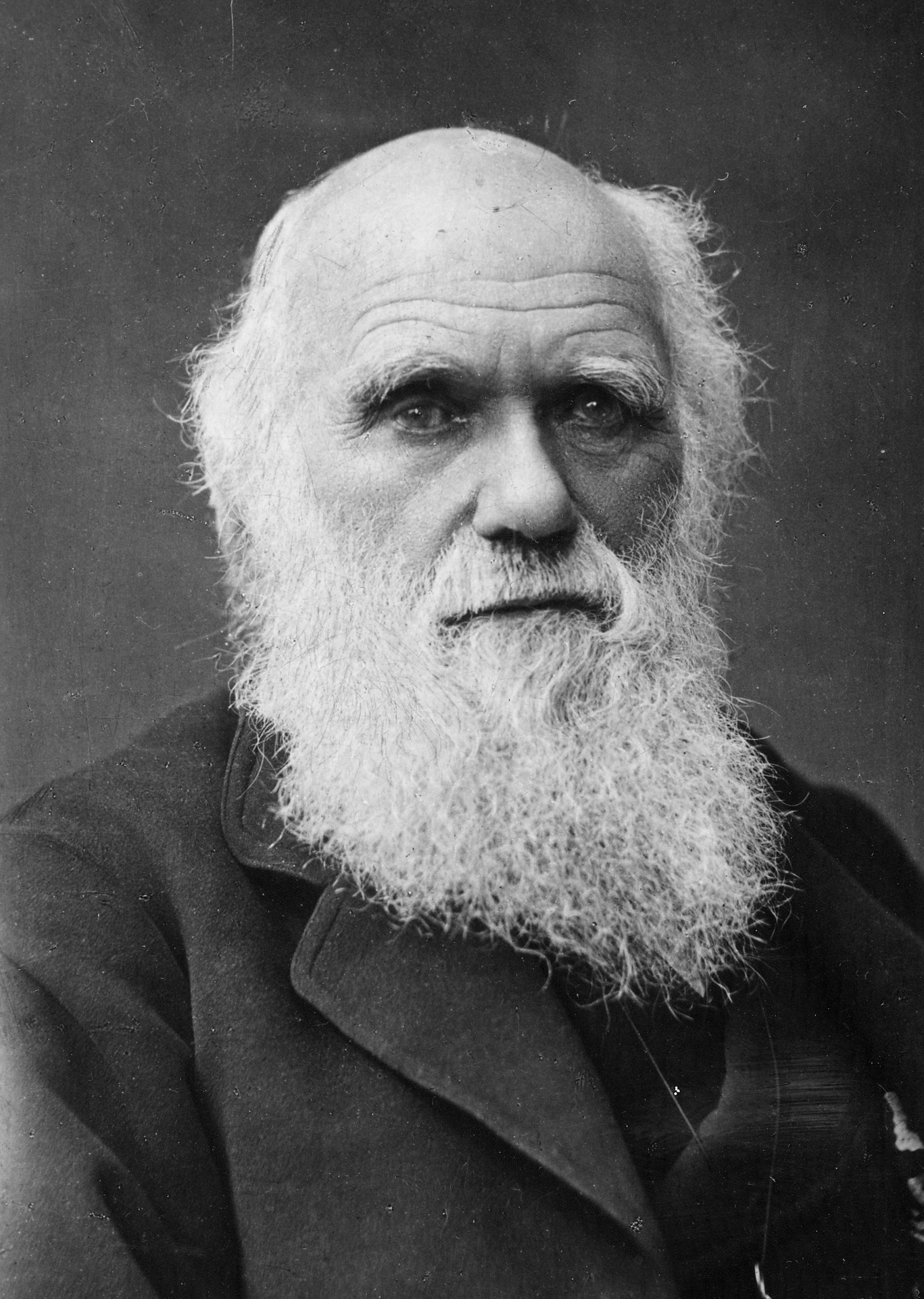
Darwin might look like a prophet, but he's a poor theologian.
In terms of Church history, the imposition of the evolutionary model since the 19th century has led to many "non-traditional" arguments and conclusions, some of which are extremely damaging to the faith.  For a lesser example, arguments that Mark's Gospel is earlier than Matthew's essentially boil down to the claim that it must be earlier because it's shorter (= the more primitive form). (There's a bit more to the argument than that, especially that so much of Mark is in Matthew, but not as much in reverse.  Still, some good arguments for Matthew's being earlier are not given as much attention, because they don't fit the model.)  There are many other, more serious ways in which the imposition of the evolutionary model distorts our understanding of faith.  Most insidious is the idea that opposes "the Jesus of history" (primitive form) against "the Christ of faith" (later complex form), and ends with denying the divinity of Jesus itself!

In terms of the doctrine of apostolic succession, especially, the evolutionary model is completely the wrong one to use.  Still, it is all too common to assume that more primitive forms of ministry must have preceded later forms, such that, in the first decades of the Church, it's not really possible to talk of "bishops," of Peter as "Pope," of the "sacraments" (apart from baptism, and the "breaking of bread," which is not yet the "Eucharist"), of a coherent body of doctrine (apart from a few elements labelled "the primitive kerygma"), etc.  The dissimilarities between the earliest Church and the "post-Apostolic" Church are just too great, it is argued, to use these later terms and institutions to describe what's going on in the "primitive form" of the earliest Church.  If these fit even in the earliest Church, then they're not really primitive forms - but, it's just impossible (it is assumed) to explain how fully developed forms of things can exist without more primitive predecessors.

But the problem with this conclusion is precisely that it is not consonant with faith in Christ, as noted above.  If Christ did not will and give the essential aspects of these things to the Apostles, then they are not constitutive of the Church!  If they are not willed and given by Christ to the Apostles, then there is no divine power behind them.  Baptism doesn't really wash away sins, it's just a symbol.  Priestly ordination doesn't really give a man a sacred power to change bread and wine into Christ's own Body and Blood, it's just a symbol of leadership, possibly even a corrupt and politicized one.  The faith which is proclaimed doesn't have to be the same one that was proclaimed by earlier generations of Christians; it can even contradict what was previously believed.  Even Scripture itself is undermined, since divine authorship is incompatible with the evolutionary model, and the Canon of the New Testament is therefore a political side-effect of Church history, and thus also one which a new politics could redefine.  In the end, imposing an evolutionary model on the Church destroys apostolic succession and many other central doctrines, and makes us all into feckless false believers in empty, meaningless symbols.

I ended my homily with an exhortation to ask the intercession of St. Matthias and the other Apostles to increase our faith and strengthen our witness.  If we don't believe in a robust doctrine of the Church and her dependance on Christ and the Apostles, if we don't accept that there is a true and unchanging apostolic deposit of faith which we must believe, live, and transmit to others unchanged, then in the end, we don't really believe in Christ as "the one Mediator between God and men."  God save us from such a puny and selfish thing!
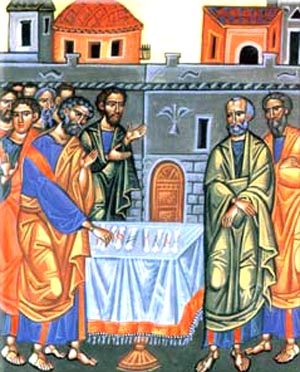
"Christ taking leave of the Apostles," Duccio di Buoninsegna ca. 1311, in the Museo dell'Opera del Duomo, Siena


Thursday, March 7, 2013

St. Anselm, Beauty, and Evangelization

In our fourth-year Christology class, we're up to Anselm, one of my favorite Scholastic thinkers.  A couple of years ago, I gave this talk on the way Anselm consistently uses the aesthetic argument ("it is fitting") to connect his theological arguments to wider (liturgical, devotional, mystical) aspects of the life of faith.


(If it doesn't play, click the "Tindeck" box at left to open a separate download page.)

Fr. Barron has a recent video on using beauty to evangelize, as a more attractive or less confrontational starting point than goodness or truth.  This overlaps conceptually with Anselm's method, although he's not specifically talking about beauty as a theological method:


I think Fr. Barron is quite correct about the impact of beauty, and its potential for evangelization.  But I think he's overlooking (probably due to the limits of the short video medium) the possible complications.  In brief, while beauty evokes goodness and truth, and calls forth from us a suitable response; and while in general  this response ultimately leads to worship of God; it's not true that beauty speaks for itself or leads directly to God.  That's precisely why the "it is fitting" argument works as Anselm uses it.  Anselm's aesthetic argument always operates in a particular context, and leads to or supports the larger conclusions evoked by concrete connections in that context (as I show in the three examples in the talk).  What we lack today, even within the Church, is a sufficiently shared context to ground the aesthetic argument.  A certain amount of work therefore needs to go into the effort to evangelize (or to catechize) from beauty, to establish a shared context and referents.  Otherwise, there's simply too much disagreement already, about what is beautiful (e.g., in the liturgy), much less about what is beauty (i.e., ultimately revealing God) to imagine that the argument from beauty by itself is going to lead to the same end for any two given people.


Thursday, February 21, 2013

The "Myth" of Early Christian Persecution?

The Cardinal Newman Society news feed has this item today, about Notre Dame theology professor, Dr. Candida Moss, promoting her new book, "The Myth of Persecution: How Early Christians Invented a Story of Martyrdom."  Here is her promotional:


Perhaps it would be an overreaction to this promotional material to express my surprise at what appears to be such a boldly revisionist project coming out of Notre Dame's theology department.  I've not read this book, and have only read about her previous book on the early martyrs; so I make no judgments about Dr. Moss's scholarship.  Certainly, I believe she would agree that there's nothing "mythic" or "invented" about the mere fact of persecution of Christians in the Roman Empire in the second and third centuries.  Consider, for example, Trajan's law criminalizing Christianity "for the name;" the numerous judicial records of exactly such trials and the death, imprisonment, or exiling of actual Christians that resulted; the mid-third-century imperial laws (Decius, Valerian) against Christian clergy, possession of the Christian scriptures, and so forth; the persecution of Diocletian and his successors in the East; none of these things have ever been in doubt as what actually happened.  (The question of why Roman authorities treated Christian in such ways is a separate one.  I'd agree with her that it wasn't "merely because they refused to deny Christ."  But why does she think these facts happened?)

This historical layer of the "Church of the martyrs" certainly does, as Dr. Moss claims, underlie in a persistent way the attitudes of Christians of other times and places to all sorts of circumstances.  In this sense, one could say there is a "myth" being formed.  But that's hardly unusual; all coherent groups of every kind, not only religious, recount shared experiences to reinforce identity and commitment.  There's no implication here, generally, that "myth" in this sense means "not true," or "distorting the historical record," or "politicized," or the like.  So it's difficult to see, based only on this promotional material and the rather provocative title, why it might follow that those implications are pertinent in this case.

But the promotion of the book as such, distinct from its scholarly content, does indeed seem to me obviously ideological ("... and they're not similarly persecuted today.")  Here is an advertisement for an upcoming lecture on the same, to be given in Washington DC in March.  Note the way in which word choice is used here to create an effect, and to qualify the meaningfulness of historical facts, in the direction of the very modern agenda already revealed in the video [my comments]:

According to cherished [w/c] church tradition, early Christians were uniquely [neither historians nor the Church have held the general position that only Christians were persecuted in the Roman Empire in Late Antiquity; one has only to look at e.g. Domitian] and systematically [the imperial laws against Christians in 251, 257, and 303-10 were as systematic as things got for the time] persecuted by a brutal [w/c] Roman Empire. Vast [w/c] numbers of believers were thrown to the lions or routinely [w/c] tortured or burned alive. In spite of these horrors, so the story goes [are we now to believe that no Christians were martyred by the Roman state?], these heroes of the early church chose to die rather than renounce their faith in God [indeed so; some Christians, then as now, possessed such courage and fidelity]. Such stories form part of the teaching of the church to the present day, inspiring some to acts of like courage in the face of modern hardships [this was and is an explicit goal in remembering the acts of the martyrs, just as the imitation of holiness is an explicit goal of remembering the lives of the saints]. Yet there is also the troubling [w/c] use of this heritage to silence the voices of those who act outside the perceived orthodoxies of the day [note the implication that all orthodox teachings are merely "perceived" and "of the day"].

In this lecture, Professor Candida Moss will address the true history [never before told! hidden for hundreds of year!] of persecution in the early church, and show how this history includes exaggerations and forgeries [this too is well known; yet we are able to evaluate the historical evidence and reliably hold that some subset of the evidence* is not exaggerated, forged, or added in later centuries] that eventually became part of the rhetoric [w/c] of the church. Moss will also address the question of the legacy [what she refers to in the trailer above as "dangerous," "especially in the language of the religious and political right"] of this history; a legacy that has animated the acts of some within the religious world to exclude [w/c; the great sin of post-modernity] those who would challenge [w/c] their hegemony [w/c].

What I find most arresting in this is how blatantly partisan such an avenue of promotion is, while still holding out the promised scholarship as properly scientific history.  Because we know, of course, that rational, right-thinking progressives never make use of a religious heritage to suggest false or unhistorical connections between the past and the present:


(Any allusion to other historical persons, living, dead, or resurrected from the dead, is purely a figment of the viewer's bigoted imagination.)
Just in the promotional material, then, one seems meant to conclude that, since the Roman Empire is not really a persecutor of Christians, but made to seem so by (some) Christians intent on preserving their "hegemony," so too the modern states of the West can and should similarly exclude Christian persons and Christian ideas (the "dangerous" "religious and political right") from the public square.  One cannot suggest that such exclusion might seem to violate otherwise compelling norms of law and fundamental rights, in a manner reminiscent of the history of persecution of Christians at other times and places, because of the implication that this is not really "persecution," for the same reasons it wasn't in late antique Rome.  And it's left dangling as a further implication that such exclusion is necessary, lest Christians rebuild that same hegemony that (the now well-worn ideology continues) has been dismantled, at such heroic cost, by the forces of egalitarian Reason in the last three or four centuries.

This maneuver (again, just in the promotional material, since I haven't read the book itself), strikes me as highly damaging to the faith of believers.  It calls into serious doubt the accepted meaning of an important period of the Church's history, and therefore also the authority of the tradition (or even Tradition) which has accepted and "mythologized" (if you like) that meaning.  It challenges the use of that authority by the current leaders of the Church (in the Catholic Church, at least, the apostolic authority of the bishops) who have been increasingly outspoken against precisely that impetus of exclusion, common in the West for two generations.  And it undermines the solidarity of Christians with the victims of much worse injustices (many of them, of course, Christians themselves) by falsely dividing different forms of abuse of power according to ideological preferences. 

I hope the book itself will offer much better than this; this is certainly not exemplary of the love of truth and pietas to one's students which Notre Dame and Yale taught me.

* Herbert Musurillo, The Acts of the Christian Martyrs (Oxford, 1972), is an excellent example of exactly such an effort to sift true historical accounts of early Christian martyrs from later pious fictions, and is generally accepted by historians as basically accurate.