Showing posts with label Catholic joy. Show all posts

Monday, March 5, 2018

Archdiocese of Washington DC offers "Amoris Laetitia: Pastoral Plan"

This weekend, the Archdiocese of Washington DC released a longish document on their implementation of Amoris Laetitia.  Like the exhortation itself, this "Amoris Laetitia: Pastoral Plan" offers (mostly) a straightforward recapitulation of the Church's teaching about marriage, some good advice about strengthening marriage prep (both remote and proximate), and a call for conversion and stability.  We all know that our culture is increasingly anti-marriage, both in terms of more and more radical individualism and relativism, and in terms of failing to support marriage in ways both practical (tax laws, welfare state policies, etc) and theoretical (no fault divorce, education policy, court-driven custody rulings, etc).  Having a solid biblical, Catholic, Christ-centered vision of what marriage is, and of what the common problems in marriage stem from, and of how to recognize and respond to those issues in healthy and faithful ways, is critical, and I applaud anything that helps build up the culture of marriage and helps actual couples live their marriages well in Christ.

There are, however, two things about this pastoral plan that strike me as failing to aim at that goal from the outset.  This doesn't necessarily take away from the practical wisdom contained in the document, but it does invite us to think more deeply about our vision and how we communicate it.

The first is the problem of failing to articulate clearly the relationship of eros to agape.  The document states:

The desire to love and to be loved is a deep,

enduring part of our human experience. God

has written onto each human heart the desire for

self-giving love, reflected in the divine plan for

marriage and family. That plan offers a profound

“yes” to true joy in love. It gives us an invitation to

experience Christian hope in the love of God that

never ends.
 
This "desire to love and be loved" is eros-love.  Eros is often where we start, not only in marriage but in many things we pursue.  Eros is not inherently wrong or evil; it is about choices we make at the level of the "appetitive soul."  If, however, our desire and ends remain only at this level, they tend to stagnate into selfishness and idolatry, addiction and neurosis.

As Pope Benedict taught so clearly in Deus Caritas Est, natural eros must always be purified by divine agape in order to pursue the good rather than the self.  Agape is that "self-giving love, reflected in the divine plan."  It is love that imitates Christ's perfect love from the Cross.  It therefore transcends the appetitive soul, through the action of a well-formed (not an eros-formed) conscience and divine grace, allowing the rational soul to perceive and choose the authentic good for others.

What is unclear in the above paragraph is precisely that agapic love is not "natural" to us as humans.  We must learn how to love this way.  While it's true in a sense that God has written the desire for agape into our hearts (as St. Augustine wrote, "Our heart is restless until it rests in you, O Lord"), we do not have natural means to engage this.  We require grace to transcend eros-love and be converted to love with Christ's agapic love.  To fail to distinguish this grace-for-conversion here leaves the entire pastoral plan resting on an insecure foundation.  Anyone who imagines that more eros (natural desire) can solve the problems created by unrefined eros (selfish desire) is bound to fail, but this is the conclusion being (inadvertently) invited here.

Sacramental marriage gives grace precisely to transform eros into agape.  No matter how kind and loving I am to my spouse and children, if I continue to treat them as objects of desire (i.e., they must fulfill me, they are in my life for my happiness), I am not responding to this sacramental grace.  Eros transformed into agape means I live my vocation to married life as Christ crucified - that everything I am and do is for them, rather than the reverse.  From eros fulfilled comes mere happiness; from agape fulfilling others comes joy and union with Christ.

Therefore, while it is certainly true that "That (divine) plan offers a profound 'yes' to true joy in love," it must also be stated that deviations from the divine plan offer an (at least implicit) 'no' to the same conversion, joy, and agape-love.  We must not conclude what the document leaves open to us (and what Amoris Laetitia, too, often seems to suggest), that deviations from the divine plan for marriage and family contain a partial 'yes' to God and grace.  This might be true, only if the deviations result entirely from ignorance and weakness.  When they result from a deliberate choice to pursue eros-love instead of agape-love (even when that choice is less than fully informed), they do not represent authentic modes of encountering Christ's grace, and they are therefore contrary to the divine plan.  Eliding this distinction does not serve anyone well.

The second problem risks being even more corrosive.  It suggests that the Church's doctrine is not itself useful or practical, and that lived experience is needed to understand, or interpret, or even correct that doctine.

Reflecting on the implementation of Amoris

Laetitia in the Archdiocese of Washington, we

begin first with the richness of the Church’s
perennial teaching on love, marriage, family,

faith and mercy.... Secondly, we need to remember that our task is

not complete if we only limit ourselves to faith

statements. The goal is the salvation of souls

and it is a far more complex effort than simply

restating Church doctrine. For this reason, it is

essential to recognize that our teaching is received

by individuals according to their own situation,

experience and life....

At one level, this distinction is not problematic.  I am not trying to suggest that lived experience is irrelevant to doctrine, or that the reception of doctrine is not fraught with difficulties stemming from our human weakness and falibility, or stemming from cultural presumptions at odds with the Gospel, etc.  Even given this, however, it is tendentious in the extreme to suggest that the Church's pastoral care has ever attempted to engage with actual situations merely by "restating doctrine," or that, say, St. John Paul II failed to appreciate the complexities presented to the Church by contemporary culture (see e.g. Familiaris Consortio or Veritatis Splendor, or for a different vocational context, Pastores Dabo Vobis).  Should we now discard the entire Code of Canon Law, beacuse it "limits us to faith statements?"  At this level, the dichotomy becomes a blatant lie, pitting "mercy" (which now means making excuses for deviations from the divine plan for marriage and family) against "doctrine" (which now means cruelly expecting people to be unrealistically perfect). 

If this is our vision of marriage, "our faith is vain," as St. Paul says, because this vision of marriage is indistinguishable from the world's - eros without agape (love with sacrifice, happiness without personal cost), inherently self-centered, and "mercifully" lacking any possible leverage to modify behavior which is actually inimical to marriage, to the dignity of persons, or to salvation. 

I don't actually believe that the Archdiocese of Washington is promoting this cultural vision of marriage.  But, by including these two ambiguities, it weakens the vision which it is trying to offer and sustain, of Christ's sacramental marriage.  And our culture has already weakened that vision enough; we don't need to weaken our presentation of it still futher.

Thursday, September 24, 2015

Pope Francis in America - Homily, Midday Prayer with the Bishops, 9/23

This is, I think, the clearest, most comprehensive articulation that I've seen, of what Pope Francis is trying to do as Pope.  Some of his actions and words have, at times, been seen with confusion and ambiguity.  His "style" can be abrupt and imprecise, especially in comparison with his two immediate predecessors.  But here, there is nothing unclear or objectionable in what he's laying out, and there is a full embrace of Tradition, just as I also embrace, believe, and strive to act.  Especially, his words here are full of charity and joy, as he invites his brother bishops (and, through them, all of us) again to work with him in the vineyard of Christ.  Read the whole thing at the above link.

Some highlights:

www.gettyimages.com
The heart of the Pope expands to include everyone. To testify to the immensity of God’s love is the heart of the mission entrusted to the Successor of Peter, the Vicar of the One who on the cross embraced the whole of mankind. May no member of Christ’s Body and the American people feel excluded from the Pope’s embrace. Wherever the name of Jesus is spoken, may the Pope’s voice also be heard to affirm that: “He is the Savior”! From your great coastal cities to the plains of the Midwest, from the deep South to the far reaches of the West, wherever your people gather in the Eucharistic assembly, may the Pope be not simply a name but a felt presence, sustaining the fervent plea of the Bride: “Come, Lord!”  Whenever a hand reaches out to do good or to show the love of Christ, to dry a tear or bring comfort to the lonely, to show the way to one who is lost or to console a broken heart, to help the fallen or to teach those thirsting for truth, to forgive or to offer a new start in God… know that the Pope is at your side, the Pope supports you. He puts his hand on your own, a hand wrinkled with age, but by God’s grace still able to support and encourage.
 
I speak to you as the Bishop of Rome, called by God in old age, and from a land which is also American, to watch over the unity of the universal Church and to encourage in charity the journey of all the particular Churches toward ever greater knowledge, faith and love of Christ. Reading over your names, looking at your faces, knowing the extent of your churchmanship and conscious of the devotion which you have always shown for the Successor of Peter, I must tell you that I do not feel a stranger in your midst. I am a native of a land which is also vast, with great open ranges, a land which, like your own, received the faith from itinerant missionaries. I too know how hard it is to sow the Gospel among people from different worlds, with hearts often hardened by the trials of a lengthy journey. Nor am I unaware of the efforts made over the years to build up the Church amid the prairies, mountains, cities and suburbs of a frequently inhospitable land, where frontiers are always provisional and easy answers do not always work. What does work is the combination of the epic struggle of the pioneers and the homely wisdom and endurance of the settlers. As one of your poets has put it, “strong and tireless wings” combined with the wisdom of one who “knows the mountains”.
 
www.gettyimages.com
We are bishops of the Church, shepherds appointed by God to feed his flock. Our greatest joy is to be shepherds, and only shepherds, pastors with undivided hearts and selfless devotion. We need to preserve this joy and never let ourselves be robbed of it. The evil one roars like a lion, anxious to devour it, wearing us down in our resolve to be all that we are called to be, not for ourselves but in gift and service to the “Shepherd of our souls” (1 Pet 2:25).  The heart of our identity is to be sought in constant prayer, in preaching (Acts 6:4) and in shepherding the flock entrusted to our care (Jn 21:15-17; Acts 20:28-31).  Ours must not be just any kind of prayer, but familiar union with Christ, in which we daily encounter his gaze and sense that he is asking us the question: “Who is my mother? Who are my brothers?” (Mk 3:31-34). One in which we can calmly reply: “Lord, here is your mother, here are your brothers! I hand them over to you; they are the ones whom you entrusted to me”. Such trusting union with Christ is what nourishes the life of a pastor.
 
The great mission which the Lord gives us is one which we carry out in communion, collegially. The world is already so torn and divided, brokenness is now everywhere. Consequently, the Church, “the seamless garment of the Lord” cannot allow herself to be rent, broken or fought over.  Our mission as bishops is first and foremost to solidify unity, a unity whose content is defined by the Word of God and the one Bread of Heaven. With these two realities each of the Churches entrusted to us remains Catholic, because open to, and in communion with, all the particular Churches and with the Church of Rome which “presides in charity”. It is imperative, therefore, to watch over that unity, to safeguard it, to promote it and to bear witness to it as a sign and instrument which, beyond every barrier, unites nations, races, classes and generations.


Wednesday, February 12, 2014

Homily for 12 Feb 2014, Wednesday of the Fifth Week in Ordinary Time

The Old Testament reading today is the visit of the Queen of Sheba to King Solomon, 1 Kgs 10:1-10.  Here's the homily I preached, as well as I can remember and reconstruct.
Lavinia Fontana. The Visit of the Queen of Sheba to Solomon. c. 1600. Dublin, National Gallery of London.

In our first reading today, King Solomon stands as a type of Christ.  We are particularly invited in this
passage to consider first his wisdom, like that of Christ.  King Solomon's wisdom of course was exceptional, although merely human, while Christ's wisdom is divine and perfect.  But Solomon's wisdom is of God, and points us toward the more perfect wisdom of our Lord.  Because of his wisdom, he kept his kingdom in peace for many years, and gave justice and good laws.  Christ does the same, more perfectly, for His Church and for His kingdom.

We're also invited to consider Solomon as the builder of the temple in Jerusalem.  Again, he foreshadows the temple Christ builds, which is His Church, His own Body.  We want to participate in the worship that takes place in Christ's temple, and so here we are at this Holy Mass.

This passage also offers us the figure of the Queen of Sheba.  She is a more worldly ruler than Solomon, very rich and powerful and successful in her own kingdom.  But she's not a negative example of the world, because she does come to Solomon to exchange gifts and confirm peace.  Rather, she stands in relation to Solomon in very much the way we stand in relation to Christ.  She's heard of his extraordinary wisdom, his goodness and justice, and she's interested, but she can't quite believe that all this could be completely true.  We too sometimes hesitate to believe fully in the perfect wisdom, mercy, and goodness of Jesus Christ - although we have faith, certainly; yet sometimes we're reluctant to lower our guard, to set aside our reservations, and give ourselves totally to Christ.  Like her, it may seem to us that the forgiveness or the providence of Christ is just too good to be true.

So the queen comes to Solomon to test him, to see if he really is what has been reported.  And she is convinced by what she finds, and so she gives him all the gifts that she has prepared for him, if it turns out to be true.  We can do the same.  We don't need to test Christ, but we can come to him and listen to His wisdom, to His Word, and see how it satisfies us.  We can come before Him with our faith, and strive to set aside our worldly defenses and hesitations.  We can do the hard work of deeper interior conversion in order to be more open to Him, to His grace and His perfect will.  And we do this especially in prayer, and in the sacraments.

The Adoration of the Magi *
When we do this, we usually see that Christ really is our perfect king and savior.  What is reported of Him is not exaggerated!  He is the one, the only one, who can offer us pure mercy, the redemption of our sins.  And therefore, like the queen, we should give Him the gifts we have prepared.  It's significant that she gives to Solomon gifts of gold and spices - the same gifts which the Magi offer to the infant Christ in Bethlehem.  In both cases, the gift of gold represents Christ's kingship, and therefore to give Christ our gold is to give Him our allegiance and obedience.  Because He is our only savior, to grow in faith means to grow in our readiness and willingness to do only His will, to follow His laws which He enacts through His Church.

source **
In the same way, the gift of spices represents Christ's priesthood, His saving sacrifice of the Cross and
His holy passion.  To give Christ our spices is to participate in His priesthood, especially through the sacraments, which again, He offers us only through His Church.  Because He is the one High Priest, to grow in faith means to grow in desire for His grace and mercy in receiving and living out all the sacraments, as well as to grow in prayer and devotions.

When we do this - when we expose ourselves to Christ in order to receive more deeply all His gifts for us, and then give back to Him a deeper faith, obedience, and devotion - then we also show the love and mercy of God to all those around us.  We show why the ways of the world don't lead to salvation or real happiness, and what a difference it truly makes to be close to our Lord Jesus Christ.  We show this by the quality of our lives.  We preach simply and without confrontation, heart directly to heart, about our true faith and joy in Christ, our Lord and Savior.

So let us pray to the Holy Spirit for the courage to be defenseless before Jesus Christ.  Let us pray that we may receive everything He wills to give us, and that we may willingly give back to Him everything we have and are.  In this way, may we always offer the light of Christ to those in darkness.


* http://bible-belt-catholic.blogspot.com/2012/01/magis-new-work.html 
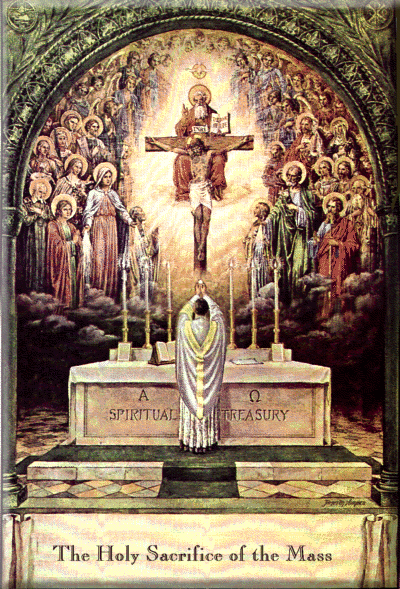
** http://catholicapologetics.info/library/directory/holymass.gif

Tuesday, November 26, 2013

"Evangelii Gaudium," "The Joy of the Gospel" - Post-Synodal Exhortation from Pope Francis

Pope Francis's post-synodal exhortation, "Evangelii Gaudium," was released today.  It's rather long, and I've read quickly through the whole thing once, but it deserves a more careful read than that.  There is a great deal worth thinking about.

My initial conclusions can be summed up pretty quickly:

     1. Pope Francis is calling us to conversion and mission, very strongly and urgently (#3, 5, etc).  In this sense he is, once again and like his namesake, both perfectly radical, and perfectly traditional.  I think this is very important to keep firmly in mind, because (a) his pastoral experience and referents are different than ours here in Iowa, and (b) sometimes he writes with less than perfect clarity, with round-about references to things that aren't obvious to all; and therefore if we're not focused on his meaning-with-the-Church, we might mistake it for something else.

     2. Pope Francis is stressing once again, just as his predecessors did, the personal quality of encounter with Christ, through the Gospel and the Church's ministry of the Gospel (#20, 27, etc).  Christ changes us, he insists.  Two of the aspects of that conversion, which he wants to stress here, are joy (even in the face of difficulties, as he says several times), and the desire for others' encounter with Christ also, which is "evangelization."  Hence the title.

     3. Pope Francis seems to have an excellent read on the modern world.  He expresses clearly the seductive but disheartening qualities of modern life (#52ff) - individualism (and its isolation), materialism (and its exploitation), secularism (and its persecution), freedom (and its stagnation), and so on.  He also sees all of these, not just in their guises outside the Church, which we oppose with the Gospel, but also their insidious corruption inside the Church, sapping the joy of believers.  This is a nuance too little talked about; I am pleased he's not afraid to point clearly to it.

     4. One could quibble with a few things he says, and a few things he doesn't say, even in a document as long as this.  For example, he points out the flaws and abuses to which capitalism is prone (e.g. #54), without (here) noting the (even greater) problems with statism/socialism (e.g. in #240, 241); his discussion of Islam is idealistic, and doesn't consider the absence of "magisterial" unity in that religion (#252, 253); except for two brief sections on popular piety (#122ff) and the homily (#135-159), he mostly waits till near the very end to point to the defining importance of the Church's liturgical life for both the initial and ongoing encounter with Christ, and the particular and necessary shape it gives our efforts at evangelizing.  These minor issues won't, in the end, take away from the significance and depth of the exhortation as a whole.

     5. His Marian conclusion is excellent (#284-288).  He calls Mary the "star of the new evangelization," and almost every sentence here has something powerful packed into it.


Wednesday, July 3, 2013

Homily for Feast of St. Thomas, 3 July 2013

Today I preached mostly on the Gospel, St. John's account of "doubting Thomas." Here's what I said, as best I recall.  Pope Francis's homily can be found here.

When Pope St. Gregory the Great preached on today's Gospel, he made the distinction between knowledge and faith.  St. Thomas saw Jesus with the eyes of his body, and so he recognized Jesus as Risen and alive.  But in a separate act, he also saw Jesus with the eyes of his soul, and recognized who it was who was really standing before him: God, the Son of God. 

There are a great many people today who are able to see with the eyes of the body, but who refuse to see with the eyes of the soul.  I'm thinking for example of people who support abortion; they can see even with the eyes of the body what harm abortion does - taking the life of an innocent child, morally damaging a mother and often a father as well, and also other people - but yet they don't recognize the moral evil.  I'm also thinking of those who don't support the traditional meaning of marriage.  They can see how important marriage really is to children and to the common good, but yet they are willing to support many things that harm marriage.  And many other examples could be listed.

The evidence of God is there, in front even of the eyes of our bodies, but there are people who refuse to make the move St. Thomas made, to go from seeing physically to seeing with the eyes of the soul, to recognize who it is who confronts us and calls us every day.  They cannot see Jesus Christ with their soul, because they do not have faith, or they do not have hope, or they do not know joy.

This is what we have to offer them.  The responsorial psalm tells us, "Go out to all the world and tell the Good News."  We are called to share the Gospel, to share our faith and hope and joy, with everyone.  We have to give them a reason to believe!  The world can't do this.  The world gives us no reason to hope, or to love or know joy, or to have any kind of faith.  But we have what they truly want, what Jesus Christ has given us, if only they could recognize what they truly need.  We have to offer it to them.

The best way to do that is always the way of humility, as St. Gregory also loved to say.  The way of humility is the way of the Cross.  It means following Jesus all the way to the end.  Sometimes, humility can mean giving up a friendship because the price of keeping the friendship is losing the Faith.  Sometimes humility means being willing to be last or less, in our family or at work, because we don't seek the power the world prizes.  Sometimes it means being unpopular, because we don't seek the world's popularity as important.  Very often it means being willing to say No to something evil, even when the whole world, it seems, is trying to say Yes to it.

But always, humility means we don't hold ourselves up with pride about our faith, as if we're special because have something that "those poor slobs" don't have.  Rather, when we share the reasons for our faith, we share something as a gift.  We don't crush people with the Faith, we offer it with gentleness, with joy.  Someone is only going to recognize Jesus Christ in our faith if what we offer is not about us, convincing them or dominating them or "winning them over."

But when we offer faith and hope, with humility and joy, we have a chance of helping people to see with the eyes of the soul: to see good and evil, to see the presence of God, to respond to the love of God.  We have to give people reasons to have hope, to love Jesus Christ.  Only then will they be able to see, and say, "My Lord and my God!"

Thursday, May 2, 2013

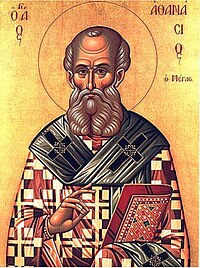
May 2, 2013 - St. Athanasius, Evangelization, the Unicity of the Church, and truth and goodness


Today is the feast day of St. Athanasius, whose chops as an opponent of heresy are second to none; and for that reason, and because of some of the reading I've been doing for the conclusion of our Christology class, as well as some recent news stories in which the Church is unnecessarily type-cast as the antagonist, I have been pondering a bit this phenomenon of increasing open, vocal, assertive, brazen anti-Christian rhetoric and posturing.  It certainly verges on discrimination, although it's not yet formally entrenched anywhere in the US, merely materially ascendant in certain places.


Dominus Iesus (2000) hit the nail squarely on the head in listing, in a very general sort of way, the nature of the erroneous thinking involved here:


4. The Church's constant missionary proclamation is endangered today by relativistic theories which seek to justify religious pluralism, not only de facto but also de iure (or in principle). As a consequence, it is held that certain truths have been superseded; for example, the definitive and complete character of the revelation of Jesus Christ, the nature of Christian faith as compared with that of belief in other religions, the inspired nature of the books of Sacred Scripture, the personal unity between the Eternal Word and Jesus of Nazareth, the unity of the economy of the Incarnate Word and the Holy Spirit, the unicity and salvific universality of the mystery of Jesus Christ, the universal salvific mediation of the Church, the inseparability "while recognizing the distinction" of the kingdom of God, the kingdom of Christ, and the Church, and the subsistence of the one Church of Christ in the Catholic Church.

The roots of these problems are to be found in certain presuppositions of both a philosophical and theological nature, which hinder the understanding and acceptance of the revealed truth. Some of these can be mentioned: the conviction of the elusiveness and inexpressibility of divine truth, even by Christian revelation; relativistic attitudes toward truth itself, according to which what is true for some would not be true for others; the radical opposition posited between the logical mentality of the West and the symbolic mentality of the East; the subjectivism which, by regarding reason as the only source of knowledge, becomes incapable of raising its "gaze to the heights, not daring to rise to the truth of being"; the difficulty in understanding and accepting the presence of definitive and eschatological events in history; the metaphysical emptying of the historical incarnation of the Eternal Logos, reduced to a mere appearing of God in history; the eclecticism of those who, in theological research, uncritically absorb ideas from a variety of philosophical and theological contexts without regard for consistency, systematic connection, or compatibility with Christian truth; finally, the tendency to read and to interpret Sacred Scripture outside the Tradition and Magisterium of the Church.

The question that I think this applies equally to, alongside the theological argument of the document itself, is why does this sort of thinking lead to specifically anti-Christian views, rather than merely to abandonment of Christianity in the cultural mainstream?  

One part of the answer is, as always, merely power.  The Church is pretty much the only coherent, readily articulated, and systematic point of view that stands against all of the "-isms" of the modern world, which are a threat to man or to the dignity of man.  And those various "-isms" would love to be able to defeat the Church in some way, both to be seen as more powerful, and to remove a strong opponent to their untrammelled domination.

But I think we shouldn't underestimate the consequences of muddled thought in and of itself.  Moral relativism is taught daily in our public schools, sometimes overtly, often by default; subjectivism is everywhere, with its stupid but powerful idea that truth is best recognized by an observable emotional response; the problem of "metaphysical emptying" is everywhere, quite apart from its Christological and ecclesiological implications, teaching people to accept lower order goods and to accept division in place of unity; eclecticism makes rational argumentation much harder than it needs to be; and so forth.  The net effect of all of these incomplete or inadequate ways of thinking is that most people are more or less convinced that what's good for them (often in a reductive and/or immediate sense) is the same as the common good; and therefore if others disagree with them, these others must be opposed to them, in the manner of trying to deny them some good.

St. Athanasius, for all his trials and struggles for the apostolic faith of the Church, didn't have this problem to deal with.  His opponents were, by and large, at least rational.  Arius thought he was solving the difficult problem of divine impassibility in the Incarnation.  Constantius thought he was doing what was good and necessary for the unity of the Empire.  That they were mistaken about these things didn't mean they couldn't be reasoned with, and indeed, eventually, the process of rational argument did secure the apostolic teaching and the rejection of Arianism fairly definitively.

In our evangelization today, at the individual level, I think we still need to do this.  How we talk about the faith, about our worldly and spiritual experiences, our consistency of word and action, and so on, constitute a kind of argument about most basic principles which is readily apparent to those around us.  And since people are not usually attracted by philosophy (a systematic presentation of the truth as ideas) but by holiness (a very different but no less systematic presentation of the truth in action), this is the right way to proceed. 

For those who think we are opposed to them personally merely because we disagree with them about ideas, it is the witness of consistent and joyful imitation of Christ by those who are known to them which has a chance to convince of our goodwill, even if conversion never follows. 

But at the wider level, this kind of personal approach doesn't work.  Here the clash of ideas and perceptions happens in a separate way from our personal witness.  Consistency and joy still matter here, but somehow it needs to be translated to that more impersonal level.  Here, martyrial witness is a powerful kind of argument.  Those who are willing to suffer for Christ (in whatever sense; in other words, to carry the Cross in daily life, without complaint, even when it is unjust) are appealing in this sense.  But the appeal rests on the coherence of the tradition or identity - in this case, the apostolic Tradition and the identity of bearing Christ's name as Christians.  If that tradition and identity is not generally perceived as internally coherent - in other words, if Christians are generally perceived to be disloyal to their own tradition, for whatever reason - at one level, it doesn't even matter if it's true or not - then the quality of the witness is badly undermined.

So as St. Athanasius knew so well, a well-formed Church is really necessary for the project of evangelization.  The weakness of our evangelization in the West in the past three-four generations is a symptom of insufficient internal coherence, consistency, joy, and zeal in bearing the Name and the Cross of our Redeemer.  John Paul II wrote the same:

Difficulties both internal and external have weakened the Church's missionary thrust toward non-Christians, a fact which must arouse concern among all who believe in Christ. For in the Church's history, missionary drive has always been a sign of vitality, just as its lessening is a sign of a crisis of faith. (Redemptoris Missio, 2)

The Catechism of the Catholic Church is a major step in the right direction.  So is a coherent anthropology at the root of our formation programs (four pillars of human, spiritual, intellectual, and pastoral formation).  So is the plethora of solid and orthodox Bible studies which use well all the tools available to us, without abusing the historical critical method in the manner which leads to supplanting Christian identity with some mere political ideology.  So is the new Missal's use of a consciously sacral language for worship.  So is Friday abstinence and the daily Rosary, as universally shared elements of a clear, Catholic identity.  And so on...  these are the things, when used well and often, that build up our conviction, our faith, our zeal, and therefore our ability to evangelize the increasingly unfamiliar world around us.


Tuesday, June 19, 2012

New Evangelization

Bishop Nickless's pastoral letter talks rather a lot about evangelization.  It's one of the five priorities he's pointing us to, and it's one that connects deeply with our diaconal vocation (proclaiming the Gospel to all, especially by joining Word and deed), and also with our family vocation as husbands and fathers (teaching the faith by word and example to family and neighbor). Catechesis, evangelization, and apologetics all go hand in hand in our likely fields of ministry.

St. Romuald was, in his day, a great and stirring example of exactly that.  His asceticism, his attractive preaching, and his zeal converted a great many, and attracted many to monastic life.  We can learn from him, of course, as from all the saints, but we suspect that, since our own culture despises Christian asceticism (although it doesn't despise Eastern asceticism - go figure that one), the example of a St. Romuald today wouldn't be nearly as attractive.

What is attractive today?  Obviously something is still working: here's an inspiring glimpse of what a fairly vigorous commitment to joyful evangelization looks like to six millennial Catholics.  And here's a fascinating interview with Austen Ivereigh, who founded a group of lay evangelists (and apologists) in England in 2010, coinciding with the Pope's visit, called "Catholic Voices," which is beginning to spread to the US as well. 

Thursday, January 12, 2012

Pastoral Recommendations for the Year of Faith

The CDF has released its "Note with pastoral recommendations for the Year of Faith". Some highlights from its introductory comments and forty specific recommendations:

This year will be a propitious occasion for the faithful to understand more profoundly that the foundation of Christian faith is “the encounter with an event, a person, which gives life a new horizon and a decisive direction.”[Deus Caritas Est, 1] Founded on the encounter with the Risen Christ, faith can be rediscovered in its wholeness and all its splendor.

The next General Assembly of the Synod of Bishops, to be held in October 2012, will have as its theme: The New Evangelization for the Transmission of the Christian Faith.

The Year of Faith is intended to contribute to a renewed conversion to the Lord Jesus and to the rediscovery of faith, so that the members of the Church will be credible and joy-filled witnesses to the Risen Lord in the world of today.... “Through his love, Jesus Christ attracts to himself the people of every generation: in every age he convokes the Church, entrusting her with the proclamation of the Gospel by a mandate that is ever new. Today too, there is a need for stronger ecclesial commitment to new evangelization in order to rediscover the joy of believing and the enthusiasm for communicating the faith.”[Porta Fidei, 7]

Recommendations - for the Universal Church:

3. During this Year, it will be helpful to invite the faithful to turn with particular devotion to Mary, model of the Church... To this end it would be proper to organize pilgrimages, celebrations and gatherings at the major Marian shrines.

6. The Year of Faith will offer a special opportunity for all believers to deepen their knowledge of the primary documents of the Second Vatican Council and their study of the Catechism of the Catholic Church. This is especially true for candidates for priesthood... [and diaconate, one should add].

7. This Year will provide an auspicious time for a more attentive reception of the homilies, catechesis, addresses and other speeches and documents of the Holy Father.

10. At the conclusion of this Year, on the Solemnity of Our Lord Jesus Christ, Universal King, there will be a Eucharist celebrated by the Holy Father, in which a solemn renewal of the profession of faith will take place.

Recommendations for episcopal conferences:

4. Pastors should work to promote television and radio transmissions, films and publications focusing on the faith, its principles and content, as well as on the ecclesial significance of the Second Vatican Council. This should be done using the new styles of communication, especially on the popular level, making these things available to a wider public.

5. The Saints and the Blessed are the authentic witnesses of the faith. It is, therefore, opportune that Episcopal Conferences work toward the dissemination of a knowledge of the local Saints of their territory, also by modern means of social communication.

6. The contemporary world is sensitive to the relationship between faith and art. It is, therefore, recommended that Episcopal Conferences maximize the catechetical potential – possibly with ecumenical cooperation – of the artistic patrimony of the region entrusted to their pastoral care.

Recommendations for Dioceses:

2. It would be desirable that each Diocese in the world organize a study day on the Catechism of the Catholic Church, particularly for its priests, consecrated persons and catechists.

7. Bishops are invited to organize penitential celebrations, particularly during Lent, in which all can ask for God’s forgiveness, especially for sins against faith. This Year also provides an appropriate occasion in which all can approach the Sacrament of Penance with greater faith and more frequently.

Recommendations for parishes and communities:

2. The Year of Faith “will also be a good opportunity to intensify the celebration of the faith in the liturgy, especially in the Eucharist.” [Porta fidei, 9]

3. Priests [and deacon] should devote greater attention to the study of the documents of Vatican Council II and the Catechism of the Catholic Church, drawing from them resources for the pastoral care of their parishes – catechesis, preaching, Sacramental preparation. They should also offer cycles of homilies on the faith or on certain specific aspects such as, for example, “the encounter with Christ”, “the fundamental contents of the Creed”, and “faith and the Church.”[Verbum Domini, 59-60, 74]

4. Catechists should hold more firmly to the doctrinal richness of the Catechism of the Catholic Church and, under the direction of their pastors, offer guidance in reading this precious document to groups of faithful...

6. The promotion of missions and other popular programs in parishes and in the workplace can help the faithful to rediscover the gift of Baptismal faith and the task of giving witness...

Thursday, June 23, 2011

June 24

Solemnity of the Birth of St. John the Baptist

The great summer festival - traditionally the big village party of the year, because crops are planted, gardens are flourishing, and the chances of starving or freezing in the next 3-4 months are remote. Hurrah! Bonfires, beer, and blessings galore.

This year, we won't be having a bonfire, but we will be celebrating with bacon! Yea! Friday abstinence trumped by solemnity! Carve off another hunk of delicious Iowa bacon, and garnish it with bratwurst. Just make sure you get to Mass before you break your fast con carne.

I love being Catholic! :)

Wednesday, January 19, 2011

Diaconate, Marriage, and Continence

One of the things I think has been missing from most of this week's fracas about Canon 277 is the recognition that continence is, first and foremost, a virtue, a response of the heart touched by the grace of Christ, before it is an external, legal obligation. But then, of course, married clergy, just like all followers of Christ, are not exempted from it -- even if, as married men, they are not obliged (or at least have not been held to the obligation) to observe the same "perfect and perpetual continence" as unmarried clergy. So then, what manner of pursuing this virtue is desirable for married clergy?

As a virtue, continence is oriented to chastity (the universal virtue of "right use of the sexual faculty," from which no one is exempted). Right use of the sexual faculty means not using it in the wrong ways (e.g., it must be open to life), or at the wrong times (i.e., not outside of marriage, and even within marriage not when e.g., it fails in respect or self-gift to the spouse, or would give scandal), or for the wrong ends (e.g., separating in any of a number of ways the procreative and unitive dimensions). Continence supports chastity, by allowing us to choose not to use the sexual faculty when it would be wrong to do so. Marital chastity means that periodic continence is necessary.

The Christian marriage of all married clergy, then, ought already to include some measure of practical, periodic continence, by the time of ordination. But as clerics, married clergy are called to some manner of more effective leadership, or witness, or demonstration, of the possibilities of Christian virtue. There are two aspects of clerical continence for married clergy that we might consider. The first is "doing more;" the second is joy.

Doing More

Doing more with respect to clerical continence means responding more generously, in our interior life, to the grace which perfects our virtue. We have already the habit of practical, periodic continence. This habit could be strengthened by a more intentional practice of the same choices, by which, within the realm of our shared spiritual life in marriage, the sacrifice of the periodic continence is more deliberately made an act of spiritual union with Christ. A whole range of possible devotional and spiritual connections will suggest themselves here.

This habit could also be strengthened in another direction, through our clerical service to Jesus Christ (diaconal or sacerdotal). This is, in effect, the "Levitical" continence which is the tradition of both Eastern Catholic and Orthodox married clergy. By deliberately subordinating our chastity (and our practical continence by which we grow more chaste) to our conformity to Christ, we submit, together with our wives, more fully to Him. This would eventually entail growing into a certain uniformity of ecclesial practice in what, exactly, that means for our service to the Holy Mass. The Latin Church has no existing tradition of this form of continence, but perhaps our experience, now and in the coming handful of generations, will be a gift to the Church.

Joy

The visible aspect of our steeping ourselves in Christ-like virtue in these ways ought to be joy. We grow in joy by growing in obedience, in the freedom to love more whole-heartedly, which is the best and deepest fruit of grace and virtue. And of course, continence and chastity are about precisely that freedom, for married Christians, just as celibacy is about that same freedom, in a different way.

Continence, whether merely periodic, intentional, Levitical, or perfect-and-perpetual, is part of our Christian lives. I hope we can do a better job of using it well, to grow in chastity, and therefore in freedom and joy, so that we can better serve our Lord Jesus Christ, in every vocation, for the salvation of many souls.