Twice in as many months (e.g., here and here), Pope Francis has inveighed against "rigid" believers. He uses very negative language against this perceived phenomenon: “They appear good because they follow the Law; but behind, there is something that does not make them good. Either they're bad, hypocrites, or they are sick. They suffer!” Such people are "enslaved," they "lead a double life." They exhibit the opposite of the beatitudes: "Rigidity is not a gift of God. Meekness is; goodness is; benevolence is; forgiveness is. But rigidity isn’t!" He attaches the same label and language to those who know, love, and respect the traditional liturgy: "Pope Francis told Father Spadaro he wonders why some young people, who were not raised with the old Latin Mass, nevertheless prefer it. 'And I ask myself: Why so much rigidity? Dig, dig, this rigidity always hides something, insecurity or even something else. Rigidity is defensive. True love is not rigid.'"
Certainly, the temptation to this sort of "pharisaical" attitude exists in the Church. It is something always to be guarded against. Because of our sacramental forms and theology, it is easy at times to get caught up in the details of the liturgy, and miss the forest (interior and spiritual realities) for the trees (exterior and physical forms, words, symbols). Likewise with the nuances of our moral theology. One can, in this sense, fall into "rigidity." And it is true that rigidity is not loving, and that rigidity resists Christ and grace.
But there is another sort of "rigidity" not often adverted to, although it appears to be far more common, currently. It consists in putting one's own will before God's, insisting that one is right while Tradition, the Church, the Bible, and God Himself must be wrong. St. James says, "Submit yourself to God... If you judge the law, you are not subject to the law." (Jms 4:7, 11). Those who are rigid in this sense judge the law of faith, and do not submit to God in their hearts.
The path of faith always involves conversion. After our initial conversion (which might be as an infant or child in Baptism), we continue to experience "ongoing conversion," as we strive over our whole life to conform our hearts and minds, our loves and desires, to those of Christ. To be united with Christ in this conformity, "putting on the mind of Christ" (Rom 2:12, etc), is precisely what it means to live as a Christian.
The heart experiencing conversion must be humble. It must recognize and accept (even when there is struggle actually to do - concupiscence is a real thing) that what the believer desires, of himself, is likely not what God desires for him, and therefore that one must learn to desire instead what God desires. This softness and pliability of the heart in respect to God's Law, Revelation, commandments and precepts, personal vocation, moral law, and Tradition is properly understood as a sign of strong faith. As the Rule of St. Benedict says in its very first words, "Listen carefully, my son, to the Master's instructions, and attend to them with the ear of your heart... The labor of obedience will bring you back to Him from whom you have drifted by the sloth of disobedience." This is the opposite of rigidity. (See e.g. the parable of the Pharisee and the publican, Lk 18:9-14.)
Rigidity, then, is not only clinging to the exterior forms of religion, which Pope Francis (rightly) decries. The willful rejection of Tradition is equally a form of rigidity (see e.g. Dei Verbum #7-8, etc). It is a hardness of heart with respect to God's calling the believer. It is spiritual pride, asserting in effect that this generation (or even this individual!) knows better what is good for souls than all prior generations, than all prior saints, doctors, mystics of the Church. I don't think it's too strong to say that there's more than a touch of idolatry, of self-worship, in this attitude. (It remains true that much of the rejection and loss of Tradition and faith in the last century is not willful, but from ignorance and weakness.)
Thus, one might correctly say: The idea that external or physical forms (e.g., the construction of a church, the placement of the Tabernacle, the beauty of vestments and statues, etc) don't matter to internal or spiritual realities (faith, union with God, repentance and conversion) is false (e.g. Sacrosanctum Concilium #8, 112-3, 122-5, etc). To cling to this idea in the face of Tradition and correction is to be rigid.
Idem: The idea that Christ did not and does not will the seven Sacraments for the Church, as the primary means of salvific grace for believers, is false (e.g. SC #5-8, Lumen Gentium #7, 11, etc). To cling stubbornly to the opposite idea, that we can meddle with the Sacraments or deny their efficacy, in the face of Tradition and correction, is to be rigid.
Idem: The ideas of moral relativism and religious indifferentism are false (e.g. Dominus Iesus, Fides et Ratio, etc). To insist, in the face of Tradition and correction, that they are true, is to be rigid.
And so forth.... In short, modernism is rigid, but Tradition properly received and loved ("the living faith of the dead," as one great Church historian noted) is life with Christ.
Showing posts with label humility. Show all posts
Showing posts with label humility. Show all posts
Wednesday, December 7, 2016
Wednesday, September 30, 2015
Bishop Olmstead (Phoenix) - "Into the Breach"
Yesterday, Bishop Olmstead published an apostolic exhortation to men to step "into the breach" of faith and spiritual life. His exhortation is excellent! Please read it. It's entirely relevant to deacons and those of you in deacon formation, too. The main point is about a revival of Catholic manliness by:
- a rejection of postmodern culture's confusion about anthropology and gender, and an embrace of traditional and Biblical norms for masculinity (i.e., strength with gentleness, justice with mercy, wisdom and humility, basic courtesy, boldness to face down evil and to lead to the good, protection of others, especially those who can't protect themselves, the Biblical "widows and orphans" - in a word, chivalry),
- chastity,
- fidelity for fathers and husbands (and a deliberate promotion of the necessary norms for being good fathers and husbands, over against the self-indulgent decadence of the culture and the scourge of divorce),
- return to the Mass and the sacrament of Confession,
- prayer and personal devotion.
Monday, March 10, 2014
Homily for 3/9, First Sunday of Lent
 | |
| via stpeterslist.com |
In our first reading, we have the occasion of that original sin, the Fall of Adam and Eve. They disobeyed God's command not to eat from the Tree of the Knowledge of Good and Evil. They failed to trust God's promises, and they believed the devil's lies, and so they disobeyed, and fell. And as St. Paul says in the second reading, this sin had great consequences for all of us: "By the disobedience of one man, sin entered the world, and with sin, death."
This doctrine of original sin is central to so many of the teachings of our Catholic faith. Original sin
 | |
| Matteo de Nassaro, slate bas-relief ca. 1501, via commons.wikimedia.com |
Yet we live in a time and a culture which tries so hard to deny the reality of original sin. The devil is still lying to us! He wants to make us fall, as he made Adam and Eve fall, and the best weapon he has to do so is to deaden our sense of sin. And so our world denies original sin and its consequences. It does so in very many ways, but I'd like us to consider just one of those ways right now.
The world tries to claim that what makes something right and true is if it comes out from the depths of one's heart. The world rejects God as illuminating what is right and wrong, rejects the Bible, rejects Tradition, rejects the wisdom of the past. None of these, and no other person, the world wants us to think, can tell us what is right and wrong, but only what is in our heart. Therefore, if you want something strongly enough, it must be right to want it. Now obviously, there is a grain of truth in this idea. There are many deep desires in our hearts that are good, love and forgiveness in the imitation of Jesus Christ foremost among them. But also obviously, there are many desires in our hearts that are equally deep, that are not at all good. We are all capable of many kinds of anger and violence and damaging the dignity of other people. Clearly, having a desire to harm someone else doesn't make harming them right.
As an example of this dynamic of the mystery of sin, consider the pornography which fills our culture. The world wants to say that there's nothing wrong with pornography, that it's simply normal. The people who make pornography are doing so freely, and don't seem to be harmed by it. The people who consume the pornography are expressing a personal desire by doing so. So where's the harm, or the sin?
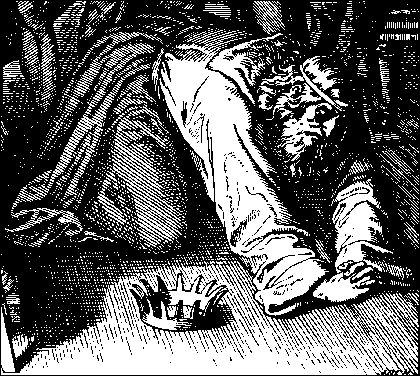 |
| King David praying - maybe Psalm 51? |
This season of Lent, just beginning, is a precious gift to each of us, an opportunity to examine our hearts and our lives in the light of Christ. Has the world's denial of sin encroached on our faith? Do we make worldly excuses for our sins? Is there some part of our life where we are still dead because of sin? Do we perhaps resist the holy desire for Christlike purity in mind and heart? Now is the time to let the light of Christ, the mercy that flowed from His side on the Cross, begin to heal that darkness. Jesus Christ conquers sin and death, refusing every temptation of the devil. His Gospel is good news! It's good news for us because it means that we too don't have to be mastered by sin, or defined by our sins. In Him we can say no to sin - not by our own strength, because we are weak, but in Him, in His perfect power and mercy and forgiveness. Now is the time to examine our lives and echo Chesterton's humble admission, to beg our Savior Jesus Christ for His mercy. Each of us can say that we are truly a sinner, in great need of His mercy, but longing to be healed and freed from our sins. In this Lent, God invites us to accept totally the words we heard just the other day, on Ash Wednesday: Repent, and believe in the Gospel.
Wednesday, July 3, 2013
Homily for Feast of St. Thomas, 3 July 2013
Today I preached mostly on the Gospel, St. John's account of "doubting Thomas." Here's what I said, as best I recall. Pope Francis's homily can be found here.
When Pope St. Gregory the Great preached on today's Gospel, he made the distinction between knowledge and faith. St. Thomas saw Jesus with the eyes of his body, and so he recognized Jesus as Risen and alive. But in a separate act, he also saw Jesus with the eyes of his soul, and recognized who it was who was really standing before him: God, the Son of God.
There are a great many people today who are able to see with the eyes of the body, but who refuse to see with the eyes of the soul. I'm thinking for example of people who support abortion; they can see even with the eyes of the body what harm abortion does - taking the life of an innocent child, morally damaging a mother and often a father as well, and also other people - but yet they don't recognize the moral evil. I'm also thinking of those who don't support the traditional meaning of marriage. They can see how important marriage really is to children and to the common good, but yet they are willing to support many things that harm marriage. And many other examples could be listed.
The evidence of God is there, in front even of the eyes of our bodies, but there are people who refuse to make the move St. Thomas made, to go from seeing physically to seeing with the eyes of the soul, to recognize who it is who confronts us and calls us every day. They cannot see Jesus Christ with their soul, because they do not have faith, or they do not have hope, or they do not know joy.
This is what we have to offer them. The responsorial psalm tells us, "Go out to all the world and tell the Good News." We are called to share the Gospel, to share our faith and hope and joy, with everyone. We have to give them a reason to believe! The world can't do this. The world gives us no reason to hope, or to love or know joy, or to have any kind of faith. But we have what they truly want, what Jesus Christ has given us, if only they could recognize what they truly need. We have to offer it to them.
The best way to do that is always the way of humility, as St. Gregory also loved to say. The way of humility is the way of the Cross. It means following Jesus all the way to the end. Sometimes, humility can mean giving up a friendship because the price of keeping the friendship is losing the Faith. Sometimes humility means being willing to be last or less, in our family or at work, because we don't seek the power the world prizes. Sometimes it means being unpopular, because we don't seek the world's popularity as important. Very often it means being willing to say No to something evil, even when the whole world, it seems, is trying to say Yes to it.
But always, humility means we don't hold ourselves up with pride about our faith, as if we're special because have something that "those poor slobs" don't have. Rather, when we share the reasons for our faith, we share something as a gift. We don't crush people with the Faith, we offer it with gentleness, with joy. Someone is only going to recognize Jesus Christ in our faith if what we offer is not about us, convincing them or dominating them or "winning them over."
But when we offer faith and hope, with humility and joy, we have a chance of helping people to see with the eyes of the soul: to see good and evil, to see the presence of God, to respond to the love of God. We have to give people reasons to have hope, to love Jesus Christ. Only then will they be able to see, and say, "My Lord and my God!"
When Pope St. Gregory the Great preached on today's Gospel, he made the distinction between knowledge and faith. St. Thomas saw Jesus with the eyes of his body, and so he recognized Jesus as Risen and alive. But in a separate act, he also saw Jesus with the eyes of his soul, and recognized who it was who was really standing before him: God, the Son of God.
There are a great many people today who are able to see with the eyes of the body, but who refuse to see with the eyes of the soul. I'm thinking for example of people who support abortion; they can see even with the eyes of the body what harm abortion does - taking the life of an innocent child, morally damaging a mother and often a father as well, and also other people - but yet they don't recognize the moral evil. I'm also thinking of those who don't support the traditional meaning of marriage. They can see how important marriage really is to children and to the common good, but yet they are willing to support many things that harm marriage. And many other examples could be listed.
The evidence of God is there, in front even of the eyes of our bodies, but there are people who refuse to make the move St. Thomas made, to go from seeing physically to seeing with the eyes of the soul, to recognize who it is who confronts us and calls us every day. They cannot see Jesus Christ with their soul, because they do not have faith, or they do not have hope, or they do not know joy.
This is what we have to offer them. The responsorial psalm tells us, "Go out to all the world and tell the Good News." We are called to share the Gospel, to share our faith and hope and joy, with everyone. We have to give them a reason to believe! The world can't do this. The world gives us no reason to hope, or to love or know joy, or to have any kind of faith. But we have what they truly want, what Jesus Christ has given us, if only they could recognize what they truly need. We have to offer it to them.
The best way to do that is always the way of humility, as St. Gregory also loved to say. The way of humility is the way of the Cross. It means following Jesus all the way to the end. Sometimes, humility can mean giving up a friendship because the price of keeping the friendship is losing the Faith. Sometimes humility means being willing to be last or less, in our family or at work, because we don't seek the power the world prizes. Sometimes it means being unpopular, because we don't seek the world's popularity as important. Very often it means being willing to say No to something evil, even when the whole world, it seems, is trying to say Yes to it.
But always, humility means we don't hold ourselves up with pride about our faith, as if we're special because have something that "those poor slobs" don't have. Rather, when we share the reasons for our faith, we share something as a gift. We don't crush people with the Faith, we offer it with gentleness, with joy. Someone is only going to recognize Jesus Christ in our faith if what we offer is not about us, convincing them or dominating them or "winning them over."
But when we offer faith and hope, with humility and joy, we have a chance of helping people to see with the eyes of the soul: to see good and evil, to see the presence of God, to respond to the love of God. We have to give people reasons to have hope, to love Jesus Christ. Only then will they be able to see, and say, "My Lord and my God!"
Subscribe to:
Posts (Atom)