Showing posts with label March For Life. Show all posts

Friday, August 26, 2016

Lessons of the Early Church

I am the Catholic I am, in large part because of the martyrs of the early Church.  Their faith shamed my lack of faith, and understanding why they felt it was worth sacrificing the world for the sake of Heaven gave me the impetus to return to the Church as the only way to salvation.  Now, the Church needs their witness again, as the world around us seems primed to descend into a new paganism.

Martyrdom of St. Polycarp - "Away with the atheists!"
The Christian refusal to cooperate with pagan Roman society was rooted in three connected things: (1) The Roman Empire was inherently idolatrous.  Civic participation required participation in pagan ritual worship.  Oaths of office required the same, to be a soldier, a teacher, etc., not just for politicians.  (2) The reality of (unjust) persecution.  Romans persecuted Christians mostly because they saw Christian faith as "atheism" and "innovation," two things that threatened the stability and success of the Empire as a whole.  But as Tertullian famously pointed out in his Apologeticum, forcing Christians to worship other gods by violence made that worship ineffective for the good of the Empire.  (3) Idolatry and unjust persecution represented abuses of power by the Empire.  All worldly authority comes ultimately from God, as Paul argued.  Its uses must therefore conform at least to natural law standards of justice.  That the Empire abused its power in these (and other) ways justified Christian non-participation.

This line of argument, which permeated Christian thought for two centuries, has been buried under other understandings of the Church's relationship to a world seemingly cooperative rather than repressive.  The successful evangelization of the West and the creation of Christendom meant that we didn't need to think much about things that support a Christianity of non-participation.  But we have this treasure somewhere in the attic, not entirely lost or forgotten.  If we confront the increasingly hostile world only with the lessons of cooperative Christendom, we will probably lose.  We need the lessons of conflict as well, distilled from that earlier Christian experience of martyrdom.

Here are three of those critical lessons.

1. The world can never provide an avenue of salvation.  This should be obvious to Christ's disciples.  Only God can forgive sins; only God can save souls; our ultimate homeland is not earth, but Heaven.  But in contrast, it's a key plank of modernism, more or less obvious in all three of its branches (liberal democracy, Communism, and fascism), that the State aspires to become all-in-all, the "savior," in a sense.  In fascism, it does so directly.  In Communism, it does so as the mediating institution of the people's revolutionary will.  In liberal democracy, it does so more subtly, as the mediating institution between conflicts of rights and powers; but over time, its mediation inevitably expands and coems to dominate everything else. In all three, "scientism" promises imminent salvation from all the suffering and evils of the world.

Reductio ad absurdum of acceptance of modernism.
Any uncritical acceptance of modernism, then, implicitly accepts the (false) claim that the State exercises the highest and most decisive form of authority.  This claim tends to be not merely political, but also moral (i.e., abusing God-given authority!).  It rejects, more or less explicitly, a traditional, Bible-informed moral vision.  Acceptance of modernism therefore also means accepting the relegation of religion to the private sphere only.  The moral verities and priorities of the culture (which are, in terms of Christian Revelation, not true) come to be enforced as true, and any serious objection to them is firmly punished, at least socially (loss of status, respect, jobs, friends, etc), possibly legally (fines, jail, the police showing up in the middle of the night to investigate your family, etc), and even (sometimes) fatally. 

A different acceptance of modernism - no less absurd.
If we accept, even implicitly, that the world offers salvation within itself, we cannot be Christians.  We must stand firmly and intentionally in the core Christian claim of salvation through Christ alone.  Short of martyrdom, we do this especially in our (public) worship. Worship focused on God (as in traditional modes) demonstrates our conviction, and teaches spiritual salvation.  Worship focused on ourselves (as in "theater in the round" church design, or hymns all about us or making us speak in God's first person voice, etc.) opens the door to implicit acceptance of the lie of the world saves itself. 

2. Forms of idolatry must be clearly rebuked.  The Church of the martyrs taught clearly and consistently to all its members that cooperation with idolatry leads to loss of saving relationship with Christ.  It wasn't just pagan rituals that were identified, it was a whole host of public or civic activities or positions that were inherently idolatrous - teachers and soldiers, attending theater or civic games, etc etc.  This process of identifying and rebuking forms of participation in idolatry was very successful.

Pope St. John Paul II, for one example, did an excellent job throughout his pontificate (and even before) of doing the equivalent for us today.  We don't tend to think in terms of "idolatry" today, but the moral equivalent corrupting the Church and society is "secularism" (and similar labels).  A creeping domination of "secular" ideas in all spheres of life is intent on displacing any Biblical or natural-law-based cultural patrimony in the West.  This is especially apparent at the moment in issues of sexuality and family, or education policy, for example.  Pope St. John Paul II showed us how to parse the good and the bad in all such conflicts, and having identified the elements or ideas inconsistent with truth and therefore unacceptable to Christians, he rebuked ideas without condemning people. 


March for Life 2013 - excellent example of rebuking without condemning

The more we conform ourselves to the mores of the world, the more this creeping secularism insinuates itself into our faith.  Pope St. John Paul II told us constantly, "Be not afraid!"  Short of martyrdom, we can be clear and consistent in our rejection of modern forms of idolatry by fearlessly knowing the truth (virtue of faith), living the truth (virtue of hope), and speaking the truth (virtue of love) - always with charity and mercy.  It is, in fact, the visibility of the true charity and mercy of Christ in our lives that can attract those mired in worldly idolatry.

3. Faith in Christ is the greatest treasure.  If we look to the world for our salvation (even unconsciously), and fall into secular (idolatrous) modes of thinking, we will inevitably undervalue our faith.  This doesn't necessarily mean we will lose our faith entirely, but we won't have much motive for living it out consistently.  We will be "secular Christians," who, even when we go every Sunday to worship God, live the rest of the week as if Christ doesn't matter to us.  We will be "formed by the culture" rather than "formed by the Church."  We will have fallen into the trap of privatizing our faith - which is precisely what the totalizing, secular world demands of us.

Pope Benedict XVI Adoring our Lord Jesus Christ
Pope Benedict XVI understood this dynamic deeply.  So much of his pontificate was aimed at enflaming our faith anew, at helping us realize just what an inestimable treasure faith in Christ actually is.  Nobody is attracted to a faith that seems not to matter even to its regular practitioners!  Only those who are on fire for God have the chance to spread the fire to others.  Only those who, by how they live in every sphere of life, clearly value above other things the love of God can proclaim the value of that love. 


If it's true, finally, that "the blood of the martyrs is the seed of the Church," then our evangelizing efforts can only bear fruit if we first die to self, and to the world, and live only in Christ. 



Monday, January 19, 2015

Homily for Sunday 18 Jan 2015 (II post Epiphaniam)

This weekend, I preached at the 7:30 EF Mass.  The Collect is the same as the OF:

Omnipotens sempiterne Deus, qui celestia simul et terrena moderaris, supplicationes populi tui clementer exaudi: et pacem tuam nostris concede temporibus. Per Dominum nostrum...

Almighty ever-living God, who govern all things, both in Heaven and on earth, mercifully hear the pleading of your people and bestow your peace on our times. Through our Lord...

Given this plea for the divine gift of peace, and the proximity to the awful anniversary of the repugnant Roe v. Wade decision this Thursday (1/22), I chose to preach on the obvious topic. The Epistle is Rom 12:6-16, and I expounded on the verse, "Let your love be without pretense. Hate the evil, adhere to the good."  The Gospel is Jn 2:1-11, the wedding at Cana, and I preached the verses, "Do whatever He tells you," and "His disciples believed in Him."  Here's my homily, as closely as I can reconstruct it.

All across the country, this weekend and this week, in different places, hundreds of thousands of
March for Life 2014
people will be marching for life.  I read this week, we now have over 80 Marches, Vigils, and Rallies for Life taking place in different cities.  And hundreds of thousands more, perhaps even millions more, will be praying along with them for an end to abortion.

I'm sure I don't have to recount for you the terrible evil that abortion is.  I'm sure we know that abortion kills an innocent human being, a baby in the womb; and that it destroys the spiritual and emotional health of mothers and fathers, of entire families; and that it corrupts our culture and our laws, and justifies other kinds of evils, too.  Abortion is the most urgent, the gravest evil of our times, and it falls to us, to our generations, to fight it.

Our readings today give us inspiration and courage to carry out this moral struggle.

St. Paul tells us, "Let your love be without pretense.  Hate the evil, and adhere to the good."  For us, this means that we must root out from our hearts the pretenses, the compromises, the little evils and sins that we sometimes indulge in.  We must make regular examination of conscience, and go to Confession often, so that our hearts will be full of pure love.  If our love is true and pure in the little things, the daily things, then we can also love without pretense in the larger things.  This is very important, because the world wants to paint us as hypocrites.  We need to be able to show that our love and our actions are consistent, so that our witness can reveal the love of Christ.

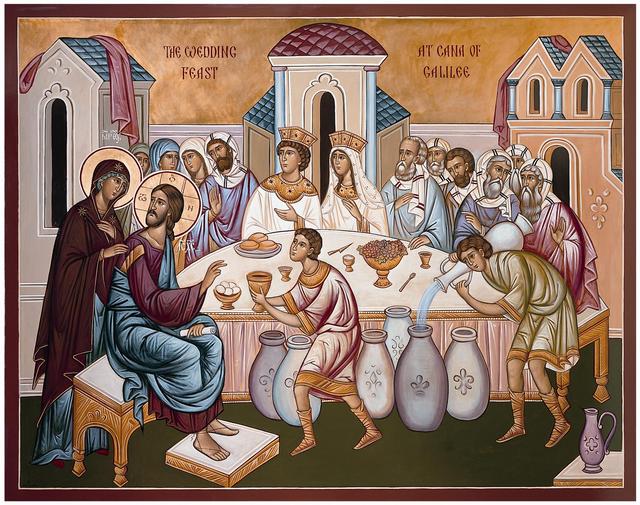
Orthodox icon of the wedding at Cana
In the Gospel, the beautiful story of the wedding at Cana, St. John gives the words of Mary, "Do whatever He tells you."  We might notice that these are the last words the Gospels record Mary saying.  Her whole life of perfect faith, perfect obedience to the Father, perfect love for her Son, is, in a sense, summed up in these words: "Do whatever He tells you."  We, too, then, need to strive to imitate our blessed Mother's perfections, by constantly "doing whatever He tells" us.  This points us to our vocation - for the great majority of us, the vocation to married life and to parenthood.  There are also vocations to priestly life and religious life, of course, but most of us are called to marriage.

And in our married life, we are called to a holy, loving union that is both chaste and fruitful.  What this means for us, then, is that we must reject contraception in our Catholic marriages.  Contraception leads to abortion, through what we can call the "contraceptive lifestyle."  Pope Paul VI showed us this link in his encyclical, "Humanae Vitae."  When we contracept, we reject the will of God in our marital union.  Whether we understand this or not, we are making ourselves the masters of life and creation.  It's only a small step, then, to try to make ourselves the masters of death, also, to set ourselves up in the place of God, choosing who can live and who will die. 

Those who work for the culture of death know this link, too.  For example, make people who have left working for Planned Parenthood report that they want to have access to public schools, to teach our teenagers (and even younger children) to use contraception, because they know that contraception will lead to abortion, and they want that business.

We need to challenge this root of abortion, and make our Catholic marriages once again free of contraception.

And the last verse of the Gospel today: "His disciples believed in Him."  We need to pray for an end

St. John at the foot of the Cross (14th c., St. Michael and All Angels Parish, Wales)
to abortion.  We need to have greater faith, that the love and mercy of Jesus Christ can overcome the evil of abortion.  We need to live with greater hope and deeper prayer, in all the spiritual aspects of this struggle.  If we live with growing love for Christ in the Church and in her sacraments, and if we live with greater fidelity to our vocations, we will also have greater faith.  We will have hearts more open to receive His infinite mercy, and also more open to the need, the longing, for that mercy in the world around us, where we can share it by our faithful and loving actions. 

The daily witness we give to the power of His mercy, like the many March for Life events, is the way to change minds and hearts about the evils in the world.  Our hope and our joy in Jesus Christ are not just for ourselves, they are for others.  We can only share as much of that mercy, hope, faith, and joy as we are open to receive from our Savior.  But as we grow closer to the Lord, our hearts are more open, and we can receive more and offer more to those around us. 

If we are faithful in these ways, we will make a difference.  We will overcome the evil of abortion, by the power of Christ's love.  Our progress may be slow, because the evil is great, but we will advance.  We have this hope.  We have this faith.  So let Christ work in us, ever more deeply, so that our witness may be stronger, to overcome evil in the world.


Monday, January 31, 2011

More March for Life footage

This 1-minute time-lapse of the March passing by a certain intersection is great!


Maniple wave to American Papist.

Thursday, January 27, 2011