Monday, March 10, 2014

Homily for 3/9, First Sunday of Lent

via stpeterslist.com 
The great Catholic author and master of wit of a hundred years ago, G. K. Chesterton, was once famously asked, "What's wrong with the world?"  Without hestitation, he pointed to himself and responded, "I am."  This answer is universally true on more than one level, but it's especially true in showing a great humility and in embracing the doctrine of original sin.

In our first reading, we have the occasion of that original sin, the Fall of Adam and Eve.  They disobeyed God's command not to eat from the Tree of the Knowledge of Good and Evil.  They failed to trust God's promises, and they believed the devil's lies, and so they disobeyed, and fell.  And as St. Paul says in the second reading, this sin had great consequences for all of us: "By the disobedience of one man, sin entered the world, and with sin, death."

This doctrine of original sin is central to so many of the teachings of our Catholic faith.  Original sin
Matteo de Nassaro, slate bas-relief ca. 1501, via commons.wikimedia.com
is why we baptize people into the Church as soon as we reasonably can.  Baptism washes away original sin, and we don't want people to wait for that healing.  Original sin is why we receive the Holy Eucharist as often as we can, and not just once in our life, to be united with our Lord Jesus Christ in His real Body and Blood, soul and divinity.  And the consequences of original sin include all of our own sins, our capacity to sin every day.  And therefore we have the Sacrament of Penance always available to us, to receive again and again God's great mercy and forgiveness.  And likewise we have the Church's moral teachings and the examples of the saints to strengthen and encourage us in the daily struggle against sin.  Without the doctrine of original sin, so much of our faith would really make no sense.

Yet we live in a time and a culture which tries so hard to deny the reality of original sin.  The devil is still lying to us!  He wants to make us fall, as he made Adam and Eve fall, and the best weapon he has to do so is to deaden our sense of sin.  And so our world denies original sin and its consequences.  It does so in very many ways, but I'd like us to consider just one of those ways right now.

The world tries to claim that what makes something right and true is if it comes out from the depths of one's heart.  The world rejects God as illuminating what is right and wrong, rejects the Bible, rejects Tradition, rejects the wisdom of the past.  None of these, and no other person, the world wants us to think, can tell us what is right and wrong, but only what is in our heart.  Therefore, if you want something strongly enough, it must be right to want it.  Now obviously, there is a grain of truth in this idea.  There are many deep desires in our hearts that are good, love and forgiveness in the imitation of Jesus Christ foremost among them.  But also obviously, there are many desires in our hearts that are equally deep, that are not at all good.  We are all capable of many kinds of anger and violence and damaging the dignity of other people.  Clearly, having a desire to harm someone else doesn't make harming them right.

As an example of this dynamic of the mystery of sin, consider the pornography which fills our culture.  The world wants to say that there's nothing wrong with pornography, that it's simply normal.  The people who make pornography are doing so freely, and don't seem to be harmed by it.  The people who consume the pornography are expressing a personal desire by doing so.  So where's the harm, or the sin? 

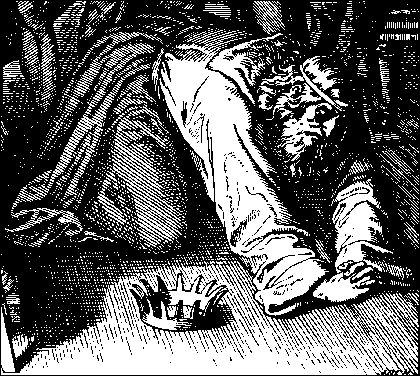
King David praying - maybe Psalm 51?
But with our Catholic understanding of original sin and the mystery of sin, we can see that all this is another lie by the devil.  Pornography is not victimless, not harmless, and not normal.  Those who make it suffer in a number of different ways.  And those who consume it also suffer in various other ways.  [I didn't enumerate in the homily, but we know what these effects are.]  It degrades the human dignity of both of them, and it becomes a constant temptation to see other people as mere objects of desire.  Pornography is the Fall in a nutshell.  And we can see this even in our first reading.  Adam and Eve do gain a true knowledge of good and evil by eating from that tree - it's not the way God promised to give this gift to them, but it's still true knowledge.  And as soon as they do, the very first thing they realize is that they are naked.

This season of Lent, just beginning, is a precious gift to each of us, an opportunity to examine our hearts and our lives in the light of Christ.  Has the world's denial of sin encroached on our faith?  Do we make worldly excuses for our sins?  Is there some part of our life where we are still dead because of sin?  Do we perhaps resist the holy desire for Christlike purity in mind and heart?  Now is the time to let the light of Christ, the mercy that flowed from His side on the Cross, begin to heal that darkness.  Jesus Christ conquers sin and death, refusing every temptation of the devil.  His Gospel is good news!  It's good news for us because it means that we too don't have to be mastered by sin, or defined by our sins.  In Him we can say no to sin - not by our own strength, because we are weak, but in Him, in His perfect power and mercy and forgiveness.  Now is the time to examine our lives and echo Chesterton's humble admission, to beg our Savior Jesus Christ for His mercy.  Each of us can say that we are truly a sinner, in great need of His mercy, but longing to be healed and freed from our sins.  In this Lent, God invites us to accept totally the words we heard just the other day, on Ash Wednesday: Repent, and believe in the Gospel.

Wednesday, February 12, 2014

Homily for 12 Feb 2014, Wednesday of the Fifth Week in Ordinary Time

The Old Testament reading today is the visit of the Queen of Sheba to King Solomon, 1 Kgs 10:1-10.  Here's the homily I preached, as well as I can remember and reconstruct.
Lavinia Fontana. The Visit of the Queen of Sheba to Solomon. c. 1600. Dublin, National Gallery of London.

In our first reading today, King Solomon stands as a type of Christ.  We are particularly invited in this
passage to consider first his wisdom, like that of Christ.  King Solomon's wisdom of course was exceptional, although merely human, while Christ's wisdom is divine and perfect.  But Solomon's wisdom is of God, and points us toward the more perfect wisdom of our Lord.  Because of his wisdom, he kept his kingdom in peace for many years, and gave justice and good laws.  Christ does the same, more perfectly, for His Church and for His kingdom.

We're also invited to consider Solomon as the builder of the temple in Jerusalem.  Again, he foreshadows the temple Christ builds, which is His Church, His own Body.  We want to participate in the worship that takes place in Christ's temple, and so here we are at this Holy Mass.

This passage also offers us the figure of the Queen of Sheba.  She is a more worldly ruler than Solomon, very rich and powerful and successful in her own kingdom.  But she's not a negative example of the world, because she does come to Solomon to exchange gifts and confirm peace.  Rather, she stands in relation to Solomon in very much the way we stand in relation to Christ.  She's heard of his extraordinary wisdom, his goodness and justice, and she's interested, but she can't quite believe that all this could be completely true.  We too sometimes hesitate to believe fully in the perfect wisdom, mercy, and goodness of Jesus Christ - although we have faith, certainly; yet sometimes we're reluctant to lower our guard, to set aside our reservations, and give ourselves totally to Christ.  Like her, it may seem to us that the forgiveness or the providence of Christ is just too good to be true.

So the queen comes to Solomon to test him, to see if he really is what has been reported.  And she is convinced by what she finds, and so she gives him all the gifts that she has prepared for him, if it turns out to be true.  We can do the same.  We don't need to test Christ, but we can come to him and listen to His wisdom, to His Word, and see how it satisfies us.  We can come before Him with our faith, and strive to set aside our worldly defenses and hesitations.  We can do the hard work of deeper interior conversion in order to be more open to Him, to His grace and His perfect will.  And we do this especially in prayer, and in the sacraments.

The Adoration of the Magi *
When we do this, we usually see that Christ really is our perfect king and savior.  What is reported of Him is not exaggerated!  He is the one, the only one, who can offer us pure mercy, the redemption of our sins.  And therefore, like the queen, we should give Him the gifts we have prepared.  It's significant that she gives to Solomon gifts of gold and spices - the same gifts which the Magi offer to the infant Christ in Bethlehem.  In both cases, the gift of gold represents Christ's kingship, and therefore to give Christ our gold is to give Him our allegiance and obedience.  Because He is our only savior, to grow in faith means to grow in our readiness and willingness to do only His will, to follow His laws which He enacts through His Church.

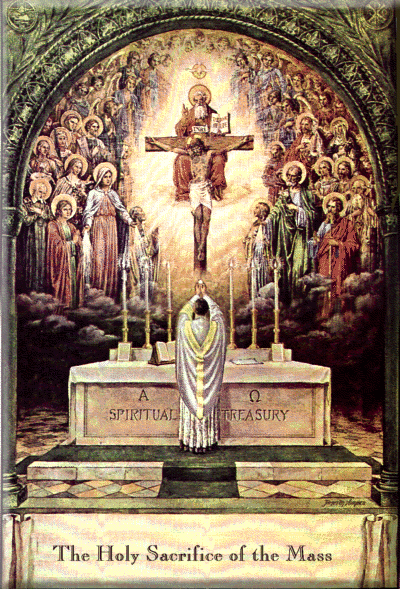
source **
In the same way, the gift of spices represents Christ's priesthood, His saving sacrifice of the Cross and
His holy passion.  To give Christ our spices is to participate in His priesthood, especially through the sacraments, which again, He offers us only through His Church.  Because He is the one High Priest, to grow in faith means to grow in desire for His grace and mercy in receiving and living out all the sacraments, as well as to grow in prayer and devotions.

When we do this - when we expose ourselves to Christ in order to receive more deeply all His gifts for us, and then give back to Him a deeper faith, obedience, and devotion - then we also show the love and mercy of God to all those around us.  We show why the ways of the world don't lead to salvation or real happiness, and what a difference it truly makes to be close to our Lord Jesus Christ.  We show this by the quality of our lives.  We preach simply and without confrontation, heart directly to heart, about our true faith and joy in Christ, our Lord and Savior.

So let us pray to the Holy Spirit for the courage to be defenseless before Jesus Christ.  Let us pray that we may receive everything He wills to give us, and that we may willingly give back to Him everything we have and are.  In this way, may we always offer the light of Christ to those in darkness.


* http://bible-belt-catholic.blogspot.com/2012/01/magis-new-work.html 
** http://catholicapologetics.info/library/directory/holymass.gif

Wednesday, December 4, 2013

Wednesday Homily - 4 December 2013, Memorial of St. John of Damascus

Today I felt called to preach about St. John of Damascus and the issue of Iconoclasm, as well as its modern variations (today's readings).

source**
Most joyful Advent to you!  Today is the memorial of St. John of Damascus, who was a priest in Damascus and a monk near Jerusalem for the last 40 or so years of his life.*  He died about 760.  He is most remembered for his development of the theology of the Incarnation, against Iconoclasm.  Iconoclasm was a movement in the Greek Church in the 8th and 9th centuries, which took too literally the prohibition against images in the Old Testament.  They literally "broke the icons," removing and destroying images from churches - icons, statues, crucifixes, and so on.

St. John recognized that this movement had some serious theological difficulties.  He exposed these difficulties in relation to the Incarnation.  He showed that, since Christ's human nature was real, and was the same as ours - "alike in all things but sin" - it was possible to depict the human nature in religious art.  In other words, we not only can but should use the things God has given us to worship Him, from wood and stone up to Christ's own humanity.  His deep arguments convinced people, and eventually overcame Iconoclasm.  So it's in large part thanks to St. John of Damascus that our beautiful Cathedral here is full of such inspiring windows and statues.

But we should not think that Iconoclasm was only a problem in the Church a thousand years ago.  It has continually popped up in history.  For example, it surfaced again in the Reformation, especially in the denominations influenced by John Calvin, which even now tend to have little or no religious art [and for the same reason, a very shallow understanding of the sacraments - not said but relevant].  It's also one of the sources of our culture's willingness to disregard some people's full humanity.  The Culture of Death is a form of iconoclasm, and the homosexual lobby is influenced in a similar way.

www.cathedralpb.com 
As Catholics, our responses to these issues are still informed by the work of St. John of Damascus.  We can oppose these issues, too, by arguing from the Incarnation.  Because we believe that Christ's human nature really is the same as ours - again, "alike in all things but sin" - we cannot accept as "just" that any person be denied the full protection of their humanity.  Because we believe in the Incarnation, we will never find anything good in abortion or euthanasia or embryonic stem-cell research.  These evils cannot go together with our Catholic faith, logically or theologically.  In the same way, because we believe in the Incarnation, we cannot accept the various arguments that it does not matter how we use our bodies.  It has to matter, if our bodies are related to Christ's body, and to our salvation.

As we continue with this Holy Mass and into this season of Advent, there are two things we can do.  First, we can deepen our faith, as we are always called to do, using the ways the Church offers us: for example, studying and praying with the Scriptures, reading the Catechism, listening to Catholic radio and reading the Fathers, all so readily available to us in this digital age.  The more we know our faith, the closer we can be to Jesus Christ, and the more open to all of His gifts of grace and mercy.  This is how we learn to love both God and neighbor, just as Pope Francis is constantly calling us to do.

Second, we can imitate St. John of Damascus in his witness and charity.  We can show the world the quality of our love and faith by how we live.  What we say and what we do each day conveys to everyone around us what we really value.  Let us display the grace and mercy of Christ we have received, especially in what we are willing to tolerate - namely, the human weaknesses of our brothers and sisters, which is always redeemable - and in what we refuse to accept and condone - namely, the evils that are contrary to our faith.  We can always make the distinction for our neighbor between weakness and evil, and be merciful without being indifferent, just as we pray God always is with us.

By growing in our faith and by the witness of our lives, we receive and share the coming salvation of our Lord Jesus Christ.


* Actually, I misspoke; he was a city counselor in Damascus, and left there about 730 to become a monk at St. Sabas's monastery near Jerusalem, and was ordained there.
** Icon from Russian Orthodox Cathedral of St. John the Baptist in Washington, DC: www.stjohndc.org

Tuesday, November 26, 2013

"Evangelii Gaudium," "The Joy of the Gospel" - Post-Synodal Exhortation from Pope Francis

Pope Francis's post-synodal exhortation, "Evangelii Gaudium," was released today.  It's rather long, and I've read quickly through the whole thing once, but it deserves a more careful read than that.  There is a great deal worth thinking about.

My initial conclusions can be summed up pretty quickly:

     1. Pope Francis is calling us to conversion and mission, very strongly and urgently (#3, 5, etc).  In this sense he is, once again and like his namesake, both perfectly radical, and perfectly traditional.  I think this is very important to keep firmly in mind, because (a) his pastoral experience and referents are different than ours here in Iowa, and (b) sometimes he writes with less than perfect clarity, with round-about references to things that aren't obvious to all; and therefore if we're not focused on his meaning-with-the-Church, we might mistake it for something else.

     2. Pope Francis is stressing once again, just as his predecessors did, the personal quality of encounter with Christ, through the Gospel and the Church's ministry of the Gospel (#20, 27, etc).  Christ changes us, he insists.  Two of the aspects of that conversion, which he wants to stress here, are joy (even in the face of difficulties, as he says several times), and the desire for others' encounter with Christ also, which is "evangelization."  Hence the title.

     3. Pope Francis seems to have an excellent read on the modern world.  He expresses clearly the seductive but disheartening qualities of modern life (#52ff) - individualism (and its isolation), materialism (and its exploitation), secularism (and its persecution), freedom (and its stagnation), and so on.  He also sees all of these, not just in their guises outside the Church, which we oppose with the Gospel, but also their insidious corruption inside the Church, sapping the joy of believers.  This is a nuance too little talked about; I am pleased he's not afraid to point clearly to it.

     4. One could quibble with a few things he says, and a few things he doesn't say, even in a document as long as this.  For example, he points out the flaws and abuses to which capitalism is prone (e.g. #54), without (here) noting the (even greater) problems with statism/socialism (e.g. in #240, 241); his discussion of Islam is idealistic, and doesn't consider the absence of "magisterial" unity in that religion (#252, 253); except for two brief sections on popular piety (#122ff) and the homily (#135-159), he mostly waits till near the very end to point to the defining importance of the Church's liturgical life for both the initial and ongoing encounter with Christ, and the particular and necessary shape it gives our efforts at evangelizing.  These minor issues won't, in the end, take away from the significance and depth of the exhortation as a whole.

     5. His Marian conclusion is excellent (#284-288).  He calls Mary the "star of the new evangelization," and almost every sentence here has something powerful packed into it.


Wednesday, November 20, 2013

Homily for Wednesday of 33rd Week, 11/20/13

Today I preached from the first reading, 2 Mac 7:1, 20-31.

Almost every religion of the world believes in some sort of afterlife.  Most people are willing to believe in the possibility that the soul survives the death of the body.  But what makes Judaism and Christianity unique on this point is that we believe, not just in a life for the soul after our death, but that the body also has an eternal destiny. 

In this first reading, we see the core of the Jewish belief.  This is one of the key places in the Old Testament, where the idea of a bodily resurrection is revealed, especially in the words of the devout mother, "Therefore... the Creator of the universe ... in his mercy, will give you back both breath and life..."  The breath is the soul, and the life is the body, which in some mysterious way not yet understood, also continues after death.  Both are raised and saved by God.  This belief prepared for the Resurrection of Jesus Christ, not only in His divinity and His human soul, but also in His human body - as we see, for example, when He shows Himself to the Apostle Thomas, with the wounds of the Passion still marked in His flesh.  It is the same body!  The same flesh that He carried in His earthly life was the flesh of His Resurrection.  This is not without change - as St. Paul says, our flesh will be changed "from corruption to incorruption," so that in Heaven our bodies, like Christ's, will no longer be subject to weakness, injury, age, and so on.  But it remains the same body.

This is part of the promise of our faith in Jesus Christ, in His Resurrection.  Mary is one of the very few for whom this has already been fulfilled.  Before Mass, we prayed the Glorious Mysteries, including the mystery of the Assumption: Mary is already taken up into Heaven in her body, and glorified in her body.  This is by way of promise to all of us, that God wants this as part of His eternal gift to us.  And so we say this in the Creed: "I believe in the resurrection of the body, and the life everlasting." 

[For the sake of time, I skipped this transition, which I hope was understood: namely, that this belief in the resurrection of the body necessitates the understanding that the person is not the soul, wearing the body in some temporary fashion, and discarding it at death, but rather the person is the union of soul and body.  This also means, of course, certain things about life beginning at conception, and the redemptive possibilities in suffering, and so on.]  There are a number of things that flow from this belief, but here let me just mention two.

First, since the body is destined for its resurrection, what we do to or with the body in this life really does matter.  Most especially, there is no way to reconcile this belief with abortion or euthanasia.  It is simply a contradiction to say on the one hand that the body is meant for Heaven, and that the person is the union of the body and the soul; and to say on the other hand that we can treat people or their bodies as disposable.  There simply is no way that these evil practices can be made compatible with our Catholic faith.  [One could obviously say much more here about pro-abortion politicians trying to claim the pro-life label, or about how the "personally opposed, but..." arguments all fail, and so on; but, desiring a shorter homily, I demurred.]

Second, we are invited to pray for the dead.  The general resurrection hasn't happened yet.  Apart from Jesus and Mary [and Elijah], all the dead are still waiting to be reunited with their restored bodies.  And so our prayers for them now can still be effective.  We can and do hope and pray that our own beloved dead, and all the dead, when they are reunited with the flesh, will also be glorified with Jesus Christ, and be eternally saved.  Especially in this month of November, we are reminded in a special way to pray for the dead, for forgiveness of sins and their eternal blessedness, body and soul in Heaven.

Tuesday, October 15, 2013

Pope Francis addresses Pontifical Council for New Evangelization: "Strip ourselves of all that is useless or harmful..."

On October 14, Pope Francis held an audience with the assembled Pontifical Council for Promoting the New Evangelization, and gave an excellent short address. He's pushing hard on the need to evangelize with a more pure and less compromised commitment to the Gospel, whole and true; and he's right to do so!  Zenit has the whole address in English translation.  Here are a few thoughts.

He begins with the importance of consistently living as followers of Christ:

Faith is a gift of God, but it is important that we Christians show that we live the faith in a concrete
image by Andrew Brown, www.theguardian.com
way, through love, concord, joy, suffering, because this elicits questions, as at the beginning of the journey of the Church: Why do they live like this? What drives them? These are questions that go to the heart of evangelization, which is the witness of faith and charity. What we need especially in these times are credible witnesses who with their life and also with the word render the Gospel visible, reawaken attraction for Jesus Christ, for God’s beauty.


Consistent witness is our best "credential," our most credible invitation to those in greatest need of Christ's mercy.  Here he mentions faith and charity, joy and suffering, as the essential marks of that invitation.  We can't follow Christ "part-time."  Our faith is obviously not real faith if it doesn't inform every aspect of our lives; our charity is just do-good-ism if it's not at the root of everything we do; and our joy isn't worth sharing if it disappears when our cross gets too heavy.  Other people clearly see this, if that's the face we present to them.  The reverse is also true: real faith, unvarying charity, true joy even in suffering, are seen to be very valuable when we hold them as such.  These are our treasures, the real gifts we have from Christ.  We have to act, then, in the same manner, holding other things to be less valuable:

As children of the Church we must continue on the path of Vatican Council II, stripping ourselves of useless and harmful things, of false worldly securities which weigh down the Church and damage her true face. There is need of Christians who render the mercy of God visible to the men of today, His tenderness for every creature. We all know that the crisis of contemporary humanity is not superficial but profound. Because of this the New Evangelization -- while calling to have the courage to go against the current, to be converted from idols to the only true God --, cannot but use the language of mercy...

AP photo, Domenico Stinellis, www.cbsnews.com
What does he mean by "useless and harmful things" and "false worldly securities?"  He said the same thing in more detail in his address to the bishops of Brazil in July, when he was there for World Youth Day. In that address, he talked about things essential to the Church: humility, beauty, simplicity, openness to mystery (especially in the liturgy), and missionThe Church needs constantly to relearn the lesson of Aparecida; she must not lose sight of it... God wants to be seen precisely through our resources, scanty resources, because he is always the one who acts.  He also talked a lot about what is central to pastoral care - Scripture, catechesis, the sacraments, community, and friendship with the Lord Jesus and with Mary and the saints:

Many people think: “the Church’s idea of man is too lofty for me, the ideal of life which she proposes is beyond my abilities, the goal she sets is unattainable, beyond my reach. Nonetheless – they continue – I cannot live without having at least something, even a poor imitation... The great sense of abandonment and solitude, of not even belonging to oneself, which often results from this situation, is too painful to hide.  Today, we need a Church capable of walking at people’s side, of doing more than simply listening to them; a Church which accompanies them on their journey; a Church able to make sense of the “night” contained in the flight of so many of our brothers and sisters from Jerusalem; a Church which realizes that the reasons why people leave also contain reasons why they can eventually return. But we need to know how to interpret, with courage, the larger picture.  I would like all of us to ask ourselves today: are we still a Church capable of warming hearts? A Church capable of leading people back to Jerusalem? Of bringing them home? Jerusalem is where our roots are: Scripture, catechesis, sacraments, community, friendship with the Lord, Mary and the apostles…

So I think what he means by "useless and harmful things" are the things that intrude in the life of the Church, separating faith from everyday life, things that are in some sense opposed to these two little lists; things that obscure rather than simplify the life of faith, or that render the mystery of Christ banal, or that marginalize or contradict the Scriptures and the sacraments, and so on.  That list is obviously very long, and indeed, very well known in the life of the Church, since every age has its particular challenges to the purity of the Good News the Church is preaching.  And it is always a struggle, in the human sense, to fight against those intrusions for the pure teaching of Christ.

The second point in yesterday's address moves directly from witness to evangelization:

The New Evangelization is a renewed movement towards him who has lost the faith and the profound meaning of life. This dynamism is part of the great mission of Christ to bring life to the world, the Father’s love to humanity.

Again, this is a clear recognition of the need of people for Christ's great mercy, and therefore the urgency Christians ought to have to offer Christ's life, the Father's love, to the darkened world.  This mission is Christ's, and therefore ours in the Church.  It's ours both because Every baptized person is a “cristoforo,” a bearer of Christ, and because No one is excluded from the hope of life, from the love of God. The Church is sent to reawaken this hope everywhere.

He goes on to say that this urgent evangelizing mission has a distinct shape or character, which is (to use a different vocabulary than this address, but to which he also refers) the "apostolic" and "ecclesial" one:

In the Church all this, however, is not left to chance or improvisation. It calls for a common commitment to a pastoral plan that recalls the essential and that is “well centered on the essential, namely on Jesus Christ." It is no use to be scattered in so many secondary or superfluous things, but to be concentrated on the fundamental reality, which is the encounter with Christ, with his mercy, with his love, and to love brothers as He loved us. A project animated by the creativity and imagination of the Holy Spirit, who drives us also to follow new ways, with courage and without becoming fossilized! 
by David Willey, www.bbc.co.uk
This "pastoral plan centered on Christ," then, is not something new.  It's what the Church has alwaysreverent worship in the liturgy, touching people deeply with the profound mystery of Christ at the intimate moments of their lives, as well as all through the year; sound Gospel preaching, including the denunciation of the evils of the day, and the call to conversion; moral clarity and leadership; taking care of the "orphans and widows," those who are least able to care for themselves - especially today in the face of the culture of death, the unborn and the elderly and very sick; radical hospitality, and the "preferential option for the poor;" and so forth.  It is the three-fold work of the Church for liturgy, proclamation, and ministry, which we see in the Book of Acts and always and everywhere in the Church since, but, as he began this address, unencumbered by the cultural dross of particular times and places.
done (not equally well at every time and place, to be sure):

His third point turns to that necessary separating of Truth from worldly accretions:

www.familyrosary.org 
In this context I would like to stress the importance of catechesis, as an instance of evangelization. Pope Paul VI already did so in the encyclical Evangelii nuntiandi (cf. n. 44). From there the great catechetical movement has carried forward a renewal to surmount the break between the Gospel and the culture and illiteracy of our days in the matter of faith. I have recalled several times a fact that has struck me in my ministry: to meet children who cannot even do the Sign of the Cross! Precious is the service carried out by the catechists for the New Evangelization, and it is important that parents be the first catechists, the first educators of the faith in their own family with their witness and with the word.

We can't offer people a pure and vibrant faith unless we ourselves are well catechized.  It's too easy, especially in this world described as "post-Christian," unwittingly to mix faith with not-faith, with moral platitudes (which may perhaps be true in themselves, but which don't lead to Christ), or with political agenda or social activism (which, again, may be either true or false, good or harmful, but which cannot lead to Christ). 

I'm really impressed with the clarity and consistency of Pope Francis's direction, in this address.  He sounds "papal," even as he gives his words a personal urgency, an authenticity from his own pastoral zeal and experience. What he seems to be urging us to consider is that we are not nearly radically enough "for the Gospel."  We make so many little compromises with the world.  Many are necessary, most are not bad or evil in any sense.  But all of them dull the brightness of the pure Gospel.  They cause us, for example, to think twice before speaking out against some moral evil or injustice, or to make subtle shifts in our priorities among transient goods that obscure in some degree our commitment to spiritual and heavenly goods.  These little compromises "domesticate" Christ.  They make Him fit into our existing lives, rather than making us change our lives to fit into His.  That's where we need a visibly greater degree of "purity," like St. John the Baptist - of prophetic stance outside the world and its systems of compromises to preserve whatever goods are valued at the time, and radical commitment to the only lasting good, salvation in Christ.

www.catholicnewsagency.com 
St. Francis in his day retrieved for the Church the apostolicity of poverty, from those who were using poverty as a weapon against the Church ("bishops are wrong because rich," "sacramental records are a tool of the government to tax the poor," etc.).  What we need today is to retrieve the apostolicity of charity, from those who are using charity as a weapon against the Church (i.e., "caring for women means supporting abortion," "caring for the poor means supporting such-or-other government program or ideology," "caring for children means unraveling real marriage," etc.).  This is why we need a more radically "evangelical" Church, one which can oppose those dark powers, not just with some alternative-but-still-essentially-worldly program, but with a recognizably spiritual program: the Gospel of our Lord Jesus Christ.

Friday, September 20, 2013

"Jesuit" Interview with Pope Francis

Yesterday, America magazine released the English-language translation of the "official" interview with Pope Francis by Jesuit priest Fr. Antonio Spadaro, SJ.  The original Italian (which I have not looked at) was published in La Civilta Catholica.

Just two thoughts on this interview for now.  One, the main-stream press is trying very hard to use anything possible which they can glean from this interview to drive wedges into the Church.  Fr. Z, among others, makes this point most ably.  Just one example: Here's the AP report on the publication of the interview, copied in a great many places.  Notice how they lead with what they imagine will be the most provocative part, even though it's clearly not the most important part, and even then, they have to misconstrue by taking significantly out of context, to make it seem to say what they want it to say.  The caption under the photo takes it thusly:

VATICAN CITY (AP) -- Pope Francis is warning that the Catholic Church's moral edifice might "fall like a house of cards" if it doesn't balance its divisive rules about abortion, gays and contraception with the greater need to make the church a merciful, more welcoming place for all.

The article's lead point (second-to-fourth third paragraphs) makes the same maneuver:

In the 12,000-word article, Francis expands on his ground-breaking comments over the summer about gays and acknowledges some of his own faults...

But his vision of what the church should be stands out, primarily because it contrasts so sharply with many of the priorities of his immediate predecessors John Paul II and Benedict XVI. They were both intellectuals for whom doctrine was paramount, an orientation that guided the selection of generations of bishops and cardinals around the globe.

Francis said the dogmatic and the moral teachings of the church were not all equivalent.


Compare that with what Francis actually said about these topics, in the section labelled "The Church as Field Hospital:"

Pope Francis begins by showing great affection and immense respect for his predecessor: “Pope Benedict has done an act of holiness, greatness, humility. He is a man of God.

“I see clearly,” the pope continues, “that the thing the church needs most today is the ability to heal wounds and to warm the hearts of the faithful; it needs nearness, proximity. I see the church as a field hospital after battle...

“How are we treating the people of God? I dream of a church that is a mother and shepherdess. The church’s ministers must be merciful, take responsibility for the people and accompany them like the good Samaritan, who washes, cleans and raises up his neighbor. This is pure Gospel. God is greater than sin...

“Instead of being just a church that welcomes and receives by keeping the doors open, let us try also to be a church that finds new roads, that is able to step outside itself and go to those who do not attend Mass, to those who have quit or are indifferent...

A person once asked me, in a provocative manner, if I approved of homosexuality. I replied with another question: ‘Tell me: when God looks at a gay person, does he endorse the existence of this person with love, or reject and condemn this person?’ We must always consider the person...

“This is also the great benefit of confession as a sacrament: evaluating case by case and discerning what is the best thing to do for a person who seeks God and grace...

“We cannot insist only on issues related to abortion, gay marriage and the use of contraceptive methods. This is not possible. I have not spoken much about these things, and I was reprimanded for that. But when we speak about these issues, we have to talk about them in a context. The teaching of the church, for that matter, is clear and I am a son of the church, but it is not necessary to talk about these issues all the time.

The dogmatic and moral teachings of the church are not all equivalent. The church’s pastoral ministry cannot be obsessed with the transmission of a disjointed multitude of doctrines to be imposed insistently. Proclamation in a missionary style focuses on the essentials, on the necessary things: this is also what fascinates and attracts more, what makes the heart burn, as it did for the disciples at Emmaus. We have to find a new balance; otherwise even the moral edifice of the church is likely to fall like a house of cards, losing the freshness and fragrance of the Gospel. The proposal of the Gospel must be more simple, profound, radiant. It is from this proposition that the moral consequences then flow."

This is very nearly the opposite of what the AP article attempts to portray.  Nothing in all this can reasonably be construed as any sort of novelty, or break with the priorities of Pope Benedict, or change in what the Church is teaching or trying to do.  Pope Francis wants the Church to be successful at getting people to love God, go to Mass and Confession, and live the content of the faith.  Whudathunkit??

It also shows very clearly my second point in this post: Pope Francis, like his predecessors, and with a deep personal urgency and simplicity, really emphasizes the proclamation of the Gospel.  That's what this interview is mostly about; he comes back to it again and again in different contexts.  In this section, he's talking especially about the initial proclamation, the invitation to hear the Good News of Jesus Christ.  As Pope Paul VI, Pope John Paul II, and Pope Benedict XVI also said, our world is increasingly in need of this initial proclamation.  Actions speak louder than words, and the most fundamental kind of invitation to the Gospel, both in actions and words, is to demonstrate to someone that they are worthy of love, by actually loving them.  This is the grace that heals, and from that being loved comes the desire to love, to experience conversion and growth in faith.  That's the only real basis for living up to God's standards of freedom and dignity, the revealed moral law.  

 Pope Francis said essentially the same things in his address to the bishops of Brazil, back in July.  The talk and the interview are both worth a good read and reflection, if nothing else just to be able to refute the even more intense barrage of false claims about his vision and goals that we're going to face now.

PS - Today, Pope Francis addressed a meeting of medical professionals and preached about the evil of abortion, against "throwing away" the lives of children.  He made the explicit point that this is not only a religious idea, but also the clear conclusion of both reason and science.  After trying to suggest yesterday in their depiction of the contents of the interview that Pope Francis doesn't really think that's very important, the main-stream media are beside themselves today.